On this page
You have two right-angled triangles. The hypotenuses match and one other side matches. That is enough to prove them congruent, and it is one of the few places where "two sides and an angle not between them" really works.
What is the RHS congruence rule?
RHS stands for right angle, hypotenuse, side. If two right-angled triangles have their hypotenuses equal in length and a pair of other sides equal in length, the triangles are congruent (Congruence (geometry), Wikipedia). The same article gives its other name, HL (hypotenuse-leg).
Our guide to congruent triangles in Class 9 covers it alongside SAS, ASA, AAS and SSS. In your answer, match hypotenuse with hypotenuse and leg with leg.
Why does RHS work only for right triangles?
The short answer is Pythagoras. Euclid's Proposition I.47 states that in right-angled triangles "the square on the side opposite the right angle equals the sum of the squares on the sides containing the right angle" (Euclid's Elements, Book I, Proposition 47).
So if the hypotenuse h and one leg a match, the other leg is √(h² − a²) in both triangles. Now all three sides match, and side-side-side finishes the proof; in Euclid that is Proposition I.8. For example, with a hypotenuse of 13 cm and a leg of 5 cm, the other leg is √(169 − 25) = √144 = 12 cm in both triangles.
That shortcut needs the right angle. RHS is a special case of SSA (two sides and a non-included angle) where SSA is safe. When the given angle is right or obtuse, the side opposite it is always longer than the adjacent side, and then SSA gives only one triangle (Congruence (geometry), Wikipedia).
What goes wrong without the right angle?
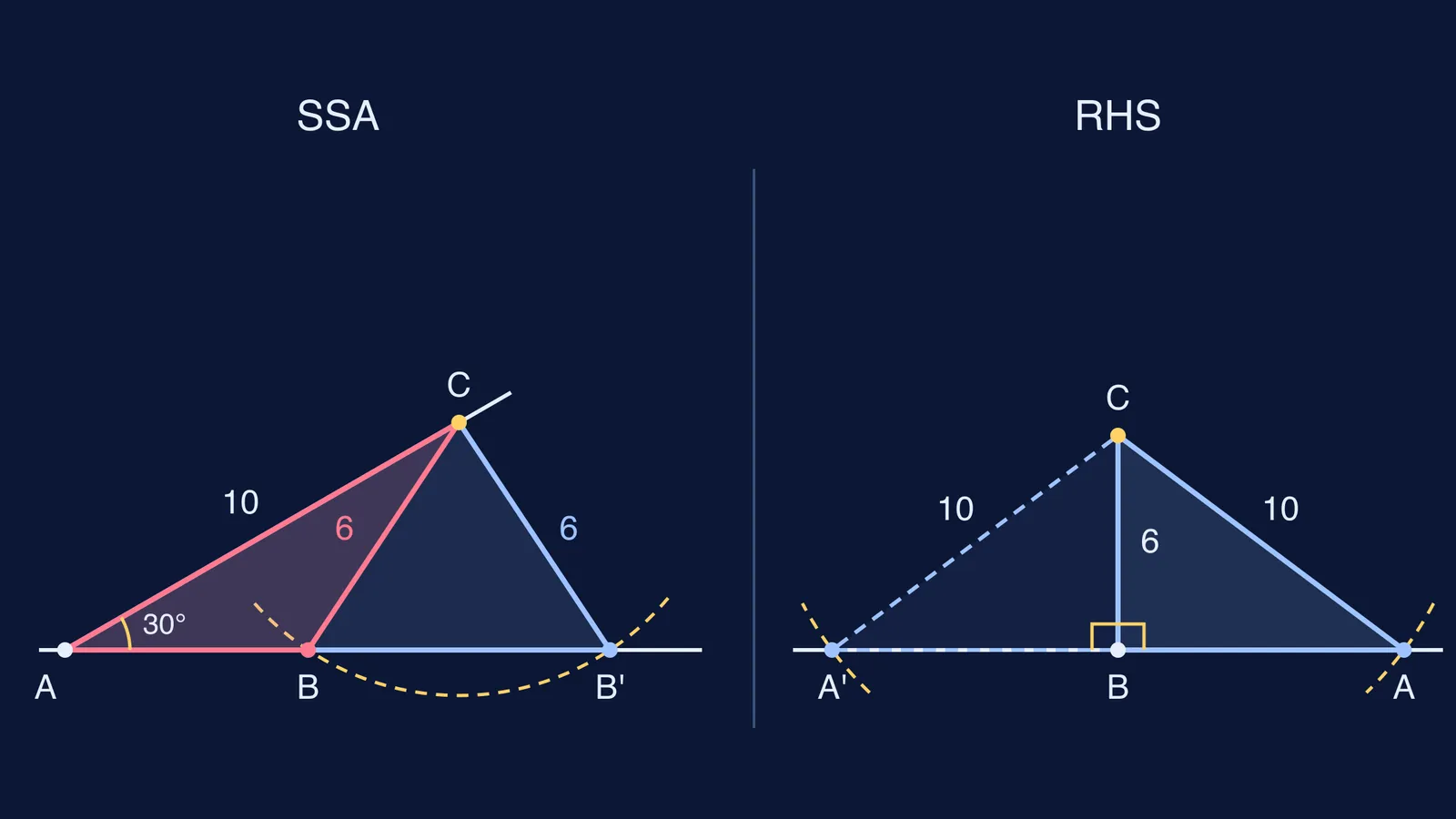
Take angle A = 30°, AC = 10 cm and CB = 6 cm, opposite A. C is 10 × sin 30° = 5 cm from the other arm, less than 6 cm, so a 6 cm compass arc from C crosses that arm twice. The crossings sit √(36 − 25) ≈ 3.32 cm either side of the foot of the perpendicular, which is 10 × cos 30° ≈ 8.66 cm from A.
So B can be about 5.34 cm or about 11.98 cm from A. Same SSA data, two different triangles. This is the ambiguous case; our explainer on why SSA and AAA do not prove triangles congruent has more of them.
Now put a right angle at B. An arc from C with radius equal to the hypotenuse cuts the line through B perpendicular to CB at two mirror-image points, so there is only one triangle up to congruence.
How do you use RHS with altitudes?
An altitude makes right angles, so RHS appears almost every time a perpendicular is drawn.
Altitude of an isosceles triangle. In △ABC with AB = AC, draw AD ⊥ BC. In △ADB and △ADC: ∠ADB = ∠ADC = 90°, hypotenuse AB = AC, and side AD is common. By RHS, △ADB ≅ △ADC, so BD = DC and ∠BAD = ∠CAD.
Equal altitudes force an isosceles triangle. In an acute △ABC, let BE ⊥ AC and CF ⊥ AB with BE = CF. In △BEC and △CFB: right angles at E and F, hypotenuse BC is common, and BE = CF. By RHS, ∠BCE = ∠CBF, so ∠C = ∠B and AB = AC.
A point equidistant from the arms of an angle. P lies inside ∠XOY with PM ⊥ OX, PN ⊥ OY and PM = PN. In △OMP and △ONP: right angles at M and N, hypotenuse OP is common, and PM = PN. By RHS, ∠MOP = ∠NOP, so P lies on the angle bisector.
Perpendicular from the centre to a chord. In a circle with centre O, draw OM ⊥ chord AB. In △OMA and △OMB: right angles at M, hypotenuses OA = OB (both radii), and OM is common. By RHS, AM = MB, so the perpendicular bisects the chord.
Each "so" step uses corresponding parts of congruent triangles; see what CPCT means and when you can use it.
A four-question check before you write "by RHS"
Have you named the right angle in both triangles?
Is the side you call the hypotenuse opposite the right angle in each triangle?
Is the other equal pair a leg in each triangle?
Have you named the vertices in matching order, such as △ADB ≅ △ADC?
If any answer is no, the triangles may still be congruent, but not by RHS. One common slip: the shared altitude is a leg, never the hypotenuse.
If you get stuck choosing a rule, the Fermi Problem Library has worked problems with a step-by-step solver that explains the reasoning rather than printing an answer. If the gap is Pythagoras or altitudes themselves, the Fermi Concept Library gives each concept its own lesson and its place in the map.
Next time you draw a perpendicular, look for two right triangles sharing a side: RHS is usually one line away.