

On this page
Indian astronomers kept time with a copper bowl that had a tiny hole in its base and floated in a tub of water. Water crept in, the bowl settled lower, and after one ghati (24 minutes) it sank. Someone emptied it, set it floating again and counted one more ghati. Archimedes' principle and Torricelli's speed of efflux explain the trick: water comes in under a fixed head set by the bowl's weight, however full the bowl already is.
What is the ghatika-yantra?
The Surya Siddhanta (chapter 13, verse 23) describes it in one line. In Ebenezer Burgess's translation: "A copper vessel, with a hole in the bottom, set in a basin of pure water, sinks sixty times in a day and night." Sixty sinkings a day make one ghati (also called a nadika) equal to 1440 ÷ 60 = 24 minutes. Do not mix it up with a muhurta, which is two ghatis, or 48 minutes.
Burgess's note on the verse quotes a specification from the commentary, not from the verse itself. The bowl is ten palas' weight of copper, six angulas (digits) high and twice that width at the mouth, so it is a hemisphere. It holds sixty palas of water. The hole must just admit a gold pin four angulas long weighing three and a third mashas. You can read the passage on page 408 of Burgess's 1860 translation in the Journal of the American Oriental Society.
The gold pin is clever: a pin of known density, mass and length has a fixed thickness, because mass = density × (π/4)d² × length. A balance and a ruler specify a hole you could not measure directly.
Why does water enter the bowl at a steady rate?
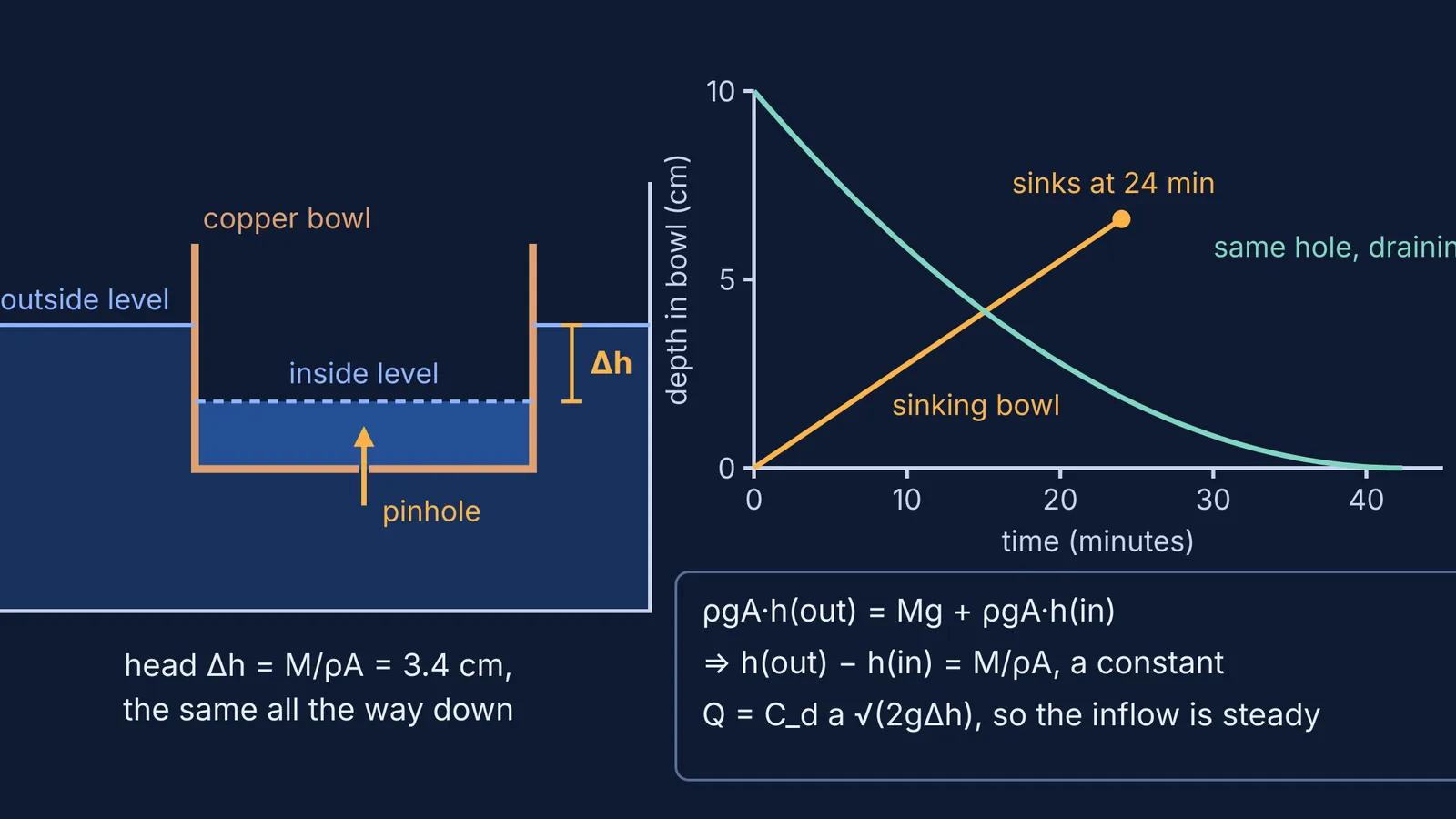
Take a thin-walled, straight-sided bowl of base area A and mass M. The outside water stands at depth h(out) on the bowl, the water inside at depth h(in).
Balance the forces. The bowl floats, so the buoyant force equals the weight of the bowl plus the water inside: ρgA·h(out) = Mg + ρgA·h(in).
Rearrange. h(out) − h(in) = M/(ρA).
Read it. The right side is a constant. The difference between the outside and inside levels does not change as the bowl fills.
That difference is the head across the pinhole: the pressure outside the hole exceeds the pressure inside by ρg·Δh. Torricelli's result (covered in our post on the speed of efflux from a tank) gives the jet speed v = √(2gΔh), and the flow is Q = C_d·a·√(2gΔh), where a is the hole area and C_d the discharge coefficient. Constant head means constant flow, so the bowl sinks at a steady speed. The head does not depend on the depth of the tub or how full the bowl is; only the bowl's mass and base area set it.
How big must the hole be for one ghati?
Worked design, illustrative numbers: a straight-sided copper bowl 15 cm across and 10 cm high, of mass 0.60 kg. Take ρ = 1000 kg/m³, g = 9.81 m/s² and C_d = 0.62.
Base area. A = π(0.075 m)² = 0.01767 m² = 176.7 cm².
Head. Δh = M/(ρA) = 0.60 ÷ (1000 × 0.01767) = 0.0340 m = 3.40 cm.
Jet speed. v = √(2 × 9.81 × 0.0340) = 0.816 m/s.
Water admitted before sinking. The bowl goes under when its rim reaches the water, so h(out) = 10 cm and h(in) = 10 − 3.40 = 6.60 cm. Volume = 176.7 × 6.60 = 1167 cm³, about 1.17 litres.
Flow needed. 1167 cm³ ÷ 1440 s = 0.810 cm³/s (0.81 mL/s).
Hole area. a = Q/(C_d·v) = 0.810 × 10⁻⁶ ÷ (0.62 × 0.816) = 1.60 × 10⁻⁶ m² = 1.60 mm².
Hole diameter. d = √(4a/π) = 1.43 mm.
Units check: kg ÷ (kg/m³ × m²) gives metres; m³/s ÷ m/s gives m². The bowl sinks 6.60 cm in 24 minutes, about 0.28 cm per minute.
The value 0.62 is an assumption. Handbooks give about 0.61 for a sharp-edged orifice at high flow rates (see the NPTEL notes on flow measurement), but a 1.4 mm hole drilled through copper sheet is small and not perfectly sharp. Real bowls had to be tested against a standard.
The bowl's mass changes the time. With the same hole, a 0.90 kg bowl has a head of 5.09 cm and sinks in 14.6 minutes. A 0.40 kg bowl has a head of 2.26 cm and takes 34.4 minutes. A heavier bowl pushes water in harder and has less room left.
Why is a sinking bowl steadier than a draining pot?
Use the same 1.43 mm hole the other way round: fill the 10 cm bowl and let it drain into air. Now the head is the water depth itself, which falls as the pot empties. Torricelli's law gives a draining time of 42.3 minutes, but the top half of the depth goes in only 12.4 minutes and the bottom half takes 29.9 minutes.
Other clockmakers fixed this by shaping the vessel, worked out in shaping a water clock so its level falls at a steady rate, or with an overflow tank that holds the head fixed, as in Ctesibius's water clock. The sinking bowl gets a fixed head from buoyancy alone, with no shaping and no overflow.
Does a real hemispherical bowl fill at a constant rate?
Not quite. A constant head needs straight walls. A hemisphere is wider at the top, so the outside and inside volumes grow at different rates. Take the commentary's ratio, 10 palas of copper to 60 palas of water, as a mass ratio of 1 : 6 (both measured in the same pala). For a hemisphere of radius R, the head starts at about 0.36R and falls to about 0.11R just before the rim goes under. The inflow at the end is about 56% of the inflow at the start, and the first half of the water enters in about 46% of the cycle.
This does not spoil the clock. The bowl marks time only when it sinks, and every cycle starts from the same empty bowl and ends at the same rim, so each cycle repeats. The copper itself also displaces water: 0.60 kg ÷ 8.96 g/cm³ ≈ 67 cm³, which can lower the head in our straight bowl by up to 67 ÷ 176.7 ≈ 0.38 cm as the walls go under.
For more buoyancy and efflux problems, the Fermi Problem Library has a step-by-step solver that explains the reasoning at each stage.
What mistakes cost marks on this kind of question?
Using the outside depth h(out) as the head. The head is the difference between the outside and inside levels.
Treating a hemisphere as if it had straight walls and claiming the inflow is exactly steady.
Confusing a ghati (24 minutes) with a muhurta (48 minutes).
Quick checklist
Buoyancy balance: ρgA·h(out) = Mg + ρgA·h(in).
Head across the hole: Δh = M/(ρA), the same all the way down for straight walls.
Flow in: Q = C_d·a·√(2gΔh).
Time to sink = water admitted ÷ Q; a heavier bowl sinks sooner.
One ghati = 1/60 of a day = 24 minutes.
A hemisphere's head falls as it fills, but every cycle still repeats, so the count of sinkings keeps time.


