

On this page
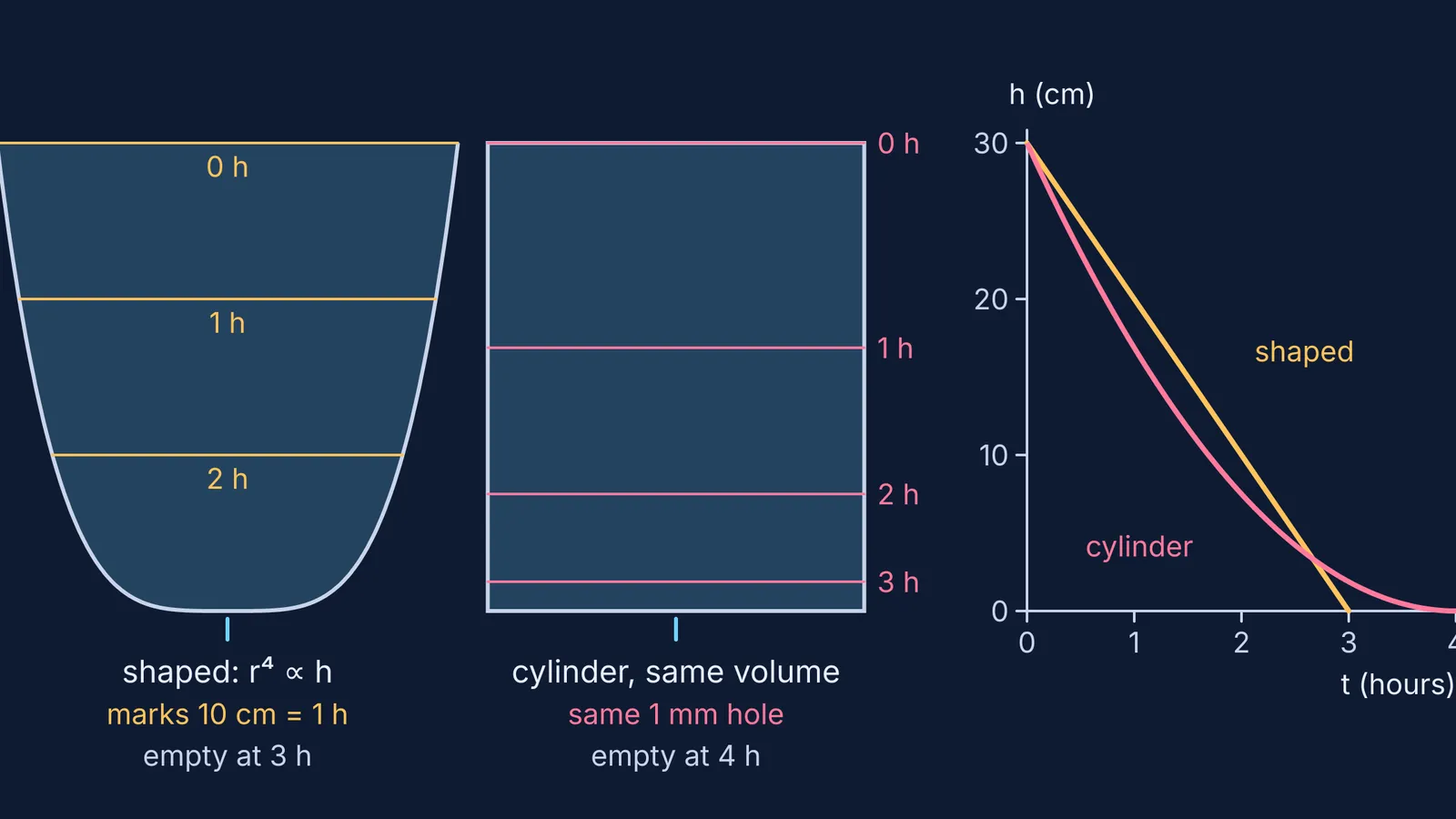
An outflow water clock is a jar with a small hole in the bottom. You read the time from how far the water level has dropped. The trouble is that water leaves faster when the jar is full, so a straight-sided jar needs marks that crowd together near the bottom. Is there a shape for which the level falls at exactly the same rate from top to bottom, so the hour marks are evenly spaced? There is, and Torricelli's law tells you what it is: the radius must grow as the fourth root of the height.
Why don't equal marks on a straight jar mean equal times?
Water leaves a small hole at depth h with speed v = √(2gh). That is Torricelli's law, derived in Torricelli's law: speed of efflux and range of a water jet, along with the time to drain a cylinder. If the hole has area a and the jar has cross-section A, continuity gives
A × (rate of fall of the level) = a√(2gh).
In a cylinder, A is fixed, so the level falls fastest at the top and slows as h shrinks. The time to drain from h to empty goes as √h. That means the top half of a cylinder empties in only 1 − 1/√2 = 29% of the total time; the bottom half takes the other 71%.
Take a cylinder 30 cm tall with a 1.0 mm hole and a radius of 12.1 cm (chosen to hold the same volume as the shaped vessel below). It empties in 4.0 hours, and the level after each hour is 16.9 cm, 7.5 cm, 1.9 cm and 0. The first hour uses 13 cm of the scale; the last hour uses under 2 cm.
What shape makes the water level fall at a steady rate?
Write c for the rate at which you want the level to fall. Put c into the continuity equation:
A(h) × c = a√(2gh), so A(h) = a√(2gh)/c.
The cross-section must grow as √h. Since A = πr², the radius goes as r ∝ h^¼, or equivalently h ∝ r⁴. The walls are steep near the bottom and flare out near the top. A cone does not do it, because a cone has r ∝ h and so A ∝ h², which overcorrects.
Worked example: design a three-hour water clock
Target: a level that falls 10 cm every hour, with a 1.0 mm diameter hole and a starting depth of 30 cm.
Hole area. a = π(0.5 × 10⁻³)² = 7.85 × 10⁻⁷ m².
Rate of fall. c = 0.10 m/3600 s = 2.78 × 10⁻⁵ m/s.
Radius formula. From πr²c = a√(2gh), r² = a√(2gh)/(πc).
At the top, h = 0.30 m. √(2 × 9.81 × 0.30) = 2.43 m/s, so r² = (7.85 × 10⁻⁷ × 2.43)/(π × 2.78 × 10⁻⁵) = 0.0218 m², and r = 14.8 cm.
Lower down. The same formula gives r = 13.4 cm at 20 cm, 11.2 cm at 10 cm, 9.4 cm at 5 cm and 6.3 cm at 1 cm. Check the fourth-root rule: going from 10 cm to 30 cm triples h, and 1.316 is the fourth root of 3.
Volume. V = ∫A dh = (a√(2g)/c) × (2/3)H^(3/2) = 0.0137 m³, about 13.7 L.
Time. The level falls at a constant c, so it takes H/c = 0.30/(2.78 × 10⁻⁵) = 10,800 s = 3.0 h, with a mark every 10 cm for each hour.
Check units. r² = (m² × m s⁻¹)/(m s⁻¹) = m². Good.
How does the vena contracta change the shape?
Torricelli's law assumes the jet fills the whole hole. In fact the stream keeps narrowing for a short distance after it leaves a sharp-edged hole, so the real outflow is only a fraction of a√(2gh). That fraction, the discharge coefficient, is about 0.6 for a sharp-edged hole (approximate; it depends on the edge and the size).
The good news is that a constant factor does not change the shape. Multiply the outflow by 0.6 and every r² is multiplied by 0.6, so every radius shrinks by √0.6 = 0.775. The top radius becomes 11.4 cm instead of 14.8 cm, and the profile is still h ∝ r⁴. In practice you would build the vessel, run it against a clock, and scale the hole or the marks to match.
Where does the ideal shape stop working?
Near the bottom. The formula says r → 0 as h → 0, so the vessel narrows to a point at the hole. At very small depths, the flow through a 1 mm hole is slow, viscosity matters, and surface tension can hold back drops. Treat the bottom centimetre or so as unreliable and stop the scale above it.
Two other routes to an even clock exist. You can keep the head constant, so the outflow never changes: the inflow clock credited to Ctesibius of Alexandria and his water clock took that approach, which is a different fix from shaping the vessel. Or you can accept uneven marks and calibrate them. The older clocks described in how sundials, water clocks and sand clocks measure time include tapered outflow vessels, which move the shape in the right direction without matching the fourth-root curve exactly.
If you want to see how continuity and Torricelli's law fit together, the Concept Library has explanations of each idea.
Quick checklist
Outflow speed: v = √(2gh). Continuity: A × (rate of fall) = a√(2gh).
A cylinder's level falls fast at first; its top half drains in 29% of the time.
Steady fall needs A ∝ √h, so r ∝ h^¼ (h ∝ r⁴).
Example: 1.0 mm hole, 10 cm per hour, radius 14.8 cm at 30 cm depth, 13.7 L, 3 hours.
A discharge coefficient scales every radius by √Cd but keeps the shape.
The bottom centimetre is unreliable.


