

On this page
On 1 September 1859 the magnetometer at the Colaba Observatory in Bombay recorded the horizontal part of Earth's field falling by about 1,600 nanotesla, roughly 4% of its normal value. In 1859 the wires that felt it were telegraph lines. Today the same kind of storm would act on power lines hundreds of kilometres long, and Faraday's law says it would push a slow, almost steady current through them. Here is how big that current can be, and why near-DC is bad news for an AC grid.
What did the Colaba magnetometer record in 1859?
Tsurutani, Gonzalez, Lakhina and Alex reduced the old Colaba readings in a 2003 paper in the Journal of Geophysical Research. They give a local noon response of ΔH = 1600 ± 10 nT, and estimate a storm index of about −1760 nT, the most intense storm on record. The paper also says the main phase of the storm, the steep fall, lasted about 1 to 1½ hours, sampled once every 15 minutes. Later work has re-examined the exact values and timing, so treat 1,600 nT as the size of the swing, not a precise number.
The story of the flare itself, and how Carrington saw it, is in Richard Carrington and the first solar flare ever recorded. Why a storm squeezes Earth's field in the first place is in where Earth's magnetic field stops the solar wind. Here we start at the ground.
How does a changing magnetic field drive current through a power line?
Faraday's law: a changing magnetic flux through any loop induces an emf round it. The ground is a conductor, so a slowly changing field induces an electric field E along Earth's surface, and currents flow in the rock.
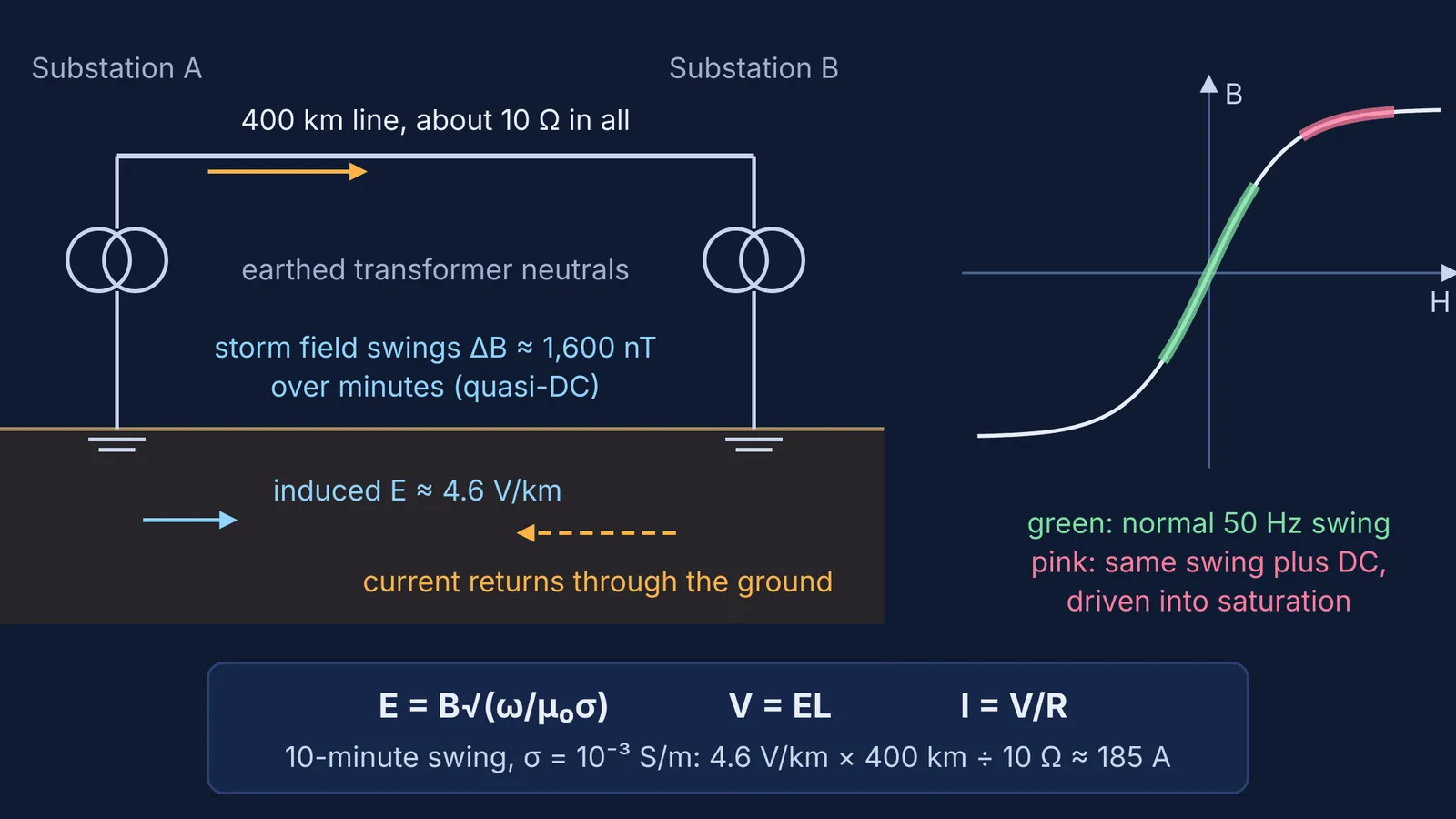
A long transmission line is connected to transformers whose star points (neutrals) are earthed at each end. The line, the two transformer windings and the two earth connections, closed by a return path through the ground, form a loop hundreds of kilometres long. The emf along the line is E × L, and the current is set by the total resistance of line, windings and earthing:
I = EL ÷ R.
Because the storm field changes over minutes, not fiftieths of a second, this current is quasi-DC: steady on the time scale of the 50 Hz supply.
How big is the electric field in the ground?
The field does not reach down forever. In a conductor a changing field dies away over a skin depth δ = √(2/ωμ₀σ), where σ is the ground's conductivity and ω the angular frequency of the change. For ground of uniform σ, the surface field is
E = B√(ω/μ₀σ).
This result is beyond the syllabus, so take it as given. You can see where it comes from with Faraday's law: take a rectangle of length L reaching down to a depth of about δ. The flux change through it is about LδΔB, so the emf per unit length is about δ times the rate of change of B. The exact result is E = Bωδ/√2.
Check the units: μ₀σ has units of (Ω·s/m)(1/(Ω·m)) = s/m², so √(ω/μ₀σ) is in m/s, and tesla × m/s = V/m.
Worked example: a 1,600 nT swing on a 400 km line
Illustrative numbers, not a real grid. Take a swing of amplitude 1,600 nT as an oscillation with a 10-minute period, ground of conductivity 10⁻³ S/m, a 400 km line, and 10 Ω for line, windings and earthing together.
Angular frequency. ω = 2π ÷ 600 s = 0.0105 rad/s.
Skin depth. δ = √(2 ÷ (0.0105 × 4π×10⁻⁷ × 10⁻³)) = 390 km.
Surface electric field. E = 1.6×10⁻⁶ T × √(0.0105 ÷ (4π×10⁻⁷ × 10⁻³)) = 1.6×10⁻⁶ × 2,887 m/s = 4.6×10⁻³ V/m = 4.6 V/km.
Emf along the line. 4.6 V/km × 400 km = 1,850 V.
Current. 1,850 V ÷ 10 Ω = 185 A, shared among the line's three phases.
Over poorly conducting rock (10⁻⁴ S/m) the field rises by √10 to 14.6 V/km. A faster 2-minute swing gives 10 to 33 V/km over the two kinds of ground. E grows as √ω, so the speed of the change matters as much as its size.
Now the reality check. Colaba's real fall took about an hour, not ten minutes. Model it as an 800 nT amplitude in a 2-hour cycle and the same line gets 0.67 V/km, 270 V and only 27 A (84 A over resistive rock). The 10-minute case is a what-if. It is not far-fetched: a 2024 review by Tsurutani and co-authors, published in JGR Space Physics, reports changes of about 700 nT per minute in the August 1972 storm, an estimated surface field of about 7.4 V/km, and quasi-DC currents of about 200 A entering power transformers in the USA and Canada. Our 10-minute swing changes at up to about 1,000 nT per minute, the same order.
Why is a near-DC current bad for a transformer?
A transformer's primary is a large inductor. At 50 Hz a magnetising inductance of, say, 50 H has a reactance of 2π × 50 × 50 = 15.7 kΩ, which keeps the magnetising current tiny. At 1/600 Hz the same winding has a reactance of only 0.52 Ω. To the storm current, the winding is almost just a piece of wire. The basic reason a steady current gives no induced emf is in why a transformer does not work on DC.
The steady current adds a steady flux to the core. The normal 50 Hz flux now swings about an offset, and on one half of each cycle it runs past the knee of the B–H curve into saturation. Then:
the magnetising current comes in large, peaky spikes, rich in harmonics;
stray flux heats the tank and other metal parts;
the transformer draws extra reactive power and voltage sags;
protection relays can see the distorted current as a fault and trip.
That is what happened in Quebec on 13 March 1989. The 2024 review quotes the contemporary account: the Hydro-Québec system was out for about 9 hours, after transformers saturated, line harmonics tripped the compensators and the system collapsed.
Should you worry about the next big storm?
Storms of the 1859 size are rare. Reports quoted in the 2024 review say the 1972 effects were most noticeable at northern latitudes and over igneous rock, where σ is small. India lies near the magnetic equator, where the auroral currents that drove the 1972 and 1989 surges are far away, although the 1859 record shows large swings can still reach low latitudes. The ground model here is a teaching model; real ground is layered and the field depends on local geology.
If Faraday's law on a loop still feels abstract, the Concept Library explains induced emf from first principles, and the Fermi Problem Library has a step-by-step solver that explains the reasoning.
Quick checklist
A changing storm field induces an electric field in the conducting ground.
A line earthed at both ends forms a huge loop: I = EL ÷ R.
Uniform ground: E = B√(ω/μ₀σ), skin depth δ = √(2/ωμ₀σ).
Faster changes and more resistive rock give larger fields.
The current is quasi-DC, so the transformer's reactance hardly limits it.
DC offset pushes the core into half-cycle saturation: harmonics, heating, tripping.


