On this page
Connect a transformer to a battery and, a moment after the switch closes, the secondary goes silent. The reason fits in one line of Faraday's law, and you can write it in three lines in a board exam.
Why does a transformer need AC?
A transformer is two coils wound on a soft-iron core, and it works by mutual induction, as section 7.8 of NCERT's Class 12 Physics chapter on alternating current describes. Current in the primary makes a magnetic flux φ in the core, and the same flux passes through the secondary.
The emf induced in the secondary is ε_s = −N_s dφ/dt, where N_s is the number of turns in the secondary (NCERT, Eq. 7.31).
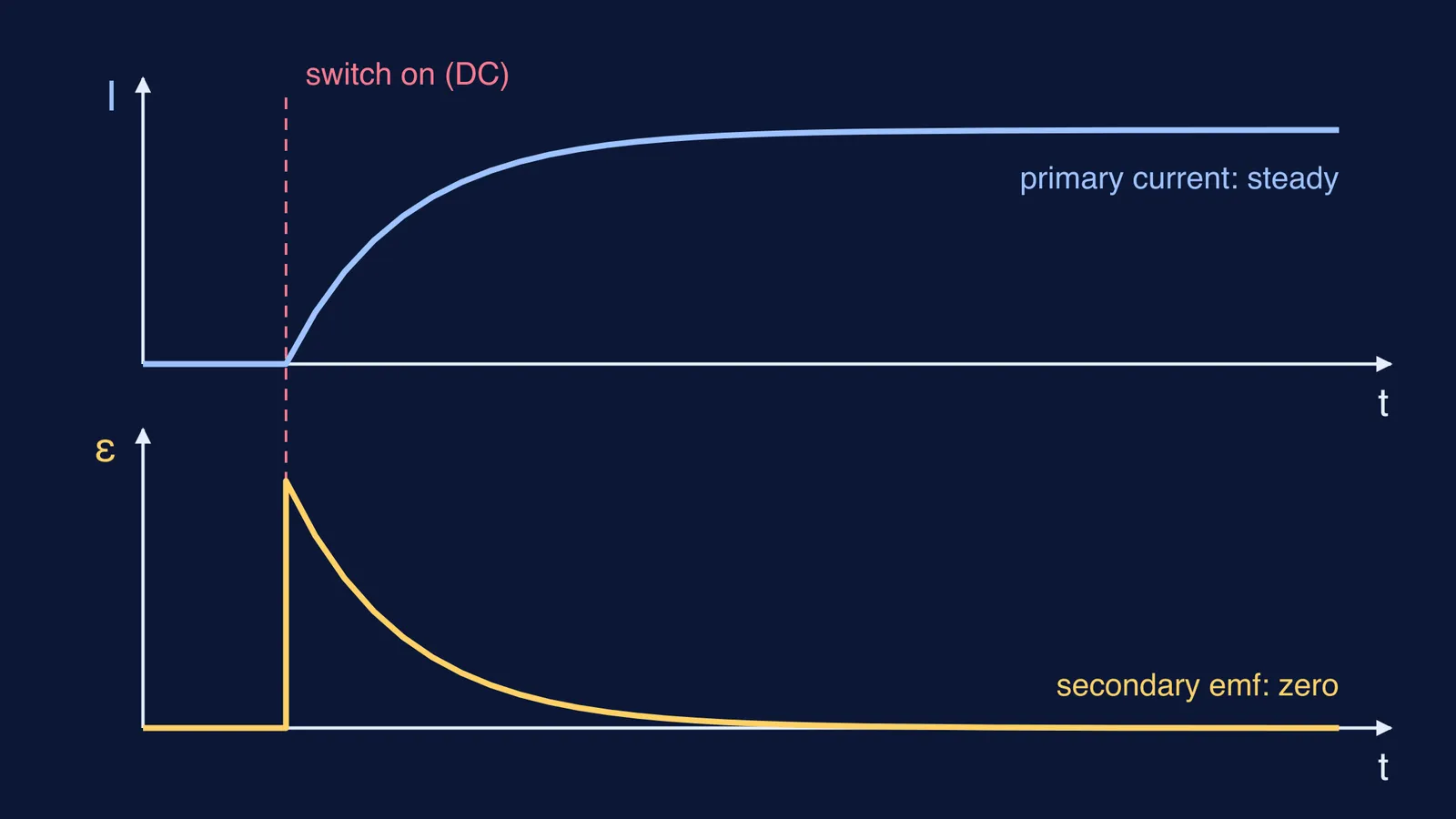
The output depends on how fast the flux changes, not on how big it is. With AC, the current and therefore the flux keep changing, so the secondary has an alternating emf. With a steady DC the flux is constant, dφ/dt = 0, and so ε_s = 0.
The classic induction experiment described in OpenStax University Physics shows the same thing: current flowed in the second circuit "only when the magnetic field in the region occupied by that circuit was changing".
What happens at the moment you switch DC on?
There is one short exception. When you close the switch, the primary current does not jump to its final value. The coil's self-inductance makes it rise as I = (V/R)(1 − e^(−t/τ)), with time constant τ = L/R (OpenStax, RL circuits).
While the current is rising, the flux is changing, so the secondary does get a pulse of emf. It is largest at the instant of switch-on and dies away as the current levels off. The same happens, with the opposite sign, when you switch off.
What happens to the primary coil on DC?
On AC, the changing flux also induces a back emf in the primary itself, ε_p = −N_p dφ/dt, and that back emf holds the primary current down. NCERT notes that in an ideal transformer, if the back emf did not balance the applied voltage, "the primary current would be infinite" because the primary is assumed to have zero resistance (NCERT, section 7.8).
On steady DC there is no back emf. The only thing limiting the current is the resistance of the copper winding, which is small. So the coil draws a large current and turns it into heat. Asked by a student from New Delhi what happens if a transformer is given DC, the University of Illinois physics Q&A service Ask the Van answered, in a 2011 reply signed LeeH: "It won't work, you won't get any output. All you get is a heating up of the transformer due to the resistance of the primary winding."
Worked example: the same coil on 12 V AC and 12 V DC
Take a primary with resistance R = 2 Ω and inductance L = 0.5 H. Round numbers, for practice.
DC, after it settles: I = V/R = 12/2 = 6 A. The coil turns P = VI = 72 W into heat, and the secondary gives 0 V.
DC, at switch-on: τ = L/R = 0.5/2 = 0.25 s. The current reaches 63% of its final value, about 3.8 A, after one time constant (OpenStax, RL circuits). After 5τ = 1.25 s it is within 1% of 6 A, because e^(−5) ≈ 0.007. For practical purposes, that 1.25 s is the whole life of the secondary pulse.
AC at 50 Hz: the inductive reactance is X_L = ωL (NCERT, chapter summary) = 2π × 50 × 0.5 ≈ 157 Ω. The 2 Ω resistance hardly matters, so the current is about 12/157 ≈ 0.076 A.
Same coil, same 12 volts: under 0.1 A on AC, 6 A on DC, roughly 80 times more.
How do you write this in a board exam answer?
A transformer works on mutual induction: the secondary emf is ε_s = −N_s dφ/dt.
A steady DC gives a constant flux, so dφ/dt = 0 and no emf is induced in the secondary, apart from a brief pulse at switch-on and switch-off.
With no back emf in the primary, only the winding's small resistance limits the current, so the primary draws a large current and heats up.
Three slips to check before you hand in:
Writing that the flux is zero on DC. It is not zero; it is constant.
Leaving out the primary heating.
Mixing up a transformer with a rectifier. A transformer changes the size of an AC voltage; it does not turn AC into DC.
If mutual induction or the RL rise still feels shaky, the Fermi Concept Library has a lesson for every concept in physics, each with its place in the map. To practise, the Fermi Problem Library has worked problems with a step-by-step solver that explains the reasoning rather than printing an answer.
Next time you see a transformer question, ask first what is changing, then write the three lines.