

On this page
Hold a lump of gallium in your palm and it turns into a silvery puddle. Its melting point is about 29.8 °C, below body temperature. Boron, two places above it in group 13, does not melt until roughly 2,076 °C. Aluminium, indium and thallium sit in between. The NCERT table of group 13 properties shows this zigzag, but the textbook says little about why it happens. The answer has to do with how each solid is built, and gallium's case is stranger than "it is a metal with weak bonding".
What are the melting points of group 13 elements?
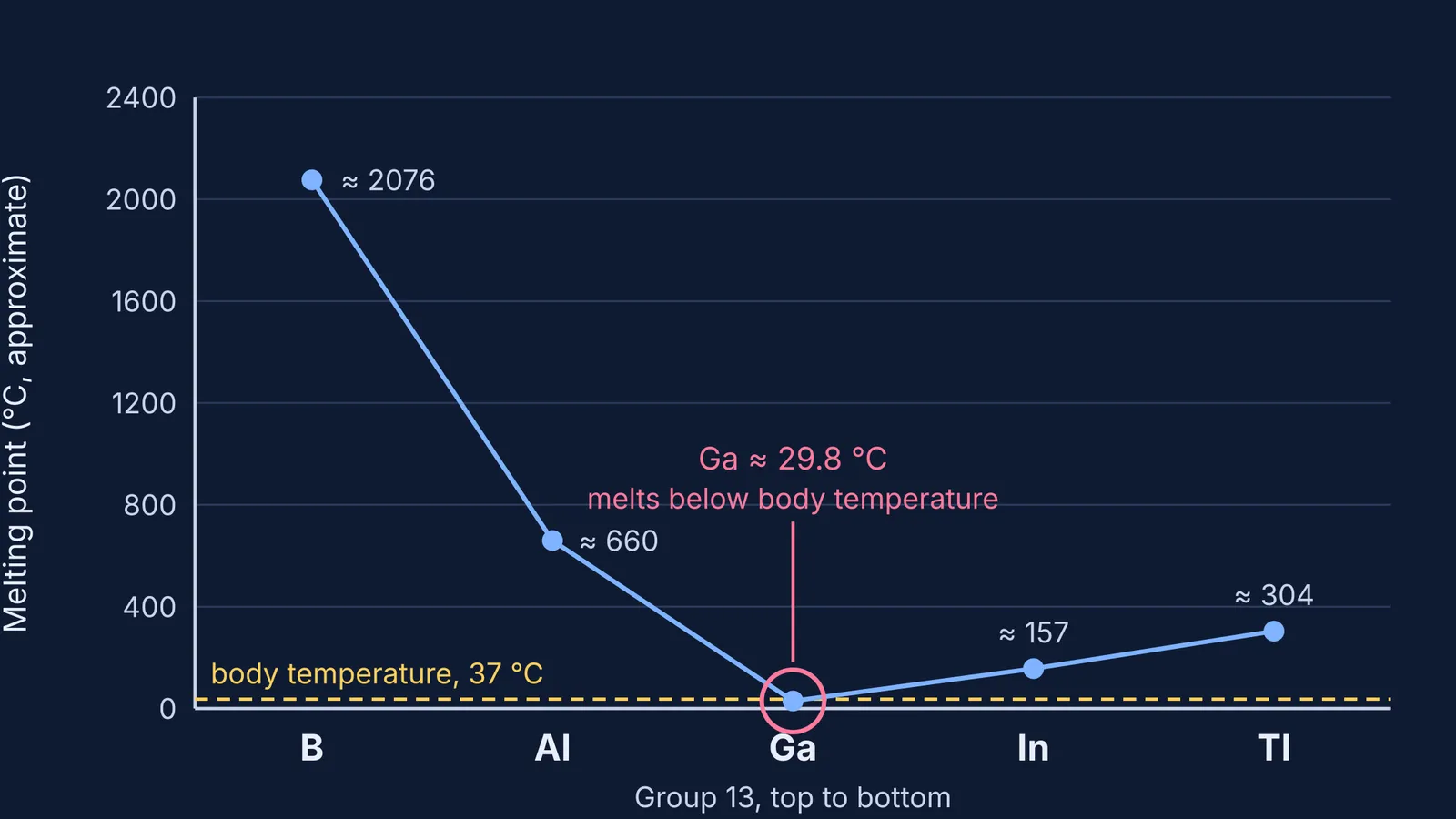
Approximate values (data tables differ slightly, boron most of all):
Boron: about 2,076 °C. Tables quote anywhere from about 2,075 °C to 2,300 °C; NCERT lists 2453 K, about 2,180 °C.
Aluminium: about 660 °C (933 K).
Gallium: about 29.8 °C (303 K).
Indium: about 157 °C (430 K).
Thallium: about 304 °C (577 K).
So the melting point falls steeply from B to Al, falls again to a minimum at Ga, then rises a little through In and Tl. In kelvin, boron's melting point is nearly eight times gallium's.
Why does boron have such a high melting point?
Boron is not a metal. It does not have enough electrons to form a simple metallic lattice, and its small atom holds its three valence electrons tightly (the same reason it does not form B³⁺ ions, explained in why boron does not form B³⁺ ions). Instead, solid boron is a covalent network solid.
The building block is the B₁₂ icosahedron: twelve boron atoms at the corners of a twenty-faced shape. Each icosahedron is bonded to neighbouring icosahedra, so the whole crystal is one giant framework of directional covalent bonds. To melt it, you must break a large share of those bonds, not just loosen attractions between particles. That is why boron behaves like diamond or silicon, with a very high melting point and great hardness, rather than like a metal.
Why is aluminium's melting point so much lower?
Aluminium is a true metal. Each atom gives its three valence electrons to a shared "sea" of delocalised electrons, and the Al³⁺ cores pack in a close-packed (face-centred cubic) lattice. Metallic bonding is strong but not directional, so the atoms can slide past each other once they have enough energy. Melting only needs the lattice to lose its long-range order; the metallic bonding itself largely survives in the liquid. So Al melts at about 660 °C, far below boron.
Why does gallium melt at only 30 °C?
This is the part NCERT simply calls "unusual". The fuller reason is the structure of solid gallium.
In ordinary solid gallium, each atom has one very close neighbour, at about 2.44 Å, and six others further away, at about 2.7 to 2.8 Å. So the crystal is built from nearly paired Ga₂ units, with a fairly strong, almost covalent bond inside each pair and weaker metallic bonding between the pairs. It is a poor, loosely packed arrangement for a metal.
Two things follow:
The solid is barely more stable than the liquid. A melting point is the temperature at which the solid and the liquid have equal free energy. In gallium the awkward paired solid gains little from being ordered, so only a little heating is enough to tip the balance to the liquid.
The liquid packs better than the solid. Liquid gallium is denser than solid gallium, and gallium expands by roughly 3% when it freezes, just like water. That is a sign that the solid structure is open and unusual, not a normal close-packed metal.
So the low melting point does not mean the bonding in gallium is weak overall. It means gallium's solid structure is a poor one, and the liquid is a comfortable state for it.
Gallium's atomic size is also affected by its filled 3d subshell, which shields the nucleus poorly. That effect explains why gallium's atomic radius is smaller than aluminium's, but it is the paired solid structure, not the radius, that gives the low melting point.
Why do indium and thallium melt higher than gallium?
Indium and thallium have ordinary metallic structures without gallium's pairing, so they return to normal metal behaviour. Their atoms are large, the metallic bonding is fairly weak, and their melting points stay low (about 157 °C and 304 °C). The small rise from In to Tl does not have a simple one-line explanation at JEE level; what you need to know is that Ga is the anomalous minimum, and why.
Why is gallium used in high-temperature thermometers?
Melting and boiling test different things. Melting asks how much better the solid is than the liquid. Boiling asks how hard it is to pull atoms apart completely into a gas. Liquid gallium has normal, strong metallic bonding, so its boiling point is high. NCERT gives 2676 K, about 2,400 °C. Some data tables give a lower value, around 2,200 °C, but either way it is enormous compared with its melting point.
The result is one of the widest liquid ranges of any element. A substance that stays liquid from about 30 °C to over 2,000 °C, and does not boil off, is useful for measuring high temperatures, which is why gallium is used in high-temperature thermometers in place of mercury, which boils at about 357 °C.
Worked example: liquid ranges of Al and Ga
Use the NCERT values: Al melts at 933 K and boils at 2740 K; Ga melts at 303 K and boils at 2676 K. Compare the range of temperature over which each is liquid.
Liquid range of Al: 2740 K − 933 K = 1807 K.
Liquid range of Ga: 2676 K − 303 K = 2373 K.
Difference: 2373 K − 1807 K = 566 K. Gallium is liquid over a range about 566 K wider.
Ratio: 2373 ÷ 1807 ≈ 1.31, so gallium's liquid range is about 31% larger.
Interpretation: the two boiling points are close (2740 K and 2676 K), because both liquids have similar metallic bonding. Almost all of the difference comes from the melting points. Gallium's solid gives up far earlier than aluminium's.
If you use a table that gives gallium's boiling point nearer 2,200 °C, the range is still about 2,170 K, and still wider than aluminium's.
If you want more group 13 questions worked in this style, the Fermi Problem Library has a step-by-step solver that explains the reasoning, not just the final answer. For the oxidation-state side of the group, see the inert pair effect in heavy p-block elements.
Quick checklist
Group 13 melting points: B very high, Al moderate, Ga lowest, In and Tl low. All values approximate; boron's varies most between tables.
Boron: covalent network of B₁₂ icosahedra, so melting breaks covalent bonds.
Aluminium: close-packed metal, so a normal metallic melting point.
Gallium: solid built from nearly paired Ga₂ units, only slightly more stable than the liquid. It expands on freezing.
Low melting point is not the same as weak bonding: gallium boils above 2,000 °C.
Liquid range of Ga (about 2373 K) is wider than that of Al (about 1807 K) using NCERT data.


