

On this page
When students in Class 11 study Group 13 elements, a clear contradiction appears in their textbooks. Aluminium readily forms ionic compounds such as aluminium fluoride and exists as a hydrated cation in solution. Yet boron, sitting directly above aluminium with the same three valence electrons (2s² 2p¹), never forms simple B³⁺ ions in any chemical environment. Instead, boron exclusively forms covalent compounds like BF₃, BCl₃, and boranes.
Why is the sum of ionisation enthalpies so high for boron?
Boron is the smallest element in Group 13, with a compact valence shell held by five nuclear protons against just two core electrons in the 1s subshell. Because its three valence electrons experience a strong effective nuclear charge, removing all three valence electrons to create a naked B³⁺ cation demands three consecutive ionisation steps.
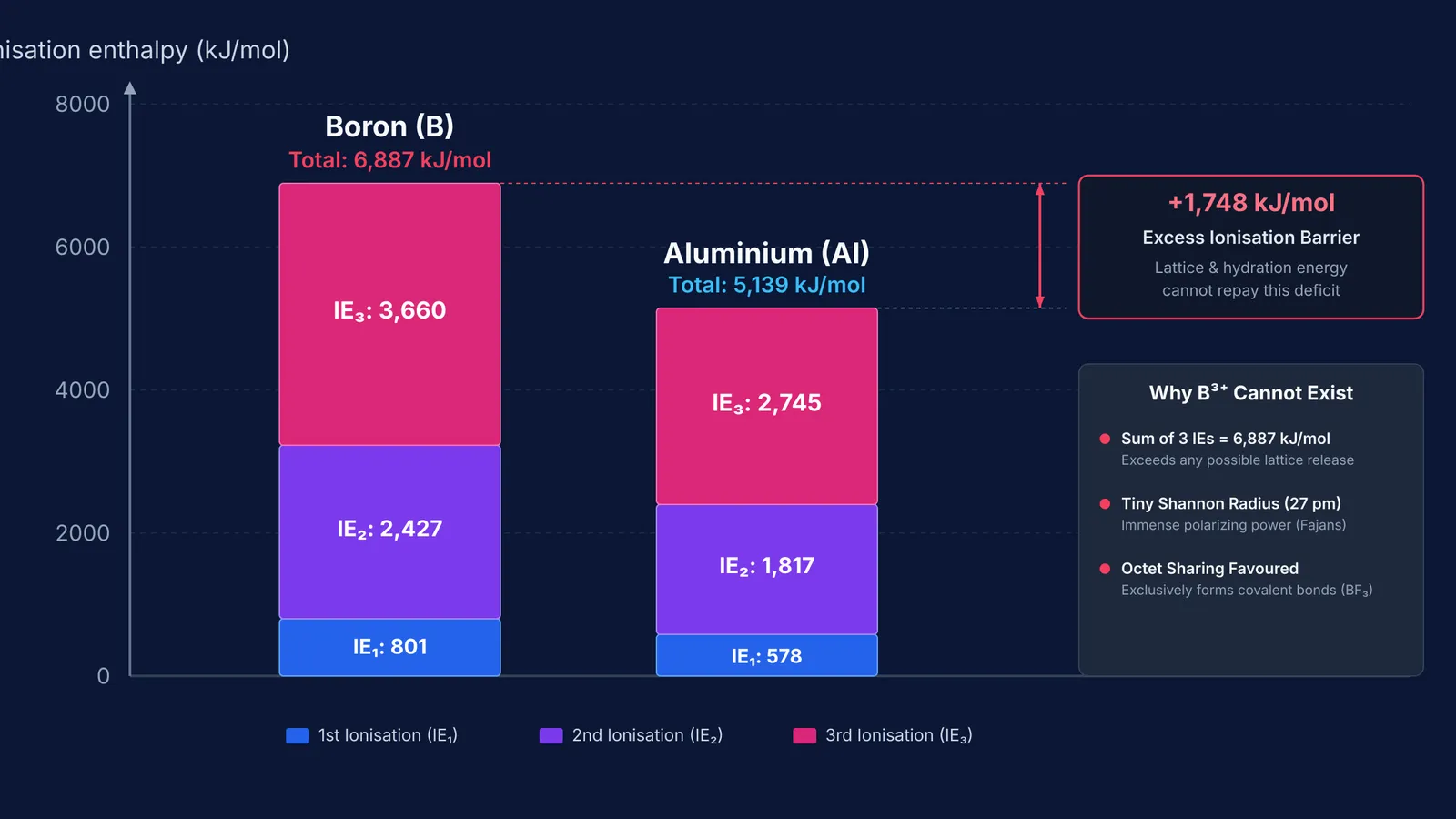
According to data from the NIST Atomic Spectra Database, the first ionisation energy to remove the 2p¹ electron requires 801 kJ/mol (8.298 eV). Removing the second electron from the filled 2s orbital requires 2,427 kJ/mol (25.155 eV), and removing the third electron costs 3,660 kJ/mol (37.931 eV). Summing these three steps yields a total ionisation enthalpy of 6,887 kJ/mol.
By comparison, NIST atomic data shows that aluminium's three valence electrons lie in shell n = 3, screened by ten core electrons. Aluminium's first three ionisation enthalpies are 578 kJ/mol, 1,817 kJ/mol, and 2,745 kJ/mol, summing to 5,139 kJ/mol. Ionising boron requires nearly 1,750 kJ/mol of extra energy compared to aluminium. When students connect atomic radius to periodic trends, the Fermi Concept Library organizes each topic in chemistry with its own lesson and its place in the map, showing how nuclear charge governs chemical behaviour.
Why can lattice or hydration enthalpy not compensate for B3+?
In solid-state chemistry, an element forms a cation only if the exothermic lattice enthalpy released during crystal formation repays the energy spent on atomisation and ionisation. Textbooks use Born-Haber cycles for lattice enthalpy to track these balances.
Solid boron has an exceptionally high standard enthalpy of atomisation of 560 kJ/mol, recorded in the NIST-JANAF Thermochemical Tables. Adding this cost to the 6,887 kJ/mol ionisation sum means a chemical reaction must supply over 7,440 kJ/mol before an ionic crystal can assemble. Real solid lattices cannot release enough electrostatic energy to overcome that deficit.
In aqueous solution, the same thermodynamic constraint applies. When aluminium salts dissolve, Al³⁺ releases roughly -4,665 kJ/mol of hydration enthalpy, according to ion solvation data from Yizhak Marcus, forming the octahedral [Al(H₂O)₆]³⁺ complex. A hypothetical B³⁺ ion cannot replicate this stability. Because boron belongs to Period 2, it possesses only 2s and 2p valence orbitals, capping its maximum coordination number at 4. Its high charge density also polarises water molecules so intensely that it expels protons, yielding neutral boric acid, B(OH)₃, rather than a hydrated B³⁺ cation.
How do Fajans' rules explain boron's covalent bonding?
Even if hypothetical B³⁺ cations could encounter anions, electrostatic polarization would quickly turn the bond covalent. In 1923, chemist Kasimir Fajans formulated Fajans' rules, which show that cations with high positive charge and tiny ionic radii exert extreme polarizing power on surrounding electron clouds.
Crystallographic values published by R. D. Shannon in 1976 show that an octahedral Al³⁺ cation has an effective ionic radius of 53.5 pm. A hypothetical B³⁺ ion would have an effective radius of just 27 pm in six-coordination, and 11 pm in tetrahedral coordination. Concentrating a +3 charge into a 27 pm radius creates an immense charge-to-size ratio.
Under Fajans' rules for predicting covalent character, this extreme charge density pulls electron clouds into the internuclear region, forcing electron sharing. In boron trifluoride, data from the NIST Chemistry WebBook shows a standard enthalpy of formation of -1,136.0 kJ/mol and an average B–F bond dissociation energy of 646 kJ/mol. Boron gains far greater thermodynamic stability through strong covalent bonds—reinforced by Lewis acidity and back bonding in boron trihalides—than through ionic interactions.
A 3-step framework for Group 13 bonding questions
When you encounter questions in JEE Main or NEET-UG on whether a Group 13 compound is ionic or covalent, apply this 3-step reasoning framework:
Total the ionisation enthalpies: Compare the energy cost to remove valence electrons (NIST ASD data). Boron requires 6,887 kJ/mol, while aluminium requires 5,139 kJ/mol.
Balance with lattice or hydration energy: Check whether the release of electrostatic or hydration energy can offset this initial cost. For boron, the deficit remains far too large.
Check polarisation and coordination limits: Apply Fajans' rules. Boron's tiny radius produces extreme polarisation, forcing covalent sharing, and its lack of d-orbitals caps coordination at 4.
For multi-step thermochemical calculations, the Fermi Problem Library has worked problems with a step-by-step solver that explains the reasoning rather than printing an answer.


