

On this page
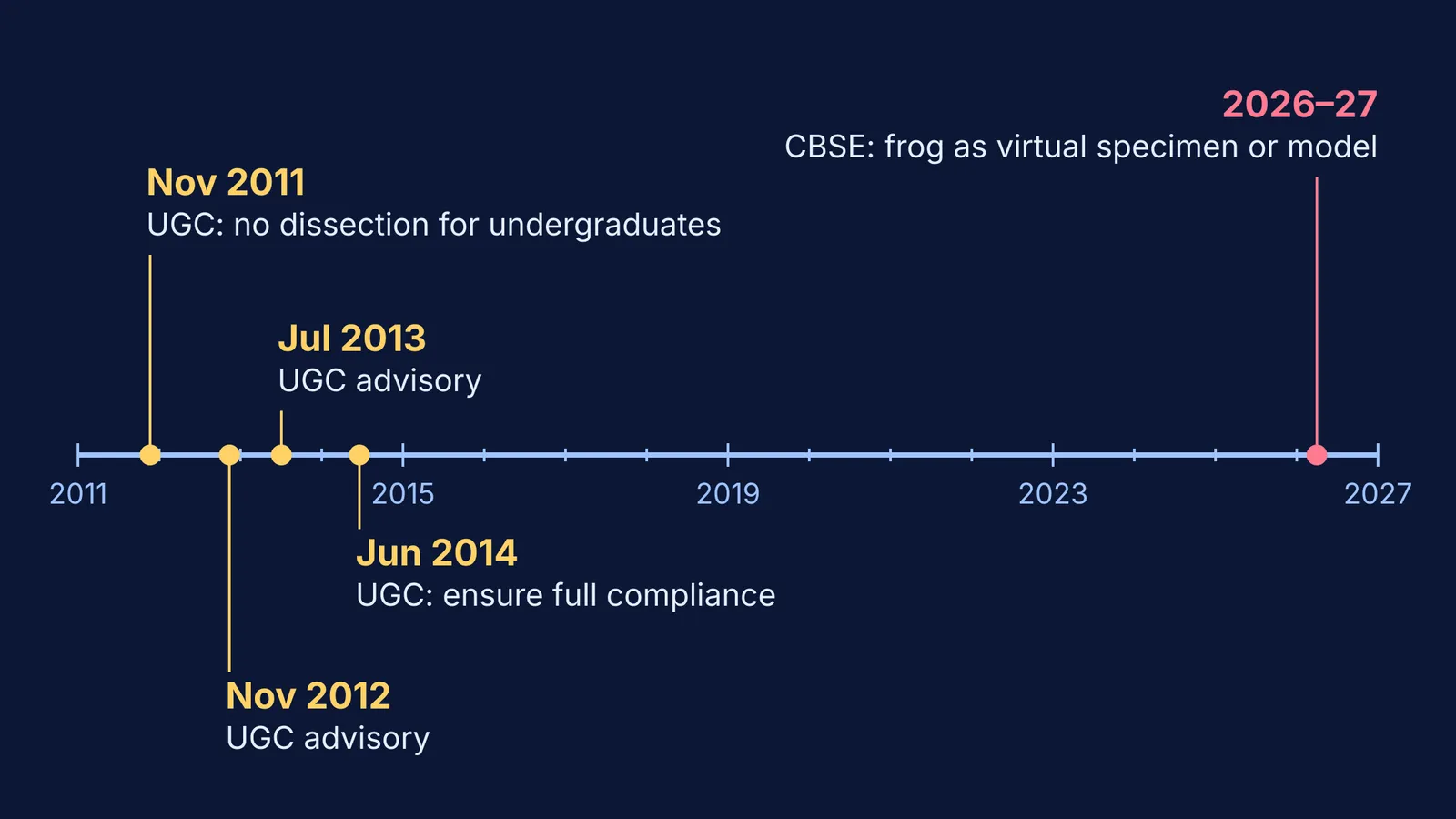
Your parents may have dissected a frog in college; you almost certainly won't. Between 2011 and 2014 the University Grants Commission (UGC) told colleges to stop making students dissect animals, and CBSE's current syllabus has Class 11 students study the frog from virtual specimens, slides or models instead. Frog anatomy is still on the syllabus. What changed is how you learn it.
Why did frog dissection stop in Indian colleges and schools?
The first reason was where the frogs came from. The UGC's guidelines for discontinuation of dissection and animal experimentation in Zoology/Life Sciences say that more than a million students were taking programmes that needed animals for dissection, and that most of those animals were caught from the wild. Removing them, the guidelines argue, compounds habitat loss, pollution and climate change in depleting animal populations. Frogs, whose population had "declined to alarming levels", were often cited as the example.
The second reason was the law. The same UGC document points to the Wild Life Protection Act, 1972, which at the time listed all frogs of the genus *Rana* under Schedule IV, and tells institutions not to use protected animals, particularly *Rana* frogs, in laboratory exercises. It also cites the Prevention of Cruelty to Animals Act, 1960, which asks that experiments on animals be avoided where books, models or films would do.
What did the UGC guidelines actually say?
The UGC's guideline list shows the main document dated 22 November 2011. Its key rules:
Undergraduates "shall not be required to dissect any animal". If internal anatomy is on the curriculum, teachers demonstrate one species that can be bred on a large scale while students observe and record.
In exams, students may at most be asked to label parts on specimens the teachers have already dissected.
Labs should use museum specimens, slides, photographs, video clips, models, charts, plastinated specimens and field observation, and digital dissection software for anatomy.
Postgraduates may choose limited dissection of a few designated specimens or a biodiversity project instead.
Every institution that still uses animals must set up a Dissection Monitoring Committee.
Compliance was patchy. After advisories in November 2012 and July 2013, in a June 2014 letter to all vice chancellors UGC secretary Jaspal S. Sandhu wrote that the Commission was "still receiving representations" about some institutions not following the guidelines, and asked for full compliance.
How do Class 11 students learn frog anatomy now?
In the CBSE Biology syllabus for 2026-27, Chapter 7, Structural Organisation in Animals, still covers the morphology and anatomy of the frog's digestive, circulatory, respiratory, nervous and reproductive systems. In the practical, the frog appears in the spotting list as "virtual specimens/slides/models", alongside the earthworm, shark and pigeon. The Animal Kingdom chapter carries the note "No live animals or specimen should be displayed."
You are examined on the same anatomy; you just learn it by labelling and explaining rather than cutting. Our explainer on the frog in Structural Organisation in Animals walks through the chapter itself.
Is virtual dissection as good as the real thing?
For learning the facts, the evidence is encouraging. A 2022 systematic review in The American Biology Teacher by Elisabeth Ormandy and colleagues looked at 20 studies published between 2005 and 2020. In 19 of the 20, students performed at least as well with non-animal methods as with dissection, and in 14 of those 19 they did better.
That result is about knowledge. The UGC guidelines themselves say exams in these courses will be "more oriented towards knowledge component rather than skill development", so a virtual tool will not teach you to hold a scalpel. It can teach you where every organ sits and what it does, which is what your exam asks.
A one-week plan to learn frog anatomy without a scalpel
Plan on about 20 minutes a day, and produce the anatomy rather than just look at it.
Day 1: Read the frog section in NCERT, close the book and list every organ you remember, by system.
Day 2: Find each organ on a virtual dissection tool or your lab's model; add the ones you missed.
Day 3: Draw the digestive system from memory, label it, check against the textbook and circle every mistake.
Day 4: Repeat for the circulatory system, then compare the frog's heart with a fish's and a human's using our post on why fish have a two-chambered heart and humans four.
Day 5: Respiratory, nervous and reproductive systems: explain each aloud, then check NCERT.
Day 6: Spotting drill: someone points at parts on a model or chart; name each and give one feature.
Day 7: Draw all five systems from memory on one page. Any blanks are next week's revision.
Some processes, like blood moving through the chambers of a heart, make more sense in motion than on a page. The Fermi Simulation Lab has interactive simulations for ideas that are easier to see than to read, and parents can use our 20-minute simulation plan for parents and teens to run a session at home.
Start with Day 1 tonight: one read, then one list from memory.


