
On this page
Whether a science simulation helps your child depends less on the software than on what they do while it runs. You can supply the missing part yourself in 20 minutes, even if you last studied physics decades ago.
Are online science simulations actually useful for learning?
Used actively, yes. In a 2008 paper in Science, the team behind the free PhET simulations at the University of Colorado reported that students who did a 2-hour circuits exercise with the Circuit Construction Kit simulation showed higher mastery of current and voltage on the final exam than students who did the same lab with real equipment (Wieman, Adams and Perkins, 2008). The simulation group in the original study (Finkelstein and colleagues, 2005) also built a real circuit faster, according to a Carleton College teaching summary.
Simulations can show the invisible, such as air molecules in a sound wave, and let you change one quantity and watch what follows. In a quantum mechanics course using the Photoelectric Effect simulation, about 80% of students showed mastery of the concepts, against only 20% in a course taught traditionally (Wieman, Adams and Perkins, 2008).
A 2012 review of the past decade of experimental studies concluded that computer simulations can enhance traditional instruction, especially lab activities, but noted that the research had largely not considered the role of teacher support (Rutten, van Joolingen and van der Veen, 2012). That gap is where you come in.
What are simulations bad for?
Watching. The PhET team found students cannot make sense of the science in a simulation just from watching; they must interact with it (Science, 2008). In a classroom study, students who passively watched demonstrations understood the concepts no better than students who saw no demonstration at all (Crouch, Fagen, Callan and Mazur, 2004).
Aimless clicking. A review of discovery learning with simulations describes the problems learners run into when left alone, and argues for pairing simulations with support (de Jong and van Joolingen, 1998).
Practical skills. The 2008 paper says some goals, such as operating complex lab equipment, are not addressed by simulations. School practicals still need real apparatus.
How can I run a simulation session with my teen if I don't know the physics?
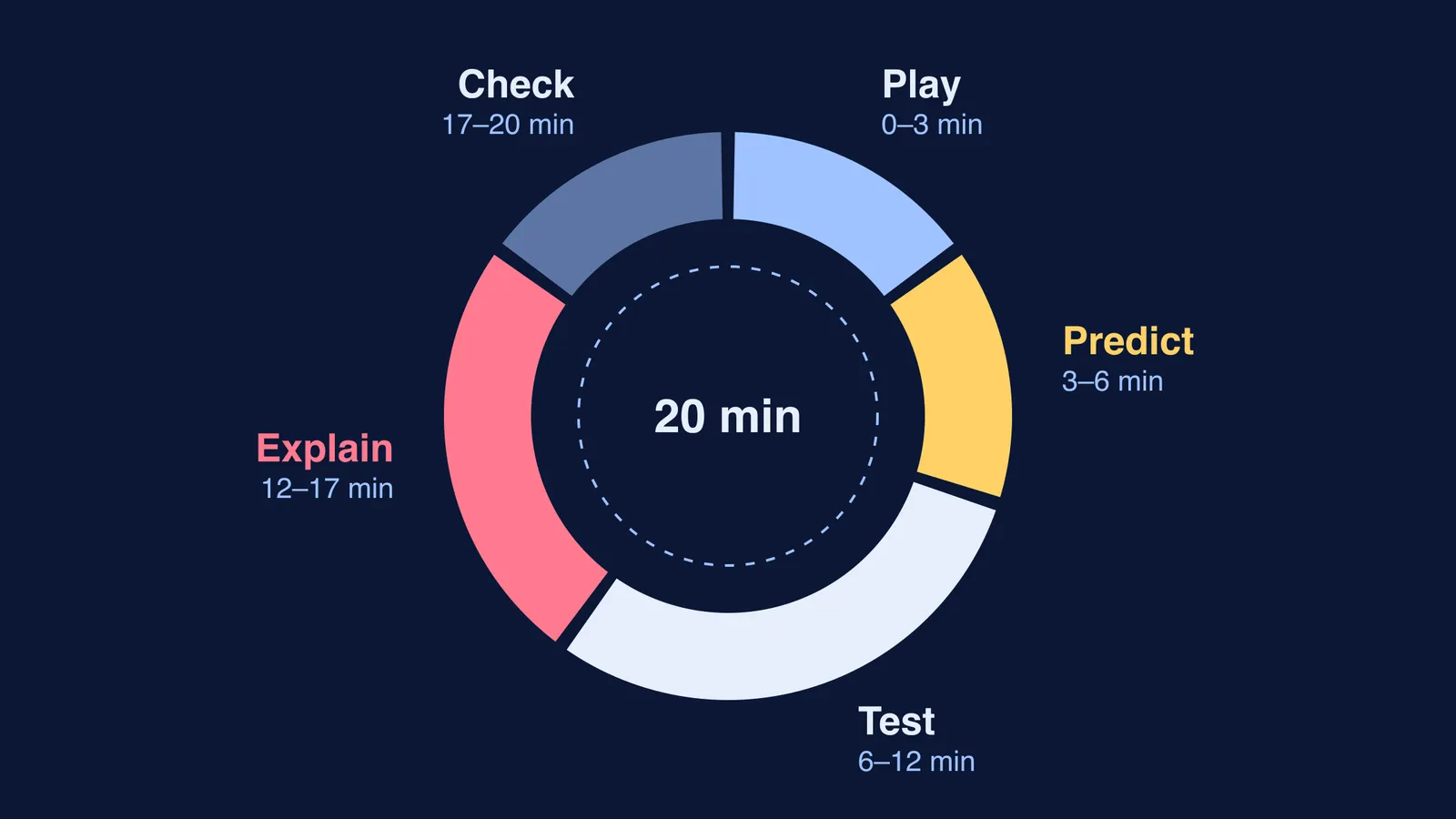
You are not the teacher here. Your job is to ask, keep time and make sure predictions are written before anyone clicks. The 2004 study found that students who predicted a demonstration's outcome before seeing it showed significantly greater understanding (Crouch and colleagues). This plan builds the whole session around that one habit.
Play (minutes 0 to 3). Your teen opens the simulation and explores freely. Start with the simplest view; with one simulation, the PhET team saw students overwhelmed when the full, busy view came first (Science, 2008).
Predict (minutes 3 to 6). Agree on one question. Your teen writes a prediction and a reason in a notebook. You write yours too.
Test (minutes 6 to 12). Change one thing at a time. Write down each result.
Explain (minutes 12 to 17). Ask your teen to explain the result to you as if you had missed the class, especially where the prediction was wrong.
Check (minutes 17 to 20). Close the simulation. Your teen predicts one new case, or answers one textbook question, without the screen.
What does a session look like? A pendulum example
The free PhET Pendulum Lab lets you change the string length, the mass of the bob, gravity and the size of the swing, and time each swing.
You: “If we make the bob heavier, will it swing faster, slower or the same?” Let your teen commit to an answer in writing.
Test: double the mass and time ten swings. Then change only the length.
What you will see: for small swings, the time for one swing depends only on the length and gravity, not on the mass (HyperPhysics, Georgia State University). A longer string gives a slower swing.
Explain: if your teen predicted that heavier is faster, ask: “The stopwatch says no. What could explain that?” Let them try before you open the textbook.
Check: “What would happen on the Moon, where gravity is weaker?” They predict, then test it with the gravity setting.
If you get stuck on the physics, say so. “I don't know, how could we find out?” is exactly the attitude you are trying to teach.
How do I know the session worked?
Predictions were written before any clicking.
Wrong predictions were discussed, not quietly erased.
Your teen can explain the result with the laptop closed.
Pick a topic from this week's school chapter that your teen finds hard to picture. Our Fermi Simulation Lab has interactive simulations for ideas that are easier to see than to read, and the same predict, test, explain routine works there.
To go deeper, read what PhET research says interactive simulations are good for, when simulations beat static diagrams and when they don't, or try a ready-made session with this concave mirror simulation where you predict the image at six positions.