

On this page
Shake some activated charcoal with dilute acetic acid, filter it, and titrate what is left. The solution is now weaker, because some of the acid has stuck to the charcoal's surface. Repeat this with five starting concentrations, plot two logarithms, and you get a Freundlich isotherm from a burette and a few conical flasks. This post covers the method, the arithmetic and the traps.
Is this experiment still on the syllabus?
Only for JEE Advanced. Rationalised NCERT Class 12 dropped the surface chemistry chapter, so adsorption is no longer tested in NEET-UG or JEE Main. The JEE Advanced syllabus still lists adsorption and the Freundlich isotherm. The old NCERT text used acetic acid on charcoal as its example of adsorption from solution, and the experiment shows the isotherm more clearly than any gas example. If you are preparing only for NEET-UG or JEE Main, you can skip this post.
All the numbers below are illustrative. They were made up to follow a Freundlich line. They are not measured data.
Our post on reading 1/n and k from a Freundlich graph does the same algebra for a gas, with pressure in kPa. Here the pressure is replaced by the concentration left in solution, and the real work is getting x/m out of a titre.
How do you set up the experiment?
Make up acetic acid solutions of 0.200, 0.150, 0.100, 0.075 and 0.050 M.
Put 50.0 mL of each into a stoppered conical flask with 1.00 g of activated charcoal.
Set up a sixth flask with acid but no charcoal. This blank tells you the true starting concentration.
Shake all the flasks now and then for about 30 minutes, and keep them at the same temperature.
Filter each one. Throw away the first few mL of filtrate. If it still looks grey, filter it again.
Titrate 10.0 mL of each filtrate with 0.100 M NaOH, using phenolphthalein as the indicator.
Each titre gives you c(e), the equilibrium concentration left in solution. The fall from c₀ to c(e) is the acid that is now on the charcoal.
How do you get x/m from a titre?
Worked example: the flask that started at c₀ = 0.200 M.
Titre. 10.0 mL of filtrate needs 17.0 mL of 0.100 M NaOH.
Equilibrium concentration. Acetic acid and NaOH react 1 : 1 (CH₃COOH + NaOH → CH₃COONa + H₂O). So c(e) = 0.100 × 17.0 ÷ 10.0 = 0.170 M.
Fall in concentration. 0.200 − 0.170 = 0.030 M.
Moles adsorbed. Multiply by the volume in the flask, not by the aliquot: 0.030 mol L⁻¹ × 0.0500 L = 1.5 × 10⁻³ mol, or 1.5 mmol.
Mass adsorbed. 1.5 × 10⁻³ mol × 60.05 g mol⁻¹ = 0.090 g. This is x.
Per gram of charcoal. x/m = 0.090 g ÷ 1.00 g = 0.090 g g⁻¹.
The flask that started at 0.050 M needs 3.8 mL, so c(e) = 0.038 M. The fall is 0.012 M, which gives 6.0 × 10⁻⁴ mol, or 0.036 g, so x/m = 0.036 g g⁻¹.
How do you find 1/n and k from the graph?
The Freundlich equation for a solution is x/m = k c^(1/n). Take logs of both sides:
log(x/m) = log k + (1/n) log c(e)
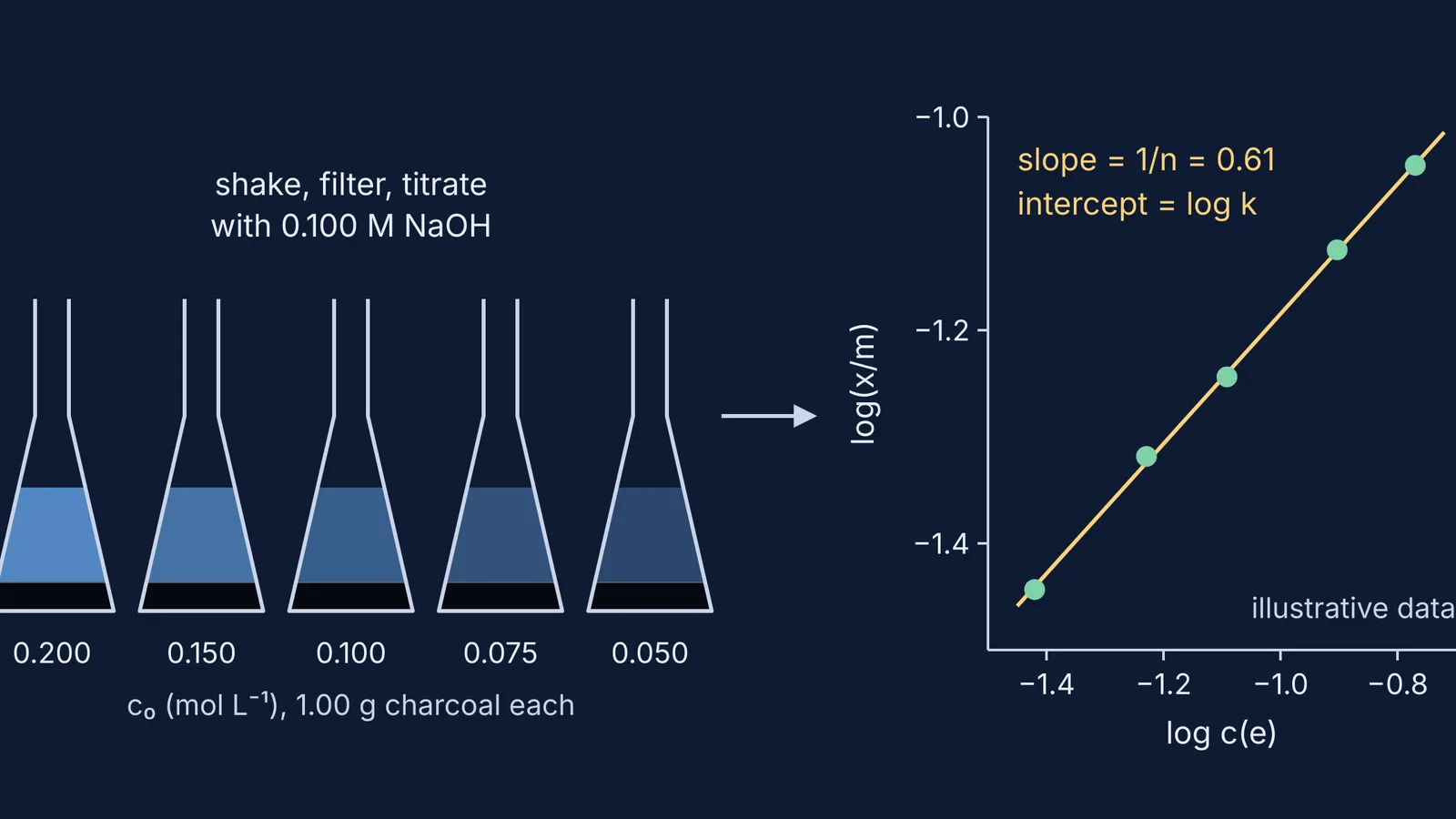
Here are all five illustrative flasks, with the titre for 10.0 mL, c(e), x/m, and then log c(e) and log(x/m):
c₀ = 0.200 M: 17.0 mL, 0.170 M, 0.0901 g g⁻¹, −0.770, −1.045
c₀ = 0.150 M: 12.5 mL, 0.125 M, 0.0751 g g⁻¹, −0.903, −1.125
c₀ = 0.100 M: 8.1 mL, 0.081 M, 0.0570 g g⁻¹, −1.092, −1.244
c₀ = 0.075 M: 5.9 mL, 0.059 M, 0.0480 g g⁻¹, −1.229, −1.318
c₀ = 0.050 M: 3.8 mL, 0.038 M, 0.0360 g g⁻¹, −1.420, −1.443
Plot log(x/m) on the y-axis against log c(e) on the x-axis. The points lie on a straight line, so the Freundlich form fits over this range.
Slope. Use the two end points: (−1.045 − (−1.443)) ÷ (−0.770 − (−1.420)) = 0.398 ÷ 0.650 = 0.61. So 1/n = 0.61, and n ≈ 1.6. A least-squares fit through all five points also gives 0.61.
Intercept. log k = log(x/m) − (1/n) log c(e) = −1.045 − 0.61 × (−0.770) = −0.575. So k ≈ 0.27, with x/m in g g⁻¹ and c in mol L⁻¹. If you change either unit, k changes too.
Check. The concentration left in solution goes up 4.47 times from the weakest flask to the strongest, but x/m goes up only 2.5 times. With 1/n below 1, the charcoal takes up a smaller share of the acid as the solution gets stronger.
To try the same plot with your own numbers, the Fermi Problem Library has a step-by-step solver that explains the reasoning.
What else does acetic acid on charcoal show?
The old NCERT text drew two observations from this kind of experiment.
Temperature. Adsorption from solution goes down as the temperature goes up, just as physical adsorption of a gas does. So keep every flask at the same temperature, or the points will not lie on one line.
Surface area. Finely powdered, activated charcoal adsorbs more than lumps of the same mass, because it has more surface.
There are also limits to remember:
Freundlich is empirical. It is a curve that fits the data, not a law derived from a model. Over a range of concentration, 1/n is a fitting constant, not a physical property of the charcoal.
It fails at high concentration. Once the surface fills up, x/m levels off and the log plot bends. A straight line over five dilute flasks does not prove the equation holds at 2 M.
The same idea, a surface holding some substances more than others, explains why charcoal picks up some gases better than others, as described in why charcoal holds SO₂ and NH₃ but barely holds H₂.
Which errors creep into the titres?
Charcoal getting through the filter. Fine particles can pass through filter paper and make the titre higher.
No blank. If the stock solution is a little off, every c₀ is wrong, and so is every x/m. The flask without charcoal fixes this.
Small titres in the dilute flasks. A 3.8 mL titre has a large relative error. Titrate 25.0 mL of filtrate instead, or use 0.0500 M NaOH for the weakest two flasks.
Flasks left for different times. Give every flask the same shaking time so each one reaches equilibrium.
For a JEE Advanced question that uses the isotherm the other way round, from k and n to the amount adsorbed, see the solutions and surface chemistry practice questions.
Quick checklist
c(e) = M(NaOH) × V(NaOH) ÷ V(aliquot).
x = (c₀ − c(e)) × the volume in the flask × 60.05 g mol⁻¹.
Plot log(x/m) against log c(e). The slope is 1/n and the intercept is log k.
Run a blank, filter twice, and keep the temperature constant.
Call the result a Freundlich fit over the range you measured, not a law.


