

On this page
Shake one gram of activated charcoal with sulphur dioxide at room temperature and it takes up hundreds of millilitres of the gas. Do the same with hydrogen and it holds only a few millilitres. NCERT gives the rule behind this: gases that liquefy easily, the ones with a high critical temperature, are adsorbed more. This post explains why that rule works, tests it against real data for six gases, and adds the thermodynamic reason adsorption always gives out heat.
Which gases does charcoal adsorb most?
The general rule for physical adsorption (physisorption) is:
the higher a gas's critical temperature (Tc), the more of it is adsorbed at a given temperature and pressure
this is because the van der Waals forces that hold a gas on a surface are the same forces that turn it into a liquid
NCERT's own example compares SO₂, CH₄ and H₂: one gram of activated charcoal adsorbs more SO₂ than CH₄, and more CH₄ than H₂. Some printings give the critical temperature of SO₂ as 630 K. Standard data tables give about 431 K. The ranking does not change, but use 431 K if you are asked for the value.
Why does critical temperature predict adsorption?
The critical temperature is the highest temperature at which a gas can be liquefied by pressure alone. A high Tc means strong attraction between molecules: the van der Waals constant a is large compared with b, since Tc = 8a/27Rb. That link is worked through in critical temperature from a and b.
Physisorption is close to condensation. A molecule that sticks to charcoal is held by the same dispersion and dipole forces that would hold it in a liquid, only now the partner is the carbon surface. So a gas whose molecules attract each other strongly also sticks well to the surface. NH₃ and SO₂ are polar and condense near room temperature. H₂ is tiny, non-polar and only liquefies below 33 K, so at room temperature very little of it stays on the surface.
This trend is a physisorption trend. Chemisorption depends on whether a chemical bond can form between the gas and the surface, so Tc does not predict it. How temperature affects the two kinds differently is covered in physisorption vs chemisorption: why temperature flips them.
Does the data follow the critical temperature?
Here is a worked check. Rank six gases by Tc, predict the order of adsorption, then compare with measured volumes.
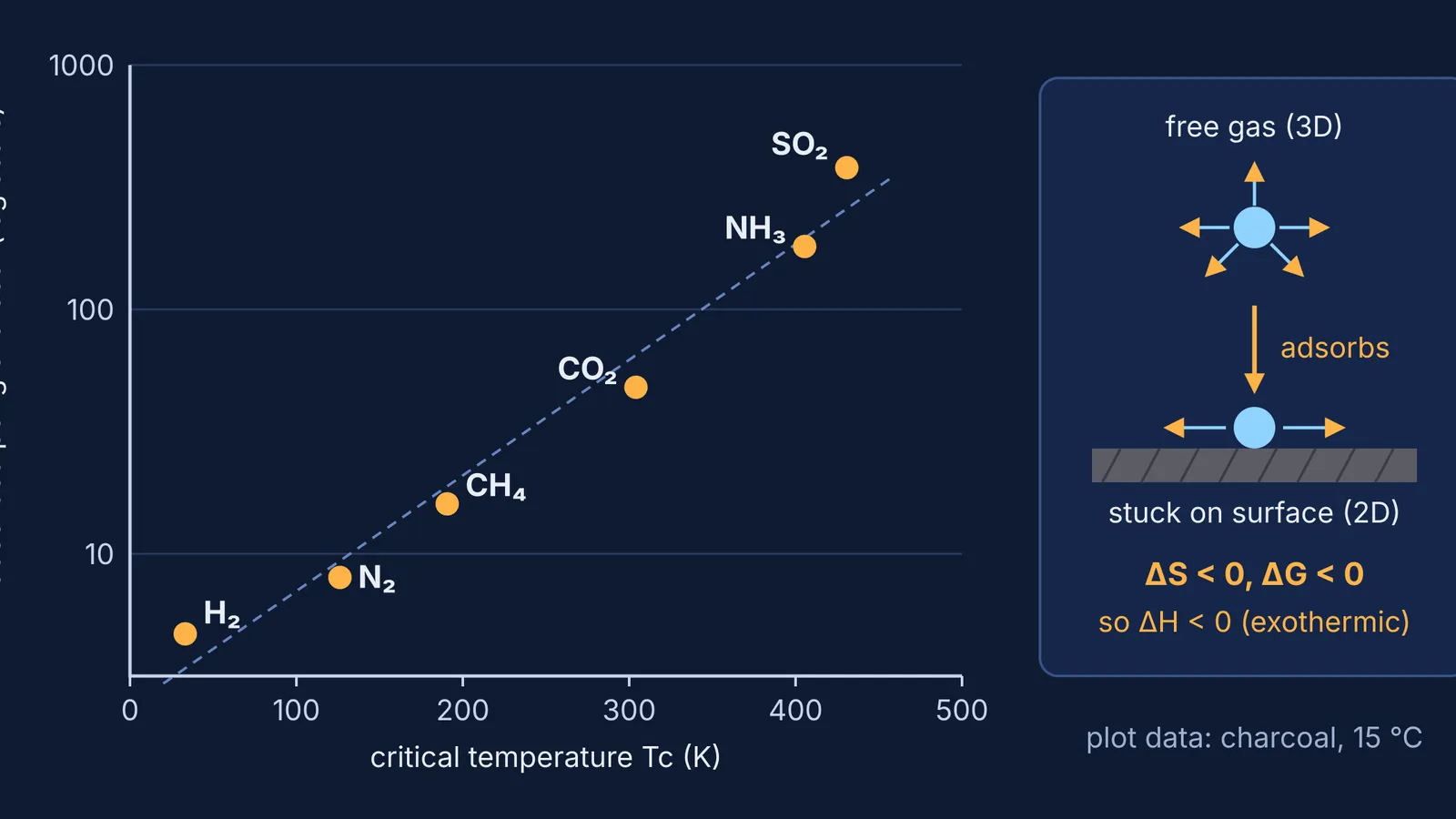
Critical temperatures (standard data, rounded): SO₂ 431 K, NH₃ 406 K, CO₂ 304 K, CH₄ 191 K, N₂ 126 K, H₂ 33 K.
Prediction. Adsorption should fall in the same order: SO₂ > NH₃ > CO₂ > CH₄ > N₂ > H₂.
Measured values. A classic table reproduced in older physical chemistry textbooks (for example Glasstone's) gives the volume adsorbed by 1 g of charcoal at 15 °C, converted to standard conditions, as about: SO₂ 380 mL, NH₃ 181 mL, CO₂ 48 mL, CH₄ 16 mL, N₂ 8 mL, H₂ 4.7 mL.
Compare. The order matches the prediction exactly.
Size of the effect. SO₂ versus H₂ is 380/4.7 ≈ 81 times. The volumes span two orders of magnitude, so they look roughly linear only when you plot log(volume) against Tc, as in the diagram above.
These are old measurements on one charcoal sample. A different charcoal gives different numbers, so learn the ranking, not the exact volumes.
Why is adsorption always exothermic?
NCERT says adsorption is invariably exothermic, and gives a thermodynamic reason you can reproduce in two lines.
A gas molecule moves freely in three dimensions. Once adsorbed, it is confined to a surface. It loses freedom of movement, so the entropy change on adsorption is negative: ΔS < 0.
Adsorption happens on its own, so ΔG = ΔH − TΔS must be negative.
With ΔS negative, the term −TΔS is positive. The only way ΔG can still be negative is if ΔH is negative, and larger in size than TΔS.
So adsorption must release heat. As more gas is adsorbed and the surface fills, ΔH becomes less negative, until ΔH = TΔS and ΔG = 0. At that point adsorption equilibrium is reached. How the amount adsorbed then depends on pressure is the subject of the Freundlich adsorption isotherm.
How negative must ΔH be? A worked example
Suppose a gas is adsorbed on charcoal at 15 °C (288 K) with ΔS = −90 J K⁻¹ mol⁻¹ (an assumed, typical value for a gas losing much of its translational freedom).
Condition for spontaneity. ΔG = ΔH − TΔS < 0, so ΔH < TΔS.
Calculate TΔS. 288 × (−90) = −25 920 J mol⁻¹ = −25.9 kJ mol⁻¹.
Result. ΔH must be more negative than −25.9 kJ mol⁻¹.
Check two values. If ΔH = −20 kJ mol⁻¹, ΔG = −20 + 25.9 = +5.9 kJ mol⁻¹: not spontaneous. If ΔH = −30 kJ mol⁻¹, ΔG = −30 + 25.9 = −4.1 kJ mol⁻¹: spontaneous.
Compare with NCERT. The enthalpy of physisorption is quoted as 20–40 kJ mol⁻¹, so −30 kJ mol⁻¹ is a reasonable value. It is close to the enthalpy of condensation of an easily liquefied gas, which is the same picture as the Tc rule.
The link between the two ideas is now clear. A high-Tc gas releases more heat when it sticks, so its ΔH is more negative, and it can afford the entropy loss at a higher temperature.
To revise the surface chemistry terms used here (adsorbate, adsorbent, isotherm, enthalpy of adsorption) in one place, the Concept Library has an entry for each.
Where is this used?
Gas masks. Activated charcoal adsorbs toxic gases such as Cl₂ and SO₂ well, because they have high critical temperatures. The O₂ and N₂ in air, with low Tc, pass through largely unadsorbed.
Separating noble gases. NCERT mentions separating a noble-gas mixture on coconut charcoal at different temperatures. Their critical temperatures rise from He (about 5 K) to Xe (about 290 K), so the heavier ones are held more strongly and can be released in turn.
High vacuum. Charcoal cooled in liquid nitrogen adsorbs leftover gas from an evacuated vessel. Cooling helps because physisorption increases as temperature falls.
A note on syllabus: surface chemistry is on the JEE Advanced syllabus but has been removed from the JEE Main and NEET syllabi, so check your own exam before investing time here.
Quick checklist
Higher critical temperature means more physisorption at the same temperature and pressure.
Reason: the same van der Waals forces cause both liquefaction and physisorption.
Charcoal at 15 °C: SO₂ > NH₃ > CO₂ > CH₄ > N₂ > H₂, matching Tc.
Use Tc about 431 K for SO₂, whatever value a textbook misprints.
Adsorption: ΔS < 0, ΔG < 0, so ΔH < 0, and |ΔH| > T|ΔS|.
Physisorption enthalpy is about 20–40 kJ mol⁻¹.
The Tc rule does not apply to chemisorption.


