On this page
Squeeze carbon dioxide hard enough at 25 °C and it turns into a liquid. Squeeze hydrogen as hard as you like at the same temperature and it never will. The difference comes down to one number, the critical temperature, and you can estimate it from the two van der Waals constants in your textbook table.
What is the critical temperature of a gas?
The critical temperature (Tc) is the highest temperature at which a gas can be turned into a liquid by pressure alone. Above Tc, no amount of compression produces a separate liquid phase. Below Tc, enough pressure will do it. The idea comes from experiments on carbon dioxide, and you can read how Thomas Andrews found the critical temperature of CO₂ in our history series.
The van der Waals equation predicts the critical point directly from its two constants: Tc = 8a/27Rb, Pc = a/27b² and Vc = 3b. If you need a refresher on where a and b come from, start with our guide to real gases and the van der Waals equation.
Why does Tc = 8a/27Rb tell you how easily a gas liquefies?
Read the formula as a contest between two effects.
a measures how strongly molecules attract each other. Stronger attraction lets the gas condense at a higher temperature, so Tc rises with a.
b measures the volume the molecules themselves take up. It sits on the bottom, so for the same attraction, bigger molecules give a lower Tc.
8/27R is the same for every gas, so Tc is simply proportional to a/b.
That last point is the exam shortcut: to rank gases by how easily they liquefy, compare a/b. The larger ratio means the higher critical temperature.
Worked example: CO₂ vs H₂
The LibreTexts table of van der Waals constants lists CO₂ at a = 3.658 bar L² mol⁻² and b = 0.04286 L mol⁻¹. The same table lists H₂ at a = 0.2453 bar L² mol⁻² and b = 0.02651 L mol⁻¹. Because a is in bar and litres, R must be too: the CODATA value of R is 8.314462618 J mol⁻¹ K⁻¹, and since 1 L bar = 100 J, that is 0.083145 L bar K⁻¹ mol⁻¹.
For carbon dioxide:
Numerator: 8a = 8 × 3.658 = 29.264
Denominator: 27Rb = 27 × 0.083145 × 0.04286 = 0.09622
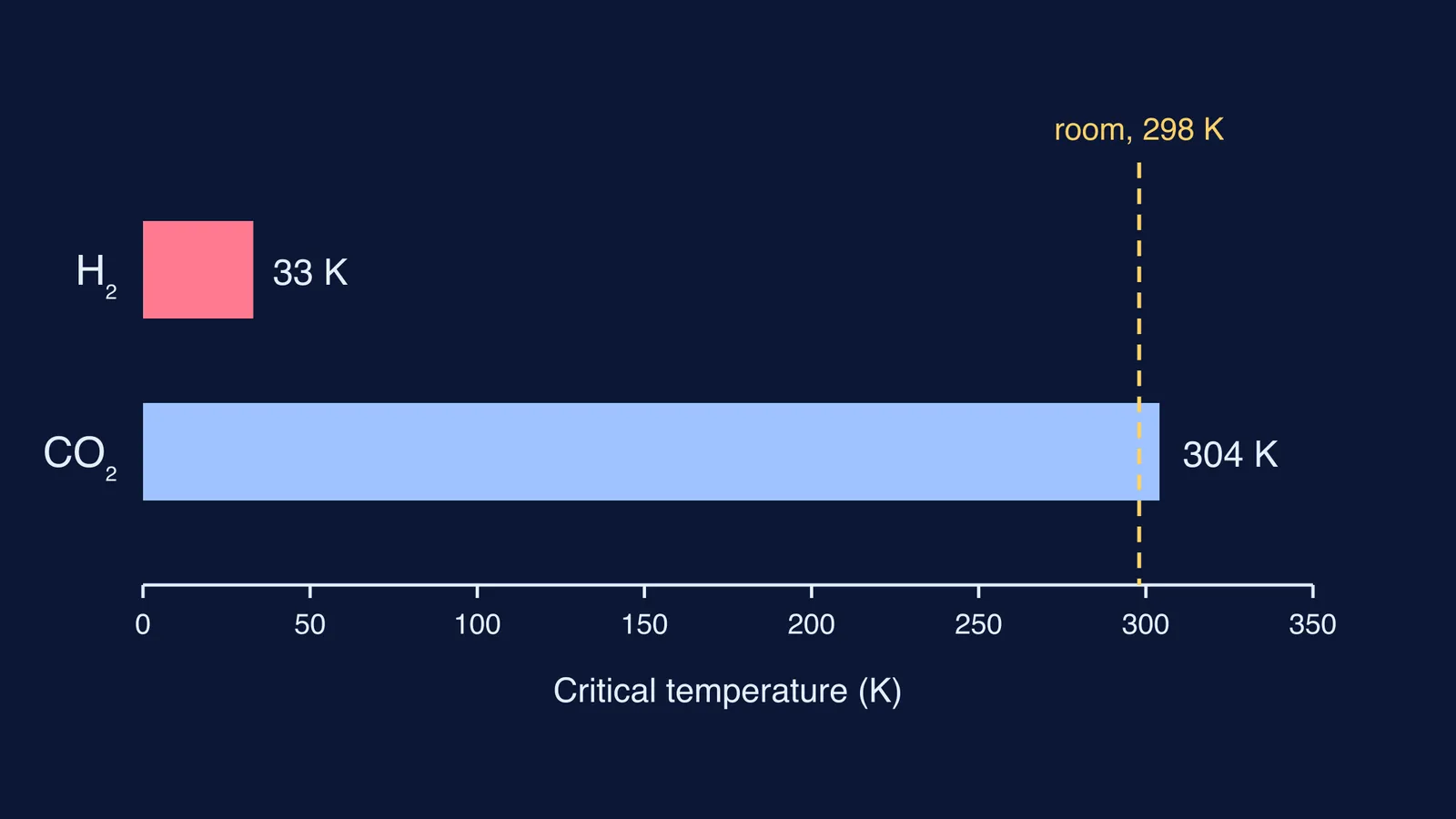
Tc = 29.264 / 0.09622 ≈ 304.1 K, or about 31 °C
For hydrogen:
Numerator: 8a = 8 × 0.2453 = 1.9624
Denominator: 27Rb = 27 × 0.083145 × 0.02651 = 0.05951
Tc = 1.9624 / 0.05951 ≈ 33.0 K, or about −240 °C
The shortcut gives the same verdict faster. a/b for CO₂ is about 85 and for H₂ about 9.3, so CO₂'s critical temperature should be roughly nine times higher, and it is.
How close is the van der Waals answer to real data?
Very close for these two gases. The NIST Chemistry WebBook lists measured critical temperatures including 304.2 K for carbon dioxide and 33.18 K for hydrogen. Our estimates of 304.1 K and 33.0 K are within 1% of both.
The pressure formula holds up too. Pc = a/27b² gives about 73.8 bar for CO₂ and 12.9 bar for H₂, against NIST's 73.825 bar and 13.00 bar on the same pages. Tabulated a and b are often fitted to measured critical data, so treat this as a check on your arithmetic, not proof that the model is exact.
What does this mean for liquefying CO₂ and H₂?
A typical room is around 298 K, below CO₂'s measured 304 K, so at room temperature compression alone turns CO₂ into a liquid. On a hot day above 31 °C, the same compression gives no liquid at all.
Hydrogen must first be cooled below about 33 K before pressure can liquefy it. That makes hydrogen far harder to liquefy, as told in our post on James Dewar and the race to liquid hydrogen.
A quick plan for exam questions on this topic:
Check the units of a and pick the matching R.
If the question only asks which gas liquefies more easily, compare a/b and stop.
If it asks for Tc, compute 8a and 27Rb separately, then divide.
Compare Tc with the stated temperature: below Tc, pressure alone works; above it, cool first.
If you get stuck on the algebra or the units, the Fermi Problem Library has worked problems with a step-by-step solver that explains the reasoning rather than printing an answer. For the ideas underneath, such as intermolecular attraction and the critical point, the Fermi Concept Library gives each concept its own lesson.
For practice, the van der Waals constants data page) lists helium at a = 0.0346 L² bar mol⁻² and b = 0.0238 L mol⁻¹.