

On this page
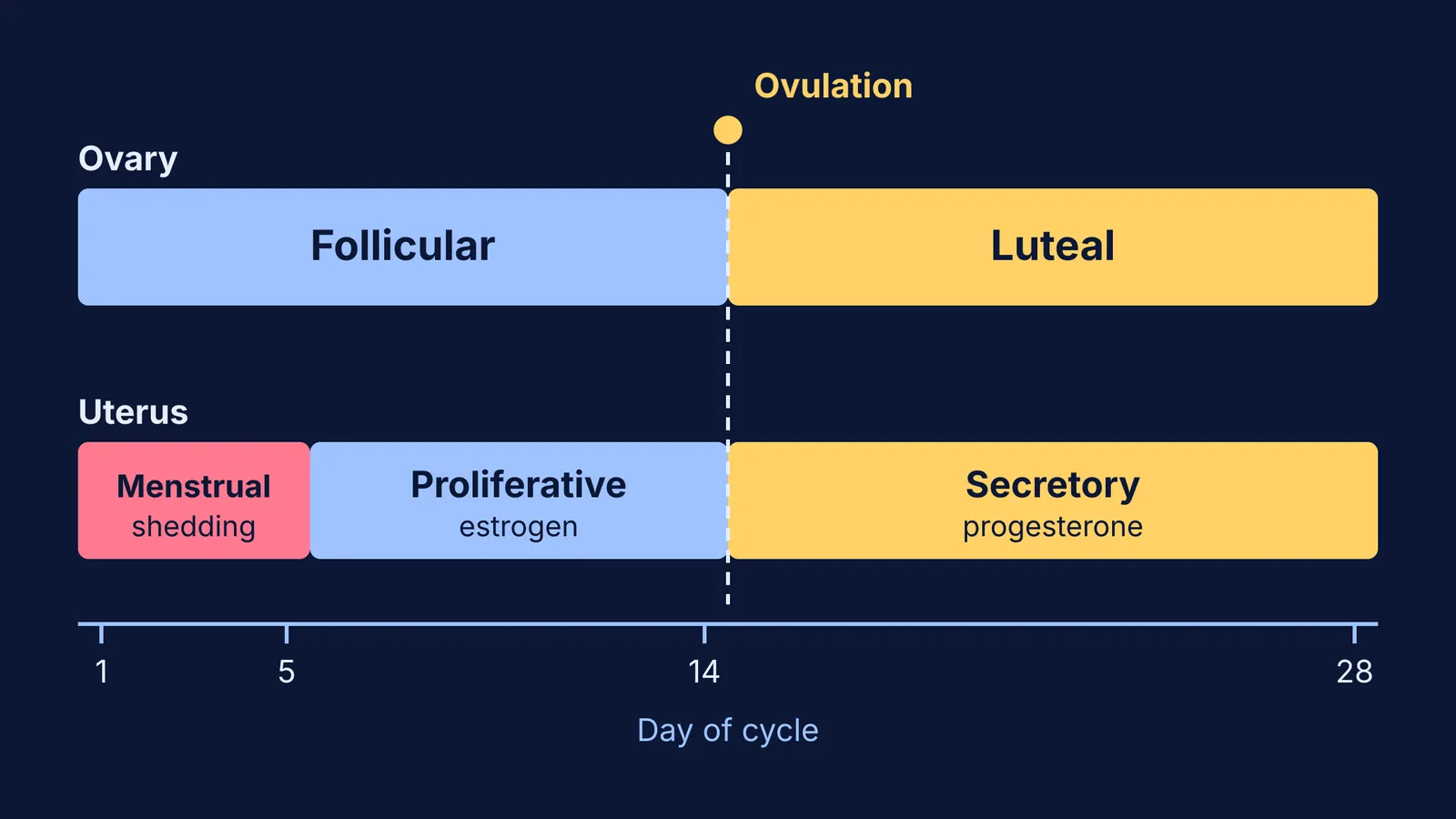
The menstrual cycle trips up many students for one reason: the textbook uses two sets of names for the same 28 days. One set describes the ovary. The other describes the uterus. Once you see them as two rows running side by side, the confusion goes away.
The topic sits in Chapter 2, Human Reproduction, of the NCERT Class 12 Biology textbook. For details we use the open textbook OpenStax Anatomy and Physiology 2e.
What is the difference between the follicular phase and the proliferative phase?
The follicular phase is an ovarian phase: it is named after the follicle that is maturing inside the ovary, and it ends with ovulation. The proliferative phase is a uterine phase: it is named after what the endometrium (the uterine lining) is doing, which is growing back. According to OpenStax, rising estrogen from the developing follicles stimulates the endometrial lining to rebuild.
So the follicle causes the proliferation. That is the link between the two names. OpenStax puts it directly: the hormones that drive the follicular and luteal phases of the ovarian cycle also control the three phases of the menstrual cycle.
How do the ovarian and uterine phases line up day by day?
Here is the two-row chart in list form, for a textbook 28-day cycle. Day 1 is the first day of bleeding; OpenStax says menses averages about five days but can last from 2 to 7 days or longer, and ovulation occurs on day 14 in a typical 28-day cycle.
Days 1 to 5: ovary in the follicular phase (early); uterus in the menstrual phase.
Days 6 to 13: ovary in the follicular phase; uterus in the proliferative phase.
Day 14: ovary releases the oocyte after the LH surge (ovulation); uterus at the end of the proliferative phase.
Days 15 to 28: ovary in the luteal phase; uterus in the secretory phase.
Notice the mismatch: the ovary has two phases, the uterus three. Menstruation sits inside the follicular phase, and most trap questions test exactly that.
In the second half, OpenStax explains that progesterone from the corpus luteum starts the secretory phase. If no pregnancy occurs within about 10 to 12 days, the corpus luteum degrades into the corpus albicans, estrogen and progesterone fall, and the lining thins, which brings on the next period.
Is ovulation always on day 14?
No. Day 14 is the textbook model, and real cycles vary (our guide on how to calculate ovulation day for 28, 30 and 35-day cycles shows the arithmetic). OpenStax notes that cycle length varies, even in the same person from one cycle to the next, typically from 21 to 32 days.
A 2019 study in npj Digital Medicine by Bull and colleagues analysed 612,613 ovulatory cycles from 124,648 app users and found a mean cycle length of 29.3 days. In that study, the mean follicular phase was 16.9 days (reported 95% interval 10 to 30) and the mean luteal phase was 12.4 days (95% interval 7 to 17). In that data the follicular phase, and with it the proliferative phase, varied far more than the luteal phase.
For exams, stick to the 28-day model unless a question gives you a different cycle length. For anything about your own cycle, a doctor or gynaecologist is the right person to ask.
Can you beat these five trap MCQs?
In a 28-day cycle, on day 9 the ovary and uterus are in: (a) luteal and secretory (b) follicular and proliferative (c) follicular and secretory (d) luteal and proliferative.
Menstruation occurs during which ovarian phase? (a) luteal (b) ovulatory (c) follicular (d) none, the ovary is inactive during menses.
The proliferative phase is mainly driven by: (a) progesterone (b) estrogen (c) LH (d) hCG.
The secretory phase depends on progesterone secreted by: (a) the Graafian follicle (b) the corpus luteum (c) the endometrium (d) the anterior pituitary.
A student's cycle is 33 days long. Which phase most likely accounts for the extra days? (a) luteal (b) secretory (c) follicular and proliferative (d) menstrual.
Answers:
1 (b). Day 9 is after menses and before ovulation.
2 (c). The trap is (d): the follicle is already growing while the lining sheds.
3 (b). Estrogen comes from the growing follicles; progesterone is a second-half hormone.
4 (b). The corpus luteum is the ruptured follicle after ovulation.
5 (c). In the Bull study above, the follicular phase varied far more than the luteal phase.
If you got question 2 wrong, rewrite the day-by-day list from memory once a day for three days. Then try our list of mistakes in human reproduction for NEET, and read whether ovaries take turns ovulating to see what ultrasound studies show.
When a term keeps slipping, the Fermi Concept Library gives every biology concept its own lesson and its place in the map. For questions you keep getting wrong, the Fermi Problem Library has worked problems with a step-by-step solver that explains the reasoning rather than printing an answer.


