

On this page
Neither the flying lizard nor the flying squirrel can fly the way a crow or a fruit bat does. They glide: they jump, spread a sheet of skin, and turn a fall into a long, steerable slope.
Can a flying lizard really fly?
No. The flying lizard, genus *Draco*, glides on a wing-like skin membrane (the patagium) held out by long ribs. A 2017 PLOS ONE study by J. Maximilian Dehling describes the membranes as "supported by elongated thoracic ribs", five to seven of them.
The study was done in India. Dehling watched Dussumier's flying lizard (*Draco dussumieri*) in areca nut and coconut plantations near Agumbe and Hebri in Karnataka, observing about 500 glides by at least 26 lizards. The longest glides covered about 26 m horizontally, the shortest only 2.2 m, and top speed was about 6.8 m/s.
The surprise was the hands. In the air, the lizard grips the front edge of its rib-wing with its forelimbs, forming what Dehling calls a composite wing, and the study suggests it controls the wing by moving them. The study describes gliding, not flapping.
How does a flying squirrel glide?
A flying squirrel's patagium is skin "draping between their lower limbs and the long cartilage rods that extend from their wrists", according to a 2018 eLife paper on the oldest flying-squirrel skeleton. That wrist rod, the styliform cartilage, supports the membrane in all flying squirrels, and the paper counts 52 species in 15 genera.
In a 2006 Journal of Experimental Biology study, Kristin Bishop filmed two southern flying squirrels gliding indoors. Their glide paths fell at 40.4° to 57.4° below horizontal, at angles of attack of 35.4° to 53.5°. Changes in body pitch went with limb movements, a sign that the squirrels actively control the glide.
What is the difference between gliding and powered flight?
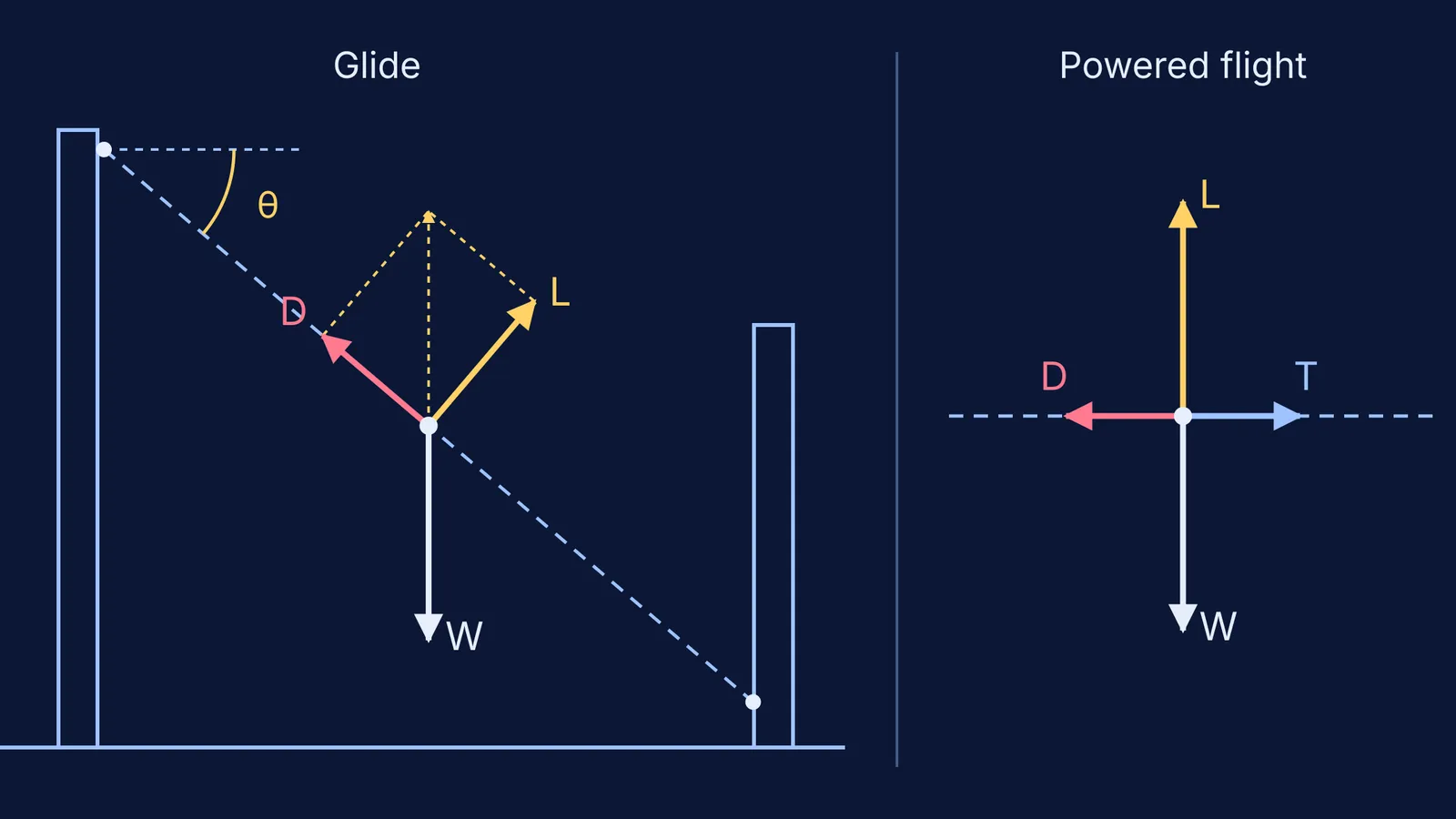
The difference is where the energy comes from. Three forces act on a glider: weight (W) pulls down, drag (D) acts backwards along the path, and lift (L) acts at right angles to the path. In a steady glide, lift and drag together exactly cancel weight. There is no thrust, so the glider trades height for distance, and the glide angle θ follows from tan θ = D/L.
A powered flier adds a fourth force. A flapping wing pushes air backwards and gets thrust (T) forwards, so a bird or bat can fly level, climb, or take off from the ground.
How far can a flying squirrel glide from 4 m?
In one of the two setups in Bishop's study, the launch perch was 4 m above the base of the landing pole. Suppose a squirrel held one glide angle down that drop.
Shallowest measured glide angle: θ = 40.4°, so tan θ = 0.851.
Horizontal distance = height ÷ tan θ = 4 ÷ 0.851 ≈ 4.7 m.
Steepest measured glide angle: θ = 57.4°, so tan θ = 1.564 and distance = 4 ÷ 1.564 ≈ 2.6 m.
This is a simplified model: Bishop found most filmed squirrels were still speeding up, not gliding steadily, and their glides were steeper than in other gliders, probably because they launched from too low to reach their shallowest glide.
For more glide-angle and force-balance questions, the Fermi Problem Library has a step-by-step solver that explains the reasoning rather than printing an answer.
Why are bats and birds the only living vertebrates that truly fly?
Powered flight is rare. A 1985 Palaeontology review by Kevin Padian states that flapping flight "has evolved in only three groups of vertebrates: pterosaurs (late Triassic), birds (late Jurassic), and bats (early Tertiary)". Pterosaurs are extinct, leaving birds and bats.
Gliding keeps turning up instead. A 2007 Annual Review by Robert Dudley and colleagues counts more than 30 independent lineages of tree-living vertebrate gliders, and discusses the idea that flapping flight grew out of jumping, controlled falling and then gliding.
Bats are the only mammals capable of powered flight, says a 2020 Mammal Review paper, with over 1400 living species, about a quarter of all mammals. Your NCERT Class 11 Animal Kingdom chapter lists *Pteropus* (flying fox), a bat, as a mammal example. Read why flying foxes don't use echolocation.
Glider or flier? A four-question checklist
Use this for any animal called "flying" in a textbook or quiz:
Can it gain height in still air by its own effort? Fliers yes, gliders no.
Can it take off from flat ground? Most fliers can; gliders need a tree or a drop.
Does its wing move to push air backwards? Flapping makes thrust; a stretched skin flap does not.
Is its path always downhill? Then it is gliding, whatever the name says.
The same balance keeps an engineless aircraft up: see how a glider flies without an engine, and for the opposite extreme, how hummingbirds hover. To revise lift, drag or vertebrate classes, the Fermi Concept Library gives each concept in physics and biology its own lesson.


