

On this page
In the forests of the Western Ghats, a small lizard runs up a tree trunk, jumps, and opens a pair of wings that were folded flat against its body a moment earlier. It sails to the next tree and lands head-up, ready to climb again. That is the Indian flying lizard, Draco dussumieri, and its wings are made of ribs, not arms. Below: how the wing works, how far it goes, and a worked example in Class 11 physics.
How does the flying lizard Draco glide?
Draco dussumieri lives in the Western Ghats and some Eastern Ghats forests of peninsular India, and its range stops in the north at the Goa gap, according to a 2025 genetic study in Molecular Ecology.
Its wing is a patagium, a fold of skin supported by five to seven greatly elongated thoracic ribs that are spread by specialised iliocostalis and intercostal muscles, as described by J. Maximilian Dehling in PLOS ONE (2017).
Dehling watched about 500 glides by at least 20 males and 6 females near Agumbe and Hebri in Karnataka. He found that once airborne, the lizard grips the front edge of the patagium with its front feet, making a composite wing of ribs, skin and forelimbs. Putting the wing together took 167 to 460 milliseconds after take-off. The sequence looks like this:
Jump from the trunk at about 2 m/s.
Swing the long ribs outwards to open the skin wing.
Grip the wing's leading edge with the claws of the front feet.
Glide, with the hands holding the wing's edge; placing one hand slightly before the other makes the lizard swerve.
Just before landing, let go of the wing and reach for the bark.
How far can a flying lizard glide?
In Dehling's observations, the longest glides covered a horizontal distance of about 26 m and the shortest only 2.2 m, to the next tree (PLOS ONE). The top speed recorded was about 6.8 m/s, of which 5.8 m/s was horizontal.
Pranav Khandelwal and Tyson Hedrick of the University of North Carolina at Chapel Hill tracked short and long glides in a wild population in 3D and split each one into three phases: a ballistic take-off dive, the glide and the landing (SICB abstract, 2017). Glide distance rose in a straight line with height lost. In long glides the take-off dive was faster and steeper and the top speed higher, which suggests the lizard chooses a short or long glide before or just after take-off.
How is gliding different from true flight?
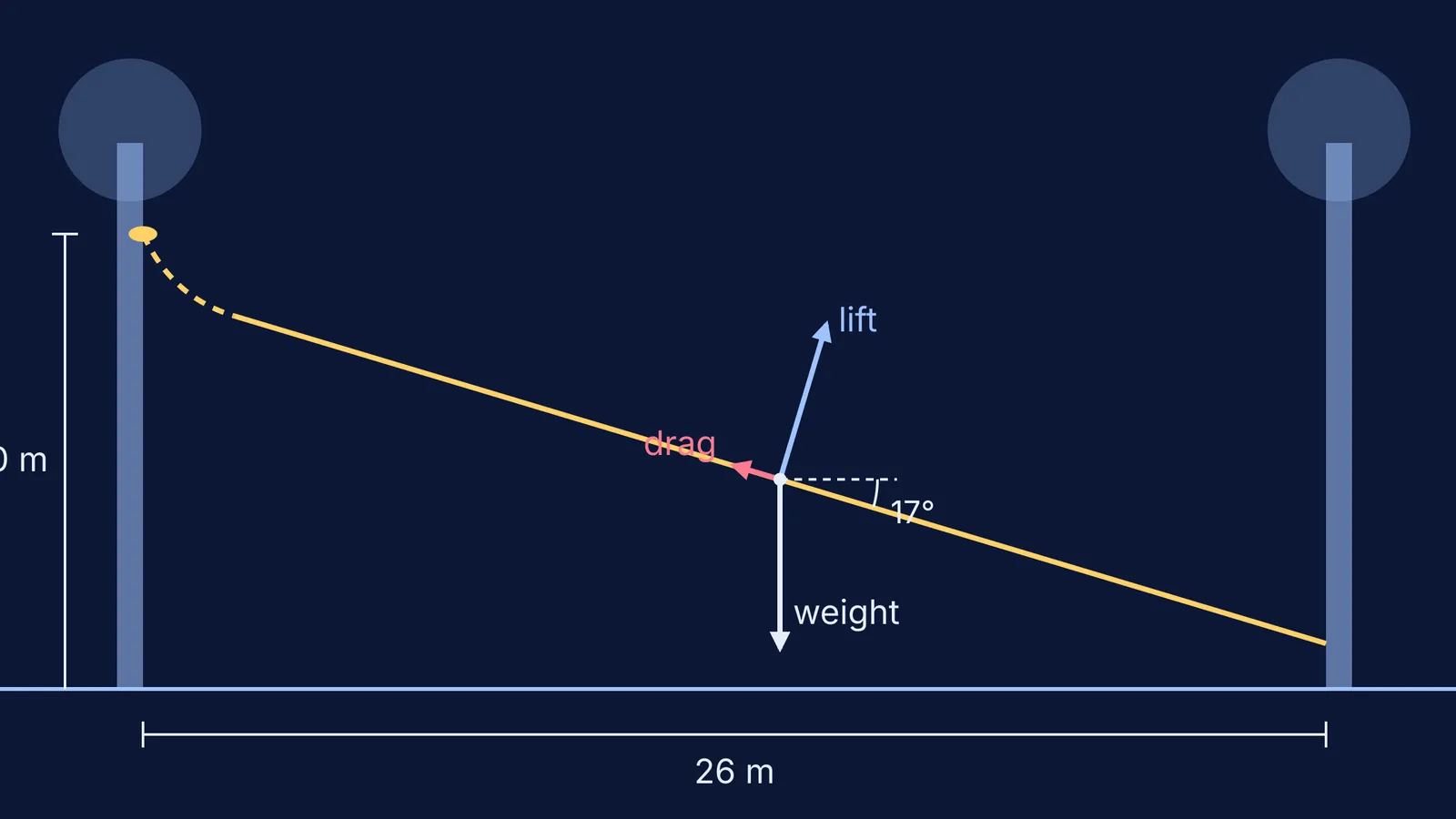
A glider has no engine. In a steady glide, lift (at right angles to the path) and drag (opposite to the path) together exactly balance the weight. So in still air a glider always loses height, and the glide ratio, horizontal distance divided by height lost, equals lift divided by drag.
True flight is different because flapping wings also push the animal forward, so a bird or bat can gain height and stay up. A review by Robert Dudley and colleagues counted more than 30 independent lineages of tree-living vertebrate gliders and discussed the idea that flapping flight evolved in trees in stages, from jumping through controlled gliding to powered flight (Annual Review of Ecology, Evolution, and Systematics, 2007). Draco is a glider in that sense: it can steer, but it cannot climb in the air. For the aircraft version, see how a glider flies without an engine.
Worked example: how far could Draco glide from 10 m up?
Computer simulations of a related species, Draco volans, by Valentin Buffa and colleagues gave a maximum lift-to-drag ratio of 3.34 in the standard gliding posture and 3.73 with the body slightly arched (Bioinspiration and Biomimetics, 2024).
Glide angle: tan θ = drag/lift = 1/3.34, so θ is about 16.7° below horizontal.
Best-case distance from 10 m: 10 × 3.34 is about 33 m.
Arched posture: 10 × 3.73 is about 37 m.
Reality check from the field speed in Dehling's study: if the total speed is 6.8 m/s and the horizontal part is 5.8 m/s, the vertical part is √(6.8² − 5.8²), about 3.5 m/s. The path at that moment was about 31° below horizontal, much steeper than 17°.
Real glides begin with a ballistic dive that loses height before the wing works at its best, so the longest field glide, about 26 m, falls short of the best case, which also comes from a different species.
What should you remember for biology and physics?
Patagium: skin on five to seven elongated ribs, gripped by the forelimbs in the air (Dehling, 2017).
Steady glide: distance = height × (lift/drag); then ask what the ideal model leaves out, such as the take-off dive or wind.
True flight: flapping adds thrust, so height can be gained.
Force balance is easier to see than to read: the Fermi Simulation Lab has interactive simulations for ideas like this, and the Fermi Concept Library has a lesson on each concept if lift and drag are hazy.
For more reptile biology, read how house lizards walk on ceilings and why lizards bask in the sun.


