

On this page
The lizard on your kitchen wall at night is almost certainly a gecko. The common house gecko, *Hemidactylus frenatus*, comes from Asia (India included), lives on buildings near electric lights, and uses adhesive toe pads to climb walls and ceilings, according to the Animal Diversity Web species account. Its grip comes from the weak pull between molecules that you meet in chemistry as van der Waals forces.
How do house lizards walk upside down on ceilings?
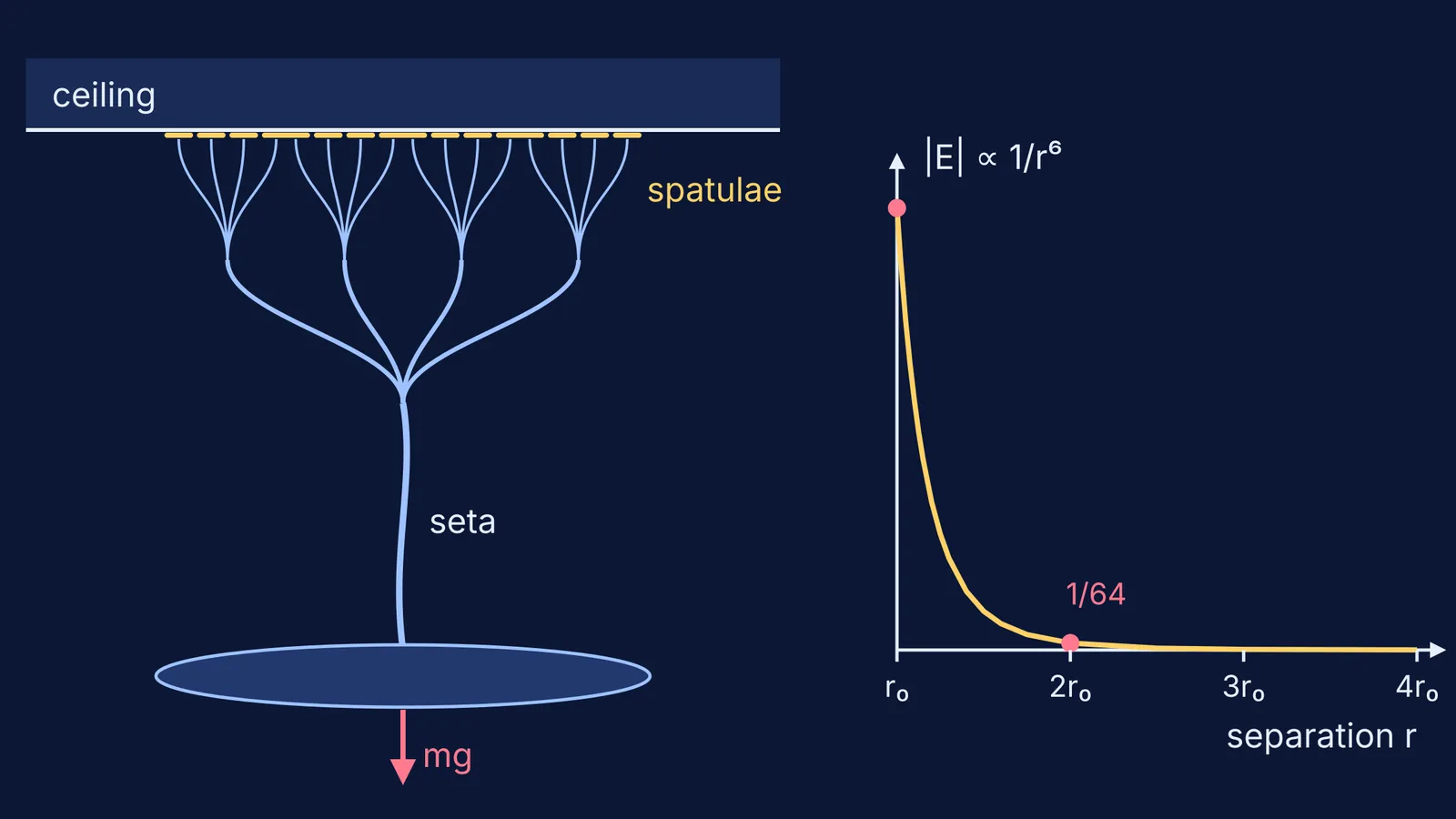
By making a huge number of very close contacts at once. A gecko's foot has nearly five hundred thousand keratin hairs called setae, each 30 to 130 micrometres long and about one-tenth the width of a human hair, according to Autumn and colleagues in Nature (2000). Each seta splits into hundreds of branches that end in flat, spatula-shaped tips 0.2 to 0.5 micrometres across. That study measured the force of a single seta for the first time and found it was ten times more effective at sticking than maximal estimates from whole animals had predicted.
Multiply the numbers and one foot has tens to hundreds of millions of tips, each small enough to lie almost flat against paint or glass.
Is it a water film or van der Waals forces?
In 2002, Autumn and colleagues in PNAS published the first direct experimental evidence that gecko setae stick by van der Waals forces. The key results:
If a thin film of water were doing the sticking (capillary adhesion), the toe would need a water-loving surface to grip.
Instead, the toes of live Tokay geckos were strongly water-repelling, and they stuck equally well to strongly hydrophobic and strongly hydrophilic surfaces.
A single isolated seta also stuck equally well to both kinds of surface on a tiny force sensor.
Artificial tips made from two different materials stuck as predicted, showing that the size and shape of the tips matter more than their chemistry.
The London dispersion energy between two molecules follows E = -kα₁α₂/r⁶, where α is polarisability and r is the distance between them, as set out in this LibreTexts chapter on non-polar molecules/Text/11:_Intermolecular_Forces_and_Liquids/11.4:__NonPolar_Molecules_and_IMF). Dispersion forces act between all molecules, even ones with no permanent dipole, such as iodine, as this LibreTexts page on London dispersion forces/Phases_and_Intermolecular_Forces/London_Dispersion_Forces) explains.
For a pair of molecules, double the distance and this attraction energy drops to 1/64 of its value. That is why the tips must be tiny and flat: only surfaces in near-perfect contact feel the pull. You can read how Fritz London explained these forces in our post on London dispersion forces between non-polar molecules.
How much weight can one gecko hair hold?
On a Tokay gecko, setae sit at a density of 14,400 per square millimetre, and a single seta can generate up to 200 micronewtons of force, according to Hansen and Autumn in PNAS (2005). Together, the paper notes, they can support many times the animal's body weight.
A worked estimate:
A house gecko weighs about 3.2 g, the average for six *Hemidactylus frenatus* in a 2023 climbing study. Its weight is mg = 0.0032 kg × 9.8 m/s² ≈ 0.031 N.
One seta at full grip holds 200 μN = 0.0002 N. Setae needed = 0.031 ÷ 0.0002 ≈ 160.
At 14,400 setae per mm², 160 setae cover about 160 ÷ 14,400 ≈ 0.011 mm², roughly one-hundredth of a square millimetre.
The hair numbers come from the larger Tokay gecko, the estimate treats the 200 μN maximum as if it acted straight down, and real toes never grip with every seta at maximum, so treat this as an order-of-magnitude answer. Even so, the gap between "160 hairs needed" and "hundreds of thousands available" shows how large the safety margin is.
How does a gecko let go?
The 2000 Nature study found that setae detach once they are tilted beyond a critical angle to the surface, so the gecko uncurls and peels its toes off, a little like removing tape. The same study found that the right orientation and a small push into the surface raised the attachment force 600-fold above frictional measurements of the same material. Geckos also keep their feet clean: in the 2005 Hansen and Autumn study, geckos with dirty feet recovered their ability to cling to vertical surfaces after only a few steps.
Where does this fit in Class 11 chemistry?
In the CBSE 2026-27 chemistry curriculum, Class 11 Unit 4 (Chemical Bonding and Molecular Structure) ends with hydrogen bonding, and the gaseous state, including deviations from the ideal gas equation, is taught but assessed only formatively. Our guide to hydrogen bonding and boiling points covers the stronger cousin.
A four-question self-check:
Name the force that holds a gecko to a ceiling.
Why does the grip work on water-loving and water-repelling surfaces alike?
If the distance between two molecules triples, by what factor does their dispersion energy fall? (Answer: 3⁶ = 729.)
How is this different from a hydrogen bond?
If the 1/r⁶ curve feels abstract, the Fermi Simulation Lab has interactive simulations for ideas that are easier to see than to read.


