

On this page
A flying fish looks like a small silver bird leaving the sea. It is really a fish with very large fins that taxis on its tail and then glides, and NCERT still puts *Exocoetus* among the bony fishes.
How does a flying fish take off from the water?
Detailed measurements come from a 2010 wind-tunnel study by Hyungmin Park and Haecheon Choi in the Journal of Experimental Biology. Its introduction pulls together earlier field observations into one sequence:
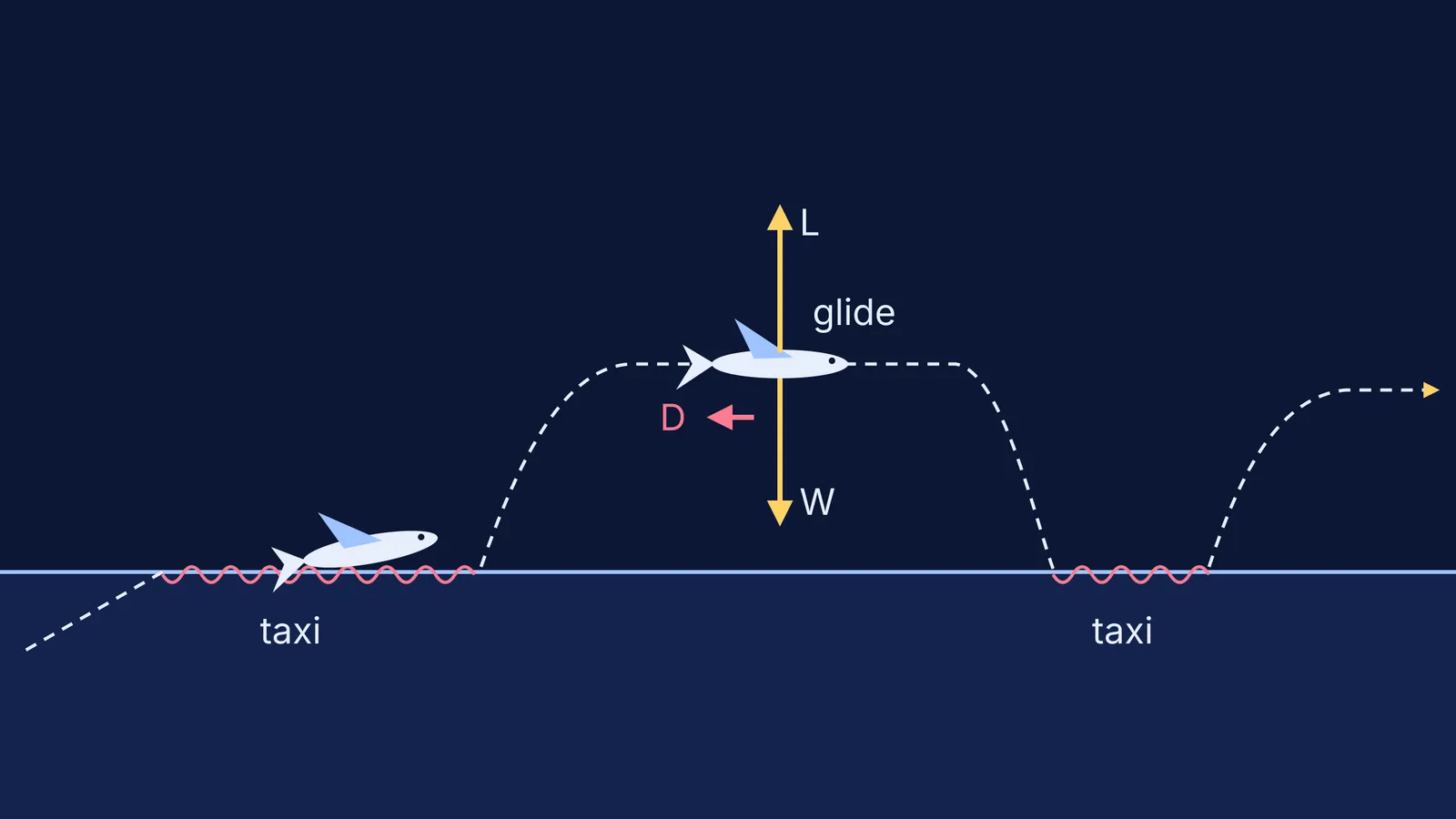
The fish leaves the sea at about 30 degrees to the surface.
It holds its pectoral fins stretched out while the lower lobe of its tail fin stays in the water.
It beats that tail in the water to speed up. This is called taxiing.
Once it is moving fast enough, it lifts off and glides.
When the glide slows, it can dip its tail back in, taxi again and start another glide.
A 2021 study in Current Biology describes the flying fish's tail fin as having a stiffened, elongated lower lobe. It helps the fish take off, and lets some species gain extra speed without fully going back into the water.
Do flying fish flap their fins?
No. The same Current Biology paper describes the enlarged pectoral fins as airfoils the fish uses to glide away from predators in the water. The push comes from the tail; in the air, the fins stay spread like a glider's wings.
Park and Choi measured how well those fixed wings work. They put models of the darkedged-wing flying fish (*Cypselurus hiraii*), fins spread, in a wind tunnel and measured the forces on them (Park and Choi, 2010):
Their gliding performance is comparable to the wings of a hawk, a petrel or a wood duck.
The pectoral fins have an aspect ratio of 9.0 to 10.7, comparable to birds' wings.
The lift-to-drag ratio was highest at attack angles of about −5 to 0 degrees, with the body nearly parallel to the sea.
Flying close to the surface (ground effect) cut drag and raised the lift-to-drag ratio.
From earlier observations, the paper reports glides covering as much as 400 m in total in 30 s, with maximum speeds of about 10 to 20 m/s.
One detail matters for *Exocoetus*. The paper separates "four-wingers" like *Cypselurus*, which have large pectoral and pelvic fins, from "two-wingers", where only the pectoral fins are enlarged, and its example of a two-winger is *Exocoetus*. Models with the pelvic fins folded away produced less lift.
Worked example: how far does one glide go?
Assume the fish holds its height, so lift roughly equals weight. Take a round, illustrative lift-to-drag ratio of 3; Park and Choi give their measured values only as a graph.
Drag = weight ÷ 3, so the fish slows down at about g ÷ 3 = 9.8 ÷ 3 ≈ 3.3 m/s².
Start at 15 m/s, in the middle of the 10 to 20 m/s maximum speeds reported by Park and Choi.
Distance before it slows to 10 m/s: s = (15² − 10²) ÷ (2 × 3.3) = 125 ÷ 6.6 ≈ 19 m.
Time: (15 − 10) ÷ 3.3 ≈ 1.5 s.
So on this estimate one glide covers tens of metres, not hundreds. A 400 m flight in 30 s averages about 13 m/s, which fits a fish that keeps taxiing to top up its speed. Compare how a glider flies without an engine.
If a step like "drag = weight ÷ 3" is where you get stuck, the Fermi Problem Library has worked problems with a step-by-step solver that explains the reasoning rather than printing an answer.
Why does NCERT still list Exocoetus as a bony fish?
Animals are classified by their body plan, not by what they can do. NCERT's Class 11 Biology chapter on the Animal Kingdom splits jawed vertebrates into Pisces (bear fins) and Tetrapoda (bear limbs). Its first example in section 4.2.11.3, Class Osteichthyes, is "Marine – *Exocoetus* (Flying fish)". The features it lists there:
a bony endoskeleton and a streamlined body
four pairs of gills, covered by an operculum on each side
cycloid or ctenoid scales
an air bladder that regulates buoyancy
a two-chambered heart; cold-blooded
A flying fish has all of these. Its wings are really pectoral fins. In birds, NCERT says the forelimbs are modified into wings, and birds have feathers. For the same reason, a bat is a mammal and not a bird.
Quick self-check before a NEET mock:
Class of *Exocoetus*? Osteichthyes (marine).
Gill cover? Yes, an operculum.
Does it fly? It glides on pectoral fins, with speed from tail taxiing.
Buoyancy organ? An air bladder.
For more on how the two fish classes differ, see cartilaginous and bony fish compared. If classification still feels like a list to memorise, the Fermi Concept Library gives each concept its own lesson and its place in the map.


