

On this page
Every school method for measuring a specific heat fights the same enemy: heat leaking away to the room while you take readings. In the method of mixtures you try to keep it small and hope. Around 1900, H. L. Callendar and H. T. Barnes found a way to cancel it instead. They let water flow steadily past an electric heater, waited until nothing changed, and then ran the experiment a second time at a different flow rate with the same temperature rise. Subtracting the two runs removes the heat loss exactly, whatever its size.
What is a continuous-flow calorimeter?
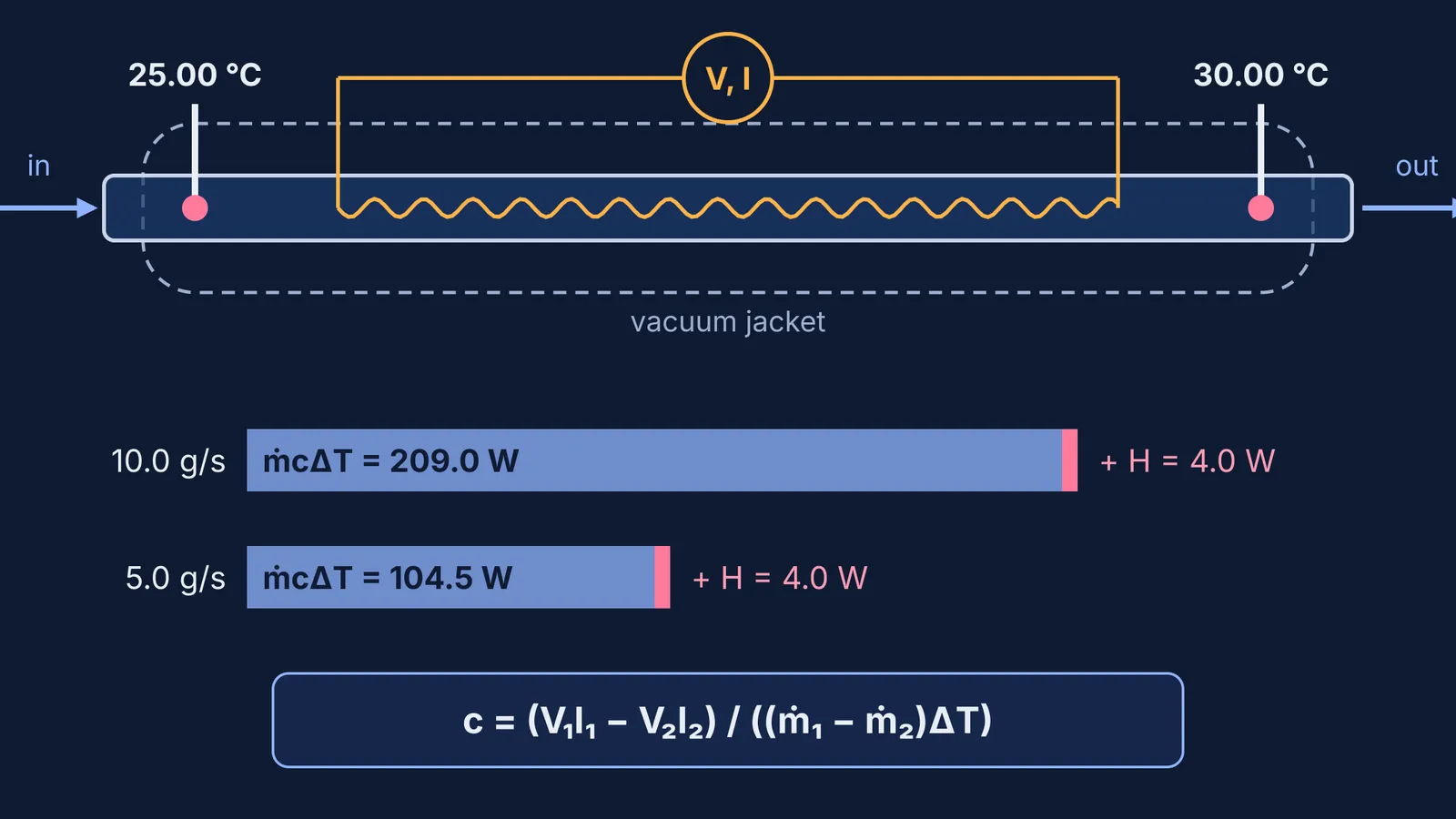
Water flows at a steady rate through a narrow glass tube. A heating wire runs along the axis of the tube, carrying a current I at a voltage V. Thermometers at the inlet and outlet read the water's temperature before and after it is heated. In Callendar and Barnes's apparatus the tube sat inside a sealed glass vacuum jacket to cut losses, and the temperature rise was read with a matched pair of platinum resistance thermometers. The 1911 Encyclopaedia Britannica article on calorimetry describes the apparatus and their results.
You measure the flow rate ṁ by collecting the water that comes out over a timed interval and weighing it. For example, 600 g collected in 60.0 s means ṁ = 10.0 g/s.
What happens to the heater's power in steady state?
When you first switch on, the tube, the wire and the thermometers all warm up. After a few minutes every temperature stops changing. That is the steady state, and every reading is taken there.
In steady state nothing is storing heat any more, so all the electrical power has somewhere to go each second:
VI = ṁcΔT + H
ṁcΔT is the heat carried away by the water, warmed by ΔT as it passes.
H is the heat lost to the surroundings each second, through the jacket and along the ends.
Two things have dropped out compared with the method of mixtures. There is no cooling correction to estimate from a cooling curve, and there is no heat capacity of the calorimeter, because nothing in the apparatus is changing temperature while you read. The method of mixtures needs both of those corrections. The price is that H is still unknown, and one run alone cannot give it.
How do two runs cancel the heat loss?
H depends on the temperatures of the tube and its surroundings. If the inlet temperature, the outlet temperature and the room stay the same, the temperature along the tube is the same too, so H is the same.
So do a second run with a different flow rate ṁ₂, and adjust the heater until the outlet temperature is back where it was. Now:
Run 1: V₁I₁ = ṁ₁cΔT + H
Run 2: V₂I₂ = ṁ₂cΔT + H
Subtract, and H vanishes:
c = (V₁I₁ − V₂I₂) / ((ṁ₁ − ṁ₂)ΔT)
This is the same idea as the Carey Foster bridge, where swapping two resistors cancels an unknown end error. You do not need to know the error. You arrange two readings in which it is identical and subtract.
Worked example: two runs at the same temperature rise
Water enters at 25.00 °C and leaves at 30.00 °C, so ΔT = 5.00 K. The heater wire has a resistance of 10.0 Ω. The readings below are illustrative, built with c = 4180 J/kg K, close to the measured value of about 4.18 kJ/kg K for water between 25 and 30 °C listed in the Engineering Toolbox water specific heat table, and a heat loss of 4.0 W.
Run 1. Flow ṁ₁ = 10.0 g/s = 0.0100 kg/s. Heat to water = 0.0100 × 4180 × 5.00 = 209.0 W. Heater power needed = 209.0 + 4.0 = 213.0 W. With 10.0 Ω, V = √(PR) = 46.2 V and I = √(P/R) = 4.62 A.
Run 2. Flow ṁ₂ = 5.0 g/s = 0.0050 kg/s. Heat to water = 104.5 W. Heater power = 108.5 W, which needs 32.9 V at 3.29 A.
Subtract. V₁I₁ − V₂I₂ = 213.0 − 108.5 = 104.5 W.
Divide. (ṁ₁ − ṁ₂)ΔT = 0.0050 × 5.00 = 0.025 kg K/s. So c = 104.5/0.025 = 4180 J/kg K, exactly the value used.
Units check. W/(kg/s × K) = (J/s)/(kg K/s) = J/(kg K).
Now see what happens if you ignore the loss and use one run alone, c = VI/(ṁΔT):
Run 1 gives 213.0/(0.0100 × 5.00) = 4260 J/kg K, 1.9% too high.
Run 2 gives 108.5/(0.0050 × 5.00) = 4340 J/kg K, 3.8% too high.
The slower run is worse, because the same 4 W loss is a bigger share of a smaller power. That is why the two flows should be very different: the larger the gap between ṁ₁ and ṁ₂, the smaller the effect of errors in the subtraction.
Why must the temperature rise be the same in both runs?
The heat loss depends on how hot the tube is compared with its surroundings. If run 2 had a larger ΔT, the tube would be hotter, H would be bigger, and the subtraction would leave part of it behind.
Small mismatches matter. In the example above, if H in run 2 were 4.1 W instead of 4.0 W, the result would come out at 4176 J/kg K instead of 4180, an error of 0.1%. If the measured ΔT were 5.01 K instead of 5.00 K, c would come out at 4172 J/kg K. So the method needs very precise thermometers, which is why Callendar and Barnes used platinum resistance thermometers.
What did the method show about water?
Because it was so precise, the method showed that the specific heat of water is not quite constant. Their results, as summarised in the 1911 Britannica, put a shallow minimum near 38 to 40 °C, with a variation of only about 0.5% between 10 °C and 80 °C. This is why careful tables give c at a stated temperature, and why textbook values range from 4180 to 4200 J/kg K. Joule had earlier measured how much work makes a given temperature rise, in his famous falling-weight experiment; the flow method turned the electrical version of that idea into a precision measurement.
For more calorimetry problems worked step by step, the Fermi Problem Library is a step-by-step solver that explains the reasoning.
Quick checklist
Steady state: VI = ṁcΔT + H, with no calorimeter heat capacity term.
Measure ṁ by weighing the water collected in a timed interval.
Two runs, different flows, same inlet and outlet temperatures, so H is the same.
c = (V₁I₁ − V₂I₂)/((ṁ₁ − ṁ₂)ΔT).
Ignoring H overestimates c, more so at low flow.
Make the two flows very different and measure ΔT precisely.


