

On this page
Almost every window pane is made by pouring molten glass onto a bath of molten tin. The glass floats, spreads out and then stops spreading, all by itself, at a definite thickness. Pilkington, the company that developed the process, gives that natural thickness as 6.8 mm. Nothing presses the glass to that size. It is set by a tug-of-war between gravity, which wants the glass to spread thinner, and surface tension, which pulls the edge back, with Archimedes' principle deciding how deep the sheet sits in the tin.
How does the float glass process work?
In Pilkington's own description of the float process, molten glass at about 1,000 °C is poured continuously onto a shallow bath of molten tin. It floats on the tin, spreads out and forms a level surface. The tin is denser than the glass, so the glass floats on top like oil on water, and because both surfaces are liquid, the sheet ends up flat and smooth without any polishing. The ribbon cools as it moves along and, in Pilkington's step-by-step account, leaves the bath as a solid ribbon at about 600 °C.
The same step-by-step page says the process went from "a single equilibrium thickness of 6.8 mm" to a range from below a millimetre to 25 mm. So the 6.8 mm comes free; every other thickness takes extra work. How glass itself is made from sand is covered in how glass is made from sand; here we only look at why the floating sheet stops at one thickness.
Why does a floating puddle stop spreading?
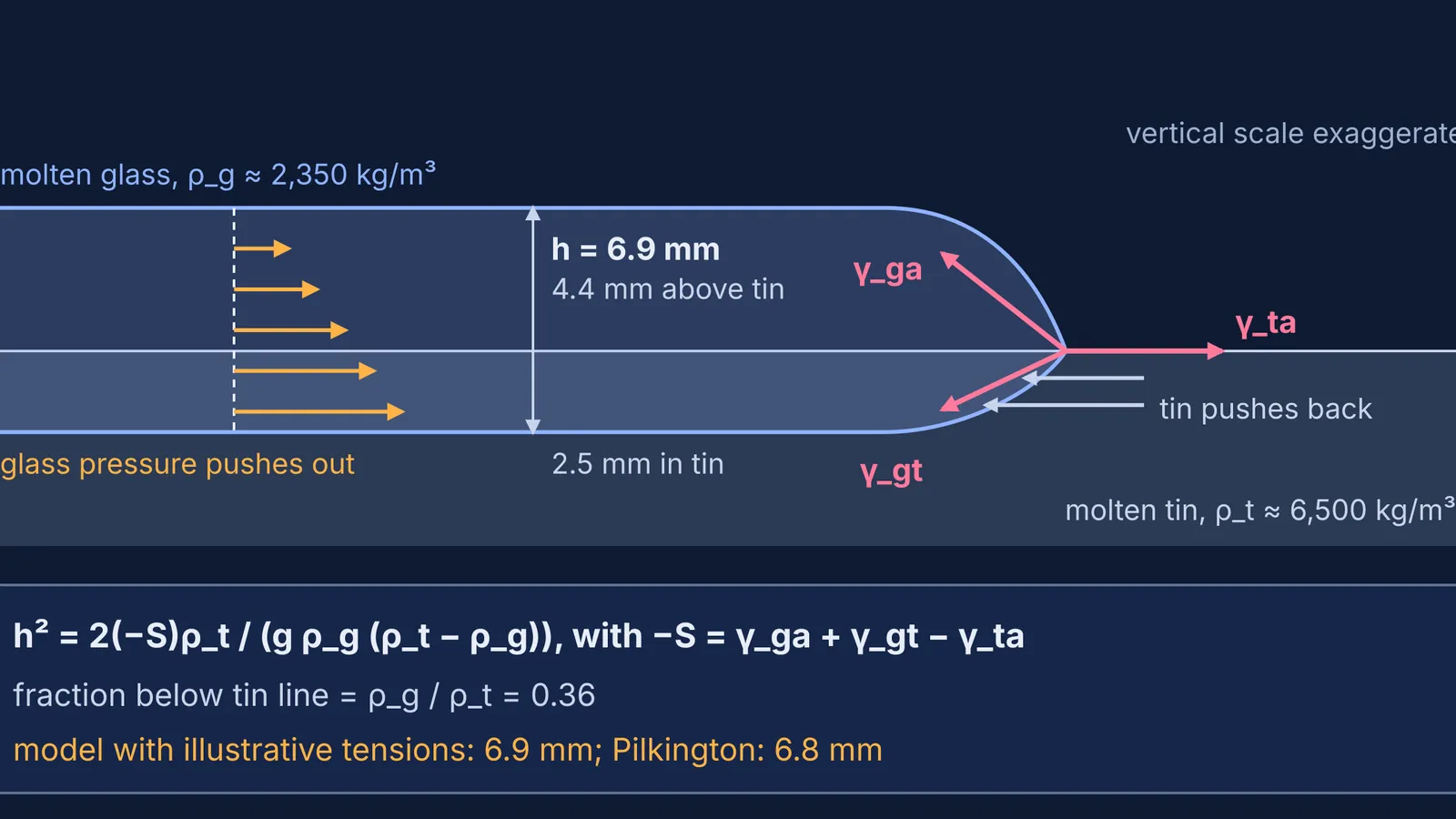
Think about the edge of the sheet. Three surfaces meet there, each with its own surface tension:
glass–air, γ_ga, pulling the edge inward along the top surface,
glass–tin, γ_gt, pulling the edge inward along the bottom surface,
tin–air, γ_ta, pulling the edge outward.
If γ_ta were larger than γ_ga + γ_gt, the glass would spread forever into a thin film. For glass on tin it is not. The shortfall, −S = γ_ga + γ_gt − γ_ta, is a net inward pull per metre of edge. (S is called the spreading coefficient; a negative S means the liquid does not wet the surface completely.)
Gravity pushes the other way. The glass is a liquid layer of height h, so the pressure inside it rises with depth, and that pressure pushes outward on the edge. A thicker sheet pushes harder. The sheet thins and spreads until this outward push exactly balances the inward pull of −S.
What does Archimedes' principle add?
On a solid table, all of the puddle's thickness is above the support. On tin, the glass sinks in until it displaces its own weight of tin. A sheet of thickness h and density ρ_g floating on tin of density ρ_t sits with a depth
d = h × ρ_g/ρ_t
below the tin surface. Now the tin presses back on the submerged part of the edge, cancelling part of the glass's outward push. Per metre of edge:
outward push of the glass: ½ ρ_g g h²
inward push of the tin on the submerged part: ½ ρ_t g d² = ½ ρ_g g h² × (ρ_g/ρ_t)
The net outward push is ½ ρ_g g h² (1 − ρ_g/ρ_t). Setting it equal to −S gives
h² = 2(−S) ρ_t / (g ρ_g (ρ_t − ρ_g))
Check units: (N/m) × (kg/m³) / ((m/s²) × (kg/m³) × (kg/m³)) = N·m·s²/kg = m², so h comes out in metres.
Worked example: how thick is the floating sheet?
Real surface tensions of molten glass and tin depend on the glass recipe, the temperature and the gas above the bath, so the values below are illustrative round numbers of a realistic size, not measured data. Densities are approximate values for the hot liquids.
γ_ga = 0.35 N/m, γ_gt = 0.50 N/m, γ_ta = 0.50 N/m
ρ_g = 2,350 kg/m³, ρ_t = 6,500 kg/m³, g = 9.81 m/s²
−S = 0.35 + 0.50 − 0.50 = 0.35 N/m.
Numerator: 2 × 0.35 × 6,500 = 4,550.
Denominator: 9.81 × 2,350 × (6,500 − 2,350) = 9.81 × 2,350 × 4,150 = 9.567 × 10⁷.
h² = 4,550 / (9.567 × 10⁷) = 4.756 × 10⁻⁵ m².
h = 6.9 × 10⁻³ m = 6.9 mm.
Fraction below the tin line: ρ_g/ρ_t = 2,350/6,500 = 0.36, so d = 0.36 × 6.9 = 2.5 mm sits in the tin and 4.4 mm stands above it.
With these values the model gives 6.9 mm, close to Pilkington's 6.8 mm. Treat that closeness as a check on the size of the effect, not as a measurement, because the surface tensions were chosen, not measured.
For the solid-surface version, written with a contact angle instead of −S, see why a big puddle on a non-stick pan is about 4.5 mm deep. The two results match when −S = σ(1 − cos θ), which is Young's equation in disguise.
How do factories make glass thinner or thicker than 6.8 mm?
The equilibrium sets the natural thickness, but the ribbon is moving. Pilkington's process page says thickness is controlled by the speed at which the solidifying ribbon is drawn off the bath. Pull it away faster than glass arrives and the ribbon stretches and thins, like pulling toffee. Machines grip the ribbon edges (the PPG patent below mentions driven edge knurls) so it thins rather than just narrowing. Surface tension then fights this stretching, which is why thin glass is harder to make.
For glass thicker than equilibrium, the ribbon must be stopped from spreading. A PPG patent on float glass thicker than the equilibrium thickness describes holding the floating glass between confining side walls. That patent also gives the equilibrium thickness of soda-lime glass on tin as about 0.27 inch, which is 6.9 mm, in line with Pilkington's figure.
Laminated windscreens start as float glass too; what happens when they crack is covered in why a car windscreen cracks but doesn't shatter.
If you want to watch a liquid layer balance gravity against surface tension, the Simulation Lab has interactive simulations for ideas easier to see than read. For surface tension and buoyancy numericals, the Fermi Problem Library has a step-by-step solver that explains the reasoning.
Quick checklist
Molten glass floats on denser molten tin and spreads until it reaches a natural thickness; Pilkington gives 6.8 mm.
Inward pull at the edge: −S = γ_ga + γ_gt − γ_ta.
Outward push: ½ ρ_g g h² (1 − ρ_g/ρ_t), reduced by the tin's push on the sunken part.
h² = 2(−S) ρ_t / (g ρ_g (ρ_t − ρ_g)); fraction submerged = ρ_g/ρ_t.
Floating makes the sheet √(ρ_t/(ρ_t − ρ_g)) times thicker than on a solid.
Thinner glass: draw the ribbon off faster. Thicker glass: confine it between walls.


