On this page
Picture it: you are on the highway, a truck ahead flicks up a pebble, there is a sharp crack, and a small star appears on the windscreen in front of you. The glass is broken, yet nothing falls into your lap. The reason is a sandwich.
What is a car windscreen made of?
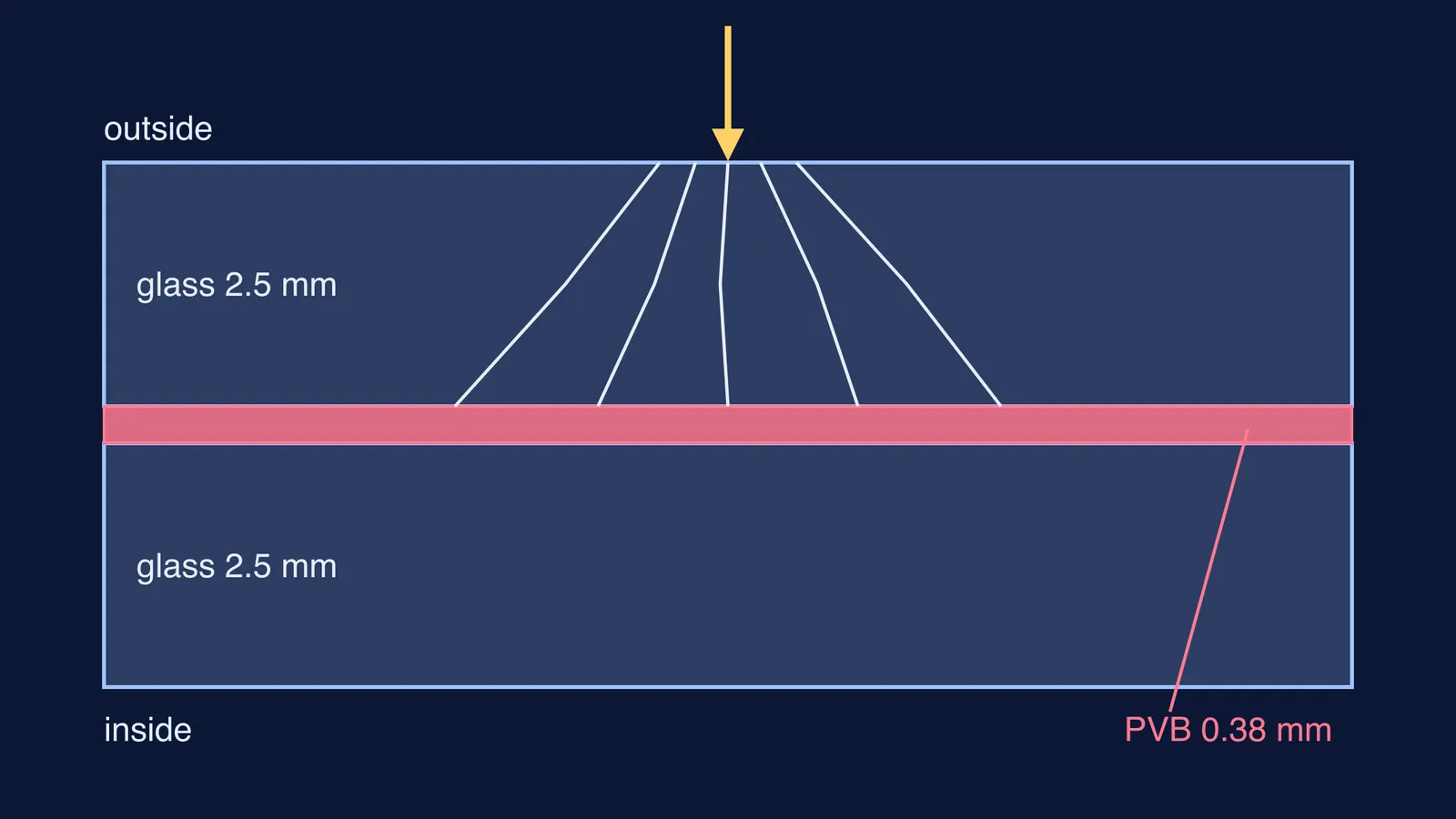
A car windscreen is laminated glass. Wikipedia's laminated glass entry defines it as a type of safety glass made of two or more layers of glass with thin polymer interlayers between them, which prevent the glass from breaking into large sharp pieces. Indian glass maker AIS describes its laminated windscreen the same way: a layer of plastic called PVB (polyvinyl butyral) sandwiched between two sheets of float glass.
A typical laminated make-up is 2.5 mm of glass, a 0.38 mm interlayer and another 2.5 mm of glass, and a car's laminated panel is around 6.5 mm thick, according to the same laminated glass entry.
Why does a car windscreen crack but not shatter?
Three ideas from your physics and chemistry syllabus explain it.
Glass is brittle. It cannot bend or stretch much before it breaks, so the energy of a hit goes into making a crack, not a dent. Stress piles up at the sharp tip of a crack, which is why a small chip can later spread into a long crack.
The crack stops at the plastic. A crack runs easily through glass, but PVB is a soft, tough polymer. When the crack reaches it, there is no brittle material to carry it on, so a stone chip on the outside can leave the inner sheet whole.
The plastic is bonded to every piece. Even when the glass breaks right through, the fragments stay stuck to the interlayer. AIS puts it simply: the shards remain stuck together instead of shattering.
That is why a badly hit windscreen shows the spider web of radial and concentric cracks, which the laminated glass entry says appears when the impact is not enough to pierce the glass completely.
Why do car side windows break into small pieces instead?
Side windows use a different design. According to Wikipedia's tempered glass entry, side windows and the rear windscreen have historically been made of tempered glass, while the windscreen is laminated glass, which will not shatter into pieces when broken. Some newer luxury cars use laminated side windows too.
Tempered glass is heated to around 620 °C and then cooled fast with forced air, which puts its outer surfaces into compression and its interior into tension (tempered glass entry). The same entry says tempered glass is about four times stronger than ordinary annealed glass. The catch: once a break gets through that squeezed skin, the stored tension is released all at once, and the whole pane breaks into small granular chunks instead of large jagged shards.
Tempered glass makes a break safer by making the pieces small. Laminated glass keeps the pieces from moving at all.
A comparison you can use in an exam answer
If a question asks you to compare types of glass, use this structure, with the figures from the laminated and tempered glass entries:
Annealed (ordinary) glass: breaks into large jagged shards.
Tempered glass: surface in compression, interior in tension; about four times stronger than annealed glass; breaks into small granular chunks. Usually used in car side and rear windows.
Laminated glass: glass, plastic interlayer, glass; cracks, but the pieces stay stuck to the plastic. Used in windscreens.
Worked example: in the typical 2.5 + 0.38 + 2.5 mm make-up, the whole sandwich is 5.38 mm thick. The plastic's share is 0.38 ÷ 5.38 ≈ 0.07, about one-fourteenth of the thickness. That thin layer is what decides whether a broken screen stays in place.
What does this mean for drivers in India?
In India, vehicle glass falls under Rule 100 of the Central Motor Vehicles Rules. As LiveLaw reported on a 2024 Kerala High Court ruling, the rule requires safety glass or glazing that conforms to IS 2553 (Part 2) (First Revision): 2019, with at least 70% visible light transmission on the windscreen and rear window and 50% on the side windows.
Two everyday points follow from the physics. A chip is a crack tip that can grow, so have a glass shop look at it soon rather than after the next pothole. And a crack in the driver's line of sight is worth asking a professional about, because the screen's job is to stay clear as well as stay in one piece.
Where can you explore ideas like these?
Compression, tension and how a brittle solid breaks are easier to understand when you can see them. The Fermi Simulation Lab has interactive simulations for the ideas that are easier to see than to read. If a term such as polymer or elasticity is fuzzy, the Fermi Concept Library covers every concept in physics, chemistry, biology, mathematics and computing.
The short version for your notes: glass cracks, plastic holds, and a windscreen is both.