

On this page
A car battery that is fully charged can sit through a night far below −20 °C and still start the engine. The same battery left flat can freeze solid at around −8 °C, swell and crack its case. The reason is one line of chemistry you already know: discharge turns sulphuric acid into water. With Faraday's law and ΔTf you can estimate, from amp-hours, where the electrolyte will freeze, and see where the formula breaks down.
What happens to the acid when a lead–acid battery discharges?
The overall discharge reaction is:
Pb + PbO₂ + 2H₂SO₄ → 2PbSO₄ + 2H₂O
It balances: two Pb, two S, ten O and four H on each side. Two electrons flow through the circuit for each Pb oxidised, and in that time two H₂SO₄ are used up and two H₂O are made. So one mole of H₂SO₄ is consumed for every mole of electrons, and one mole of water appears.
The half-reactions and why a hydrometer tracks the falling density are in lead storage battery: discharge and charging reactions. Here we follow only the acid.
Why does a flat battery freeze but a charged one does not?
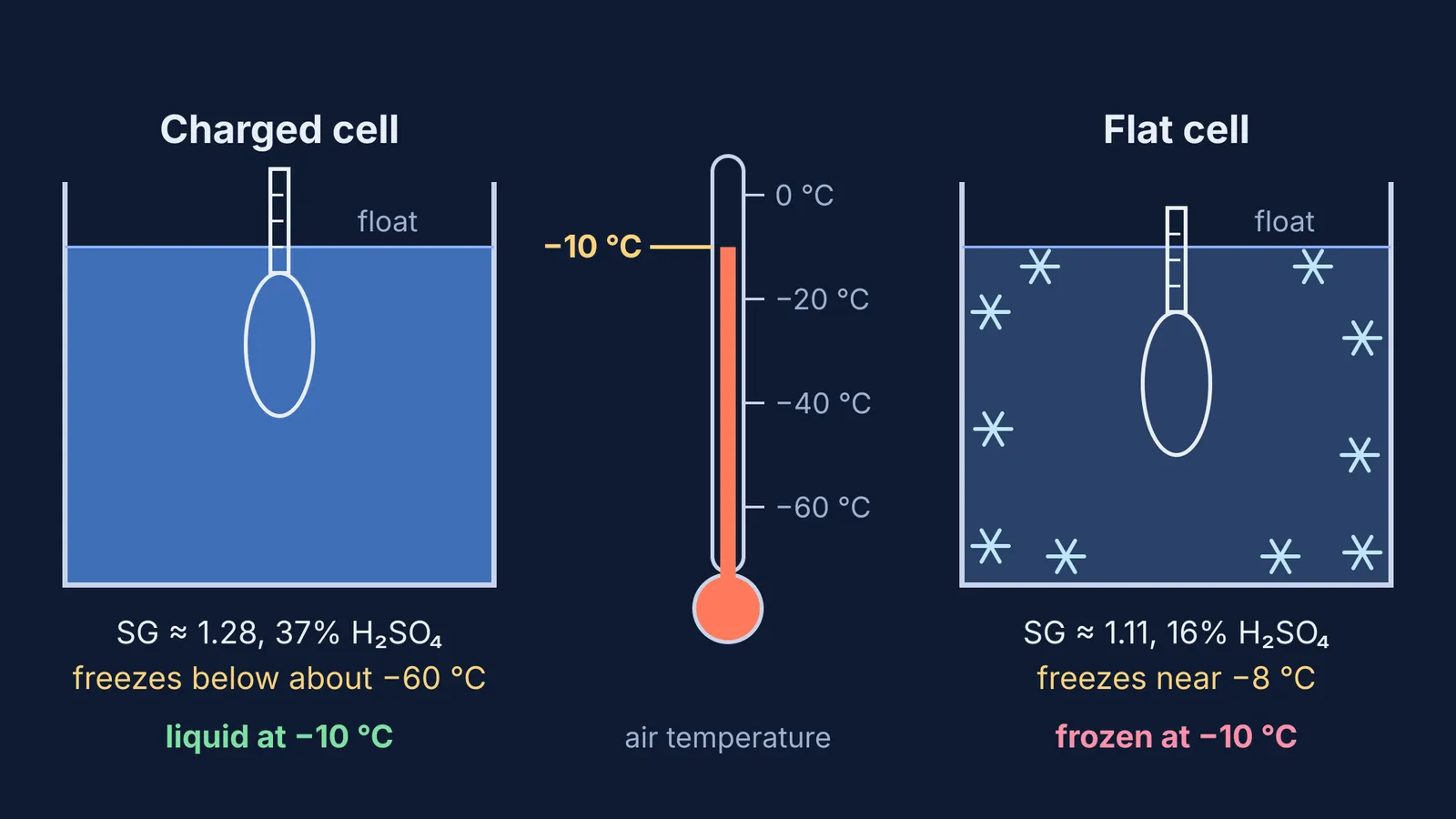
As the battery runs down, solute is removed (H₂SO₄ ends up locked in solid PbSO₄) and solvent is added (new water), so the acid gets more dilute on both counts. A more dilute solution has a smaller freezing-point depression, so its freezing point climbs towards 0 °C.
Published battery tables show how large the change is. A US Army battery manual lists the freezing point against specific gravity: about −59.5 °C at a specific gravity of 1.265 (fully charged), −26.1 °C at 1.190 (half charged) and −9.4 °C at 1.120 (discharged) (TM 5-3820-256-24-4, Table 2). Trojan Battery gives −69 °C for a fully charged battery and about −9 °C at 40% state of charge (Trojan Battery FAQ). The sources disagree on the charged figure because acid strengths and definitions of "fully charged" differ, so treat every number here as approximate. The pattern is what matters: around 60 °C of protection when charged, under 10 °C when flat.
How do you get from amp-hours to a freezing point? A worked example
Take one illustrative cell, not a real product. It holds 600 g of electrolyte at 37% H₂SO₄ by mass (specific gravity about 1.28) and delivers 40 Ah before it is called flat.
Acid and water at the start. H₂SO₄ = 0.37 × 600 = 222 g, which is 222 / 98.08 = 2.26 mol. Water = 600 − 222 = 378 g.
Charge drawn. Q = 40 A h × 3600 s h⁻¹ = 144 000 C.
Moles of electrons. n(e⁻) = 144 000 / 96 485 = 1.49 mol.
Acid used and water made. From the 1 : 1 ratio, 1.49 mol H₂SO₄ is used and 1.49 mol H₂O is formed. That water weighs 1.49 × 18.02 = 26.9 g.
What is left. H₂SO₄ = 2.26 − 1.49 = 0.77 mol, or 75.6 g. Water = 378 + 26.9 = 404.9 g. Mass fraction = 75.6 / (75.6 + 404.9) = 15.7%. Standard density tables put acid of this strength near a specific gravity of 1.11.
Molality. m = 0.77 / 0.4049 kg = 1.90 mol kg⁻¹.
Freezing-point depression. Use ΔTf = i Kf m with Kf(water) = 1.86 K kg mol⁻¹. Assume i ≈ 2, because in dilute acid H₂SO₄ ionises fully to H⁺ and HSO₄⁻ but HSO₄⁻ ionises only partly. ΔTf = 2 × 1.86 × 1.90 = 7.1 K, so the electrolyte would start to freeze near −7 °C. With i = 3 (full ionisation to 2H⁺ + SO₄²⁻) you get 10.6 K instead.
The table value for a discharged battery, about −9 °C, sits between these two estimates. Part of that agreement is luck: the true i lies between 2 and 3, and ions this concentrated do not behave ideally.
A 12 V battery is six such cells in series. The same current passes through every cell, so each cell gives the full 40 Ah and each one dilutes in the same way. Do not divide the charge by six.
Does ΔTf = iKfm work for the charged acid?
Try it on the starting electrolyte. The molality is 2.26 / 0.378 = 6.0 mol kg⁻¹. With i = 2, ΔTf = 2 × 1.86 × 6.0 = 22 K, which predicts freezing at about −22 °C. Even with i = 3 you only reach about −33 °C. The tables say about −60 °C or lower. The formula is out by a factor of two or more.
ΔTf = iKfm is derived for dilute solutions, where the solute particles are few compared with water molecules. At 6 mol kg⁻¹ that is far from true. There are about 21 mol of water for 2.26 mol of acid, so solute particles make up roughly a fifth or more of everything in the solution. The ions are also strongly hydrated: H⁺ holds several water molecules around it, so less water is free to form ice. Both effects make the real freezing point much lower than the ideal formula says. Use measured tables for battery acid.
The same ΔTf method for a non-electrolyte, and the same warning about high concentrations, appear in how much ethylene glycol stops radiator water freezing.
Why does a frozen battery crack, and can you charge it?
When dilute electrolyte freezes, ice forms from the water first and the acid left behind gets stronger, so the cell fills with slush. Ice takes up about 9% more volume than the water it came from, so the slush pushes on the plates and the plastic case, and the case can split.
A frozen battery is dangerous to revive. Hyundai's owner's manual warns not to jump start a vehicle with a frozen battery, because a low or frozen battery may rupture or explode (Hyundai owner's manual). The same manual advises keeping the battery fully charged in cold areas to prevent case damage. Let a frozen battery thaw at room temperature, check the case for cracks and leaks, and never charge or jump start it while frozen.
Topping up with water is a different matter. It only replaces water lost by electrolysis on overcharge, as explained in why only distilled water goes in an inverter battery. It does not dilute the acid below its proper strength, and it is charging, not topping up, that restores the acid and the cold protection.
To practise Faraday's-law and colligative-property problems that link like this one, the Fermi Problem Library has a step-by-step solver that explains the reasoning at each step.
Quick checklist
Discharge: Pb + PbO₂ + 2H₂SO₄ → 2PbSO₄ + 2H₂O, so 1 mol e⁻ uses 1 mol H₂SO₄ and makes 1 mol H₂O.
Convert amp-hours with Q = Ah × 3600 and n(e⁻) = Q / F.
Subtract the acid used and add the water made before you find the molality.
State your i: about 2 for dilute H₂SO₄, between 2 and 3 in reality.
Cells in series all pass the same charge; do not divide by six.
ΔTf = iKfm is fine near −9 °C for a flat battery but badly underestimates the charged acid (tables give about −60 °C or lower).
Keep batteries charged in cold weather, and never charge or jump start a frozen one.


