

On this page
Five times, most species on Earth died out in a geological instant, and each time the survivors rebuilt the living world. Learn the five as a set, with a date, a cause, a loser and a winner for each, and the topic becomes a story you can draw.
How many mass extinctions has Earth had?
Five major ones, usually called the Big Five. The US National Park Service defines mass extinctions as "spikes or rapid increases in extinction rates that occur over short periods of geologic time, leading to substantial drops in global biodiversity."
Our World in Data uses a stricter working definition: at least 75% of species lost in a geologically short period, typically under two million years.
The number five goes back to fossil counting. In a 1982 Science paper, David Raup and Jack Sepkoski compiled data on marine animal families and found four mass extinctions that stood out statistically, in the late Ordovician, Permian, Triassic and Cretaceous. A fifth, in the Devonian, stood out from the background but was not statistically significant in their data. So "five" is the standard count, with the Devonian the least clear-cut.
What were the five mass extinctions, and what caused them?
Figures below are from the National Park Service unless another link is given.
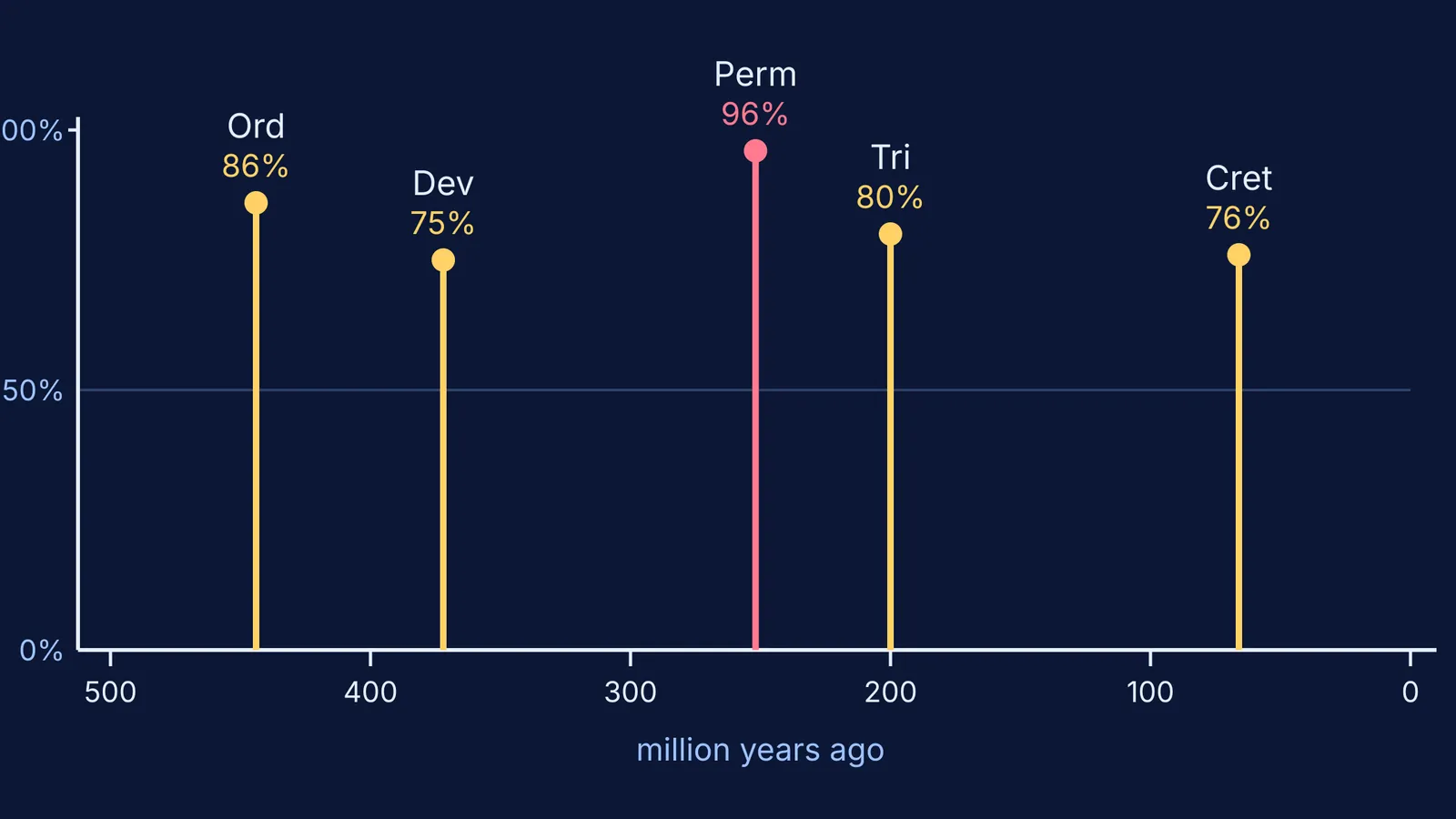
End-Ordovician, about 444 million years ago: about 86% of species lost. Rapid glaciation on the supercontinent Gondwana lowered sea levels and shrank shallow-sea habitats; a second pulse struck when warmth returned. Brachiopods, trilobites, bryozoans and graptolites were hit hard.
Late Devonian, about 372 million years ago: about 75% of species lost. The cause is unclear: cooling, volcanism, an impact, or algal blooms that stripped oxygen from seawater, possibly linked to forests spreading on land. Stromatoporoid sponges, placoderm fishes and many brachiopods and trilobites were lost.
End-Permian, about 251.9 million years ago: about 96% of species lost. Huge flood-basalt eruptions in Siberia released carbon dioxide and sulphur dioxide, driving climate change and ocean acidification. Every last trilobite disappeared, along with rugose and tabulate corals and most brachiopods. On land, the survivor Lystrosaurus became far more abundant in the Early Triassic recovery, and proterosuchids, early archosauromorphs, spread widely, with fossils in India's Panchet Formation.
End-Triassic, about 200 million years ago: about 80% of species lost. As Pangaea split and the Atlantic began to open, volcanism along the rifts changed the atmosphere and oceans. Phytosaurs died out and ammonites nearly did; dinosaurs then diversified and became dominant.
End-Cretaceous, 66 million years ago: about 76% of species lost. An asteroid an estimated 10 to 20 km across formed the Chicxulub crater in Mexico. A review led by Peter Schulte concluded that this single impact triggered the extinction, citing a worldwide iridium-rich layer and impact debris. Non-bird dinosaurs, pterosaurs, mosasaurs, plesiosaurs and ammonites vanished; birds survived and mammals flourished. For India's lava plateau from this time, see the Deccan Traps and the dinosaurs.
How do you draw a mass extinction timeline to scale?
A to-scale sketch shows what a list hides: the events are not evenly spaced. Draw a 25 cm line, 1 cm for every 20 million years. Put today at the right-hand end and measure leftwards.
End-Cretaceous: 66 / 20 = 3.3 cm from today.
End-Triassic: 200 / 20 = 10 cm.
End-Permian: 251.9 / 20 = about 12.6 cm.
Late Devonian: 372 / 20 = 18.6 cm.
End-Ordovician: 444 / 20 = 22.2 cm.
Above each mark, draw a bar for the share of species lost, 1 cm for every 10%: 8.6, 7.5, 9.6, 8.0 and 7.6 cm, oldest to youngest. Under each mark, write the cause in two words, one loser and one winner. Your sketch should match the diagram at the top of this post. Notice that the Permian and Triassic marks sit only 2.6 cm apart, about 52 million years.
If a related idea trips you up while you draw, such as adaptive radiation, the Fermi Concept Library has a lesson on each biology concept and shows its place in the map.
How can you remember the order of the five extinctions?
The initials, oldest first, are O, D, P, T, C. Try "Old Dogs Prefer Tasty Chapatis", or invent your own. Then test yourself without notes:
Which extinction was the largest, and roughly what share of species did it remove?
Which two events are firmly linked to huge volcanic eruptions?
Which event did Raup and Sepkoski's data not flag as statistically significant?
Name one group that died out and one that flourished after the end-Cretaceous event.
How far from "today" does the end-Permian mark sit on your 25 cm line?
Next, read how Georges Cuvier used fossil bones to prove extinction, or compare the Big Five with recent extinctions such as the dodo and the quagga.


