

On this page
In a darkened lab, a glass bulb sits between two large coils. Switch on the coil current and a thin blue-green line inside the bulb bends into a perfect glowing circle. Measure that circle, read two meters, and you can find the charge-to-mass ratio of the electron, e/m. This is the fine beam tube method, and NCERT's Class 12 chapter on the dual nature of radiation and matter has an exercise built on it. Here is how it works, the full calculation, and the mistakes that make results come out wrong.
What is a fine beam tube?
A fine beam tube is a glass bulb holding an electron gun and a little hydrogen gas at low pressure.
The electron gun. A heated cathode releases electrons. An accelerating voltage V between the cathode and an anode speeds them up, and they leave through a small hole as a narrow beam.
The gas. Some electrons hit hydrogen atoms on the way and excite them. The atoms emit light as they fall back, so the path of the beam glows. You are seeing the gas along the path, not the electrons themselves, which are invisible.
The coils. The bulb sits between a pair of Helmholtz coils, which make a nearly uniform magnetic field B across the bulb. How two coaxial coils do this is covered in Helmholtz coils: how two coaxial loops create a uniform field.
When B is perpendicular to the beam, the magnetic force evB is always at right angles to the velocity. It changes the direction of the electrons but not their speed, so they move in a circle.
How is the formula e/m = 2V/B²r² derived?
Two equations, one for the gun and one for the circle.
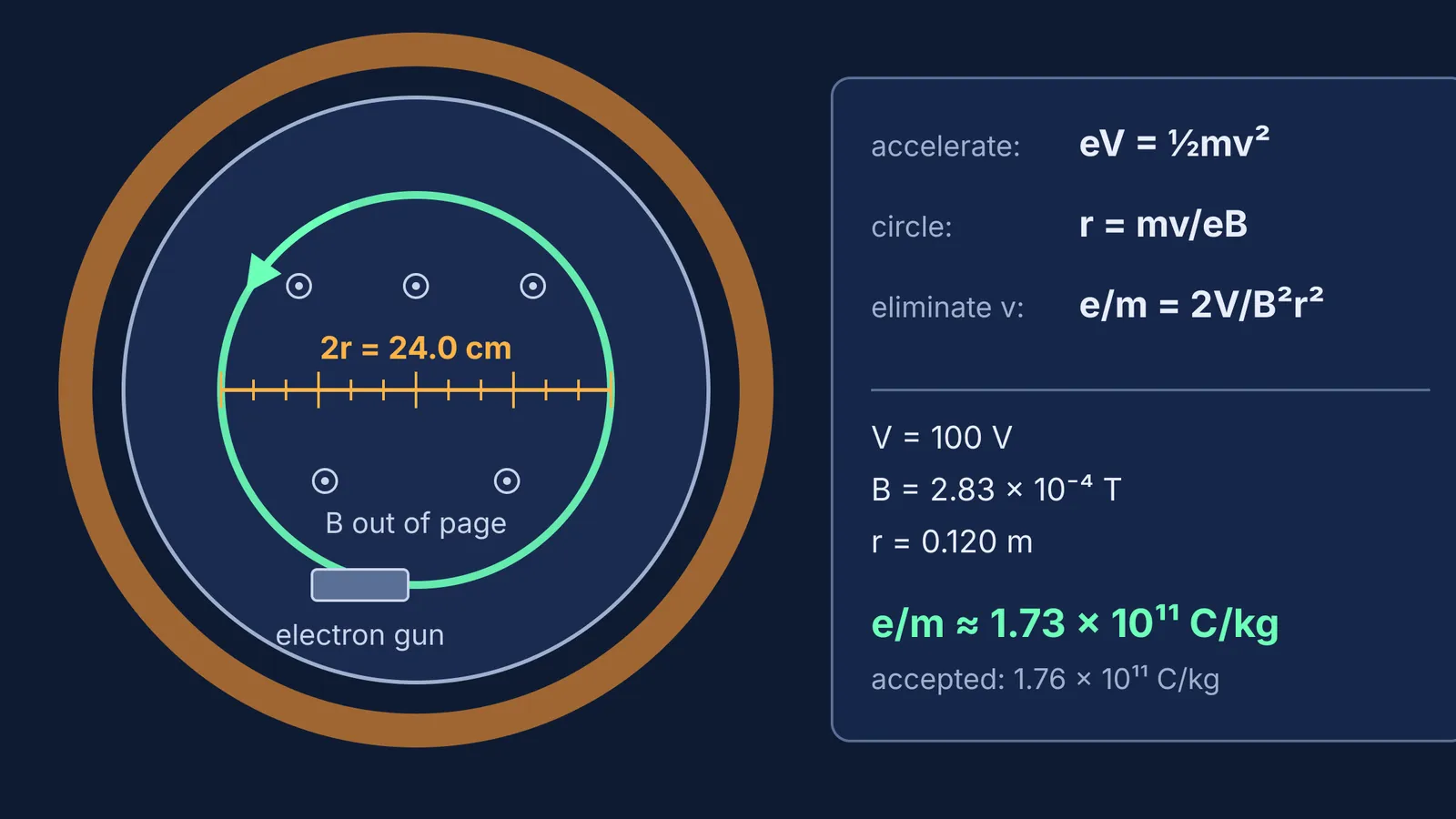
Energy from the gun. An electron starting almost at rest gains kinetic energy eV: eV = ½mv², so v² = 2eV/m.
Circular motion. The magnetic force provides the centripetal force: evB = mv²/r, so r = mv/(eB).
Eliminate v. Square the second result: r² = m²v²/(e²B²). Substitute v² = 2eV/m: r² = m² × (2eV/m) ÷ (e²B²) = 2mV/(eB²).
Rearrange. e/m = 2V/(B²r²).
Notice the powers. e/m depends on 1/B² and 1/r², so a 1% error in B or in r gives about a 2% error in e/m. That is why the radius and the field have to be measured carefully.
This is a different method from J. J. Thomson's original one, which balanced electric and magnetic forces so that v = E/B. That method is explained in properties of cathode rays and how the e/m ratio was measured.
What does the NCERT fine beam tube numerical give?
Question. Electrons accelerated through 100 V move in a circle of radius 12.0 cm in a uniform magnetic field of 2.83 × 10⁻⁴ T. Find e/m.
Write the data in SI units. V = 100 V, B = 2.83 × 10⁻⁴ T, r = 12.0 cm = 0.120 m.
Compute B². (2.83 × 10⁻⁴)² = 8.01 × 10⁻⁸ T².
Compute r². 0.120² = 0.0144 m².
Multiply. B²r² = 8.01 × 10⁻⁸ × 0.0144 = 1.153 × 10⁻⁹ T² m².
Divide. e/m = 2 × 100 ÷ 1.153 × 10⁻⁹ ≈ 1.73 × 10¹¹ C/kg.
Check the units. V ÷ (T² m²): since 1 T = 1 kg/(C s) and 1 V = 1 kg m²/(C s²), V/(T² m²) = (kg m²/(C s²)) × (C² s²/kg²) ÷ m² = C/kg. Correct.
Answer: e/m ≈ 1.73 × 10¹¹ C/kg. The accepted value is about 1.759 × 10¹¹ C/kg, so the result is about 1.4% low, which is good for a student measurement.
How fast are the electrons? From the measured values, v = (e/m)Br = 1.734 × 10¹¹ × 2.83 × 10⁻⁴ × 0.120 ≈ 5.9 × 10⁶ m/s. That is about 2% of the speed of light, so the non-relativistic formula ½mv² is fine at 100 V.
How much current do the coils need?
The field at the centre of a Helmholtz pair of radius R, with N turns in each coil and current I, is B = (4/5)^(3/2) μ₀NI/R. As an example, take coils of N = 130 turns and R = 0.15 m, which is typical of a commercial rig. Not every lab uses these values.
I = BR ÷ ((4/5)^(3/2) μ₀N) = (2.83 × 10⁻⁴ × 0.15) ÷ (0.7155 × 4π × 10⁻⁷ × 130) ≈ 0.36 A.
So a current of well under an ampere is enough. In the lab you usually set V, adjust I until the ring has a convenient size, then compute B from I.
What errors affect the fine beam tube experiment?
Parallax. The ring is inside a curved glass bulb, and the scale is outside it. If your eye is not level with and square to the ring, the reading shifts. Many rigs use a mirror scale or a sliding marker to line up the reflection with the beam. This is the main reading error.
Earth's magnetic field. Earth's field is a few times 10⁻⁵ T. Taking 5 × 10⁻⁵ T, it is about 18% of 2.83 × 10⁻⁴ T, so it can noticeably change the total field. Orient the apparatus so that Earth's field does not add to or cancel the coil field, or measure with the current reversed and average.
Energy spread. Electrons leave the hot cathode with a small spread of energies, so the ring has a finite width. Measure to its centre.
Field uniformity. The Helmholtz field is most uniform near the centre. A very large ring samples the weaker field near the edges.
Contact potentials. The electrons' true kinetic energy can differ slightly from e times the meter reading, which shifts e/m a little.
If you want to see how r changes with B and V before you take readings, the Simulation Lab has interactive simulations for ideas that are easier to see than read. The forward problem, finding r when you already know q/m, is worked in charged particles in a magnetic field: predict the circle's radius.
Quick checklist
eV = ½mv² and r = mv/(eB) combine to e/m = 2V/(B²r²).
Measure the ring's diameter and halve it.
100 V, 0.283 mT and 12.0 cm give e/m ≈ 1.73 × 10¹¹ C/kg, about 1.4% below the accepted value.
A 1% error in B or r gives a 2% error in e/m.
The glow is excited hydrogen; the electrons themselves are invisible.
Correct for Earth's field and avoid parallax.


