

On this page
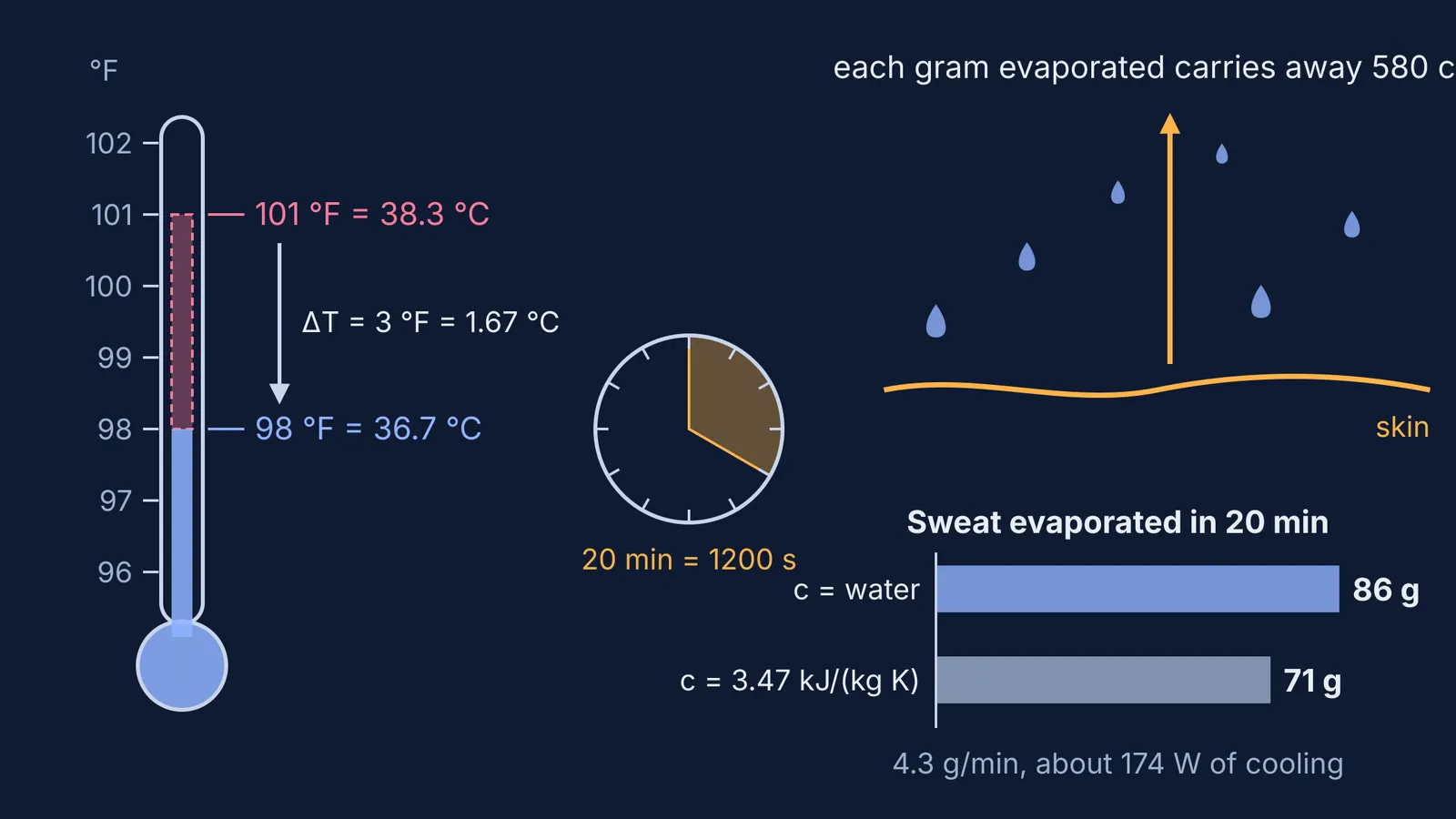
NCERT's Class 11 physics book has a short problem that looks like biology but is pure heat balance. A 30 kg child with a fever of 101 °F is given a fever medicine, sweats more, and cools to 98 °F in 20 minutes. If evaporating sweat is the only way heat leaves the body, how fast must the sweat evaporate? The answer is about 4.3 g per minute. Getting there takes one unit conversion, one Q = mcΔT, and one latent heat, and each step has a trap.
This is a physics estimate, not medical advice. For a child with a fever, follow a doctor's advice.
What does the fever and sweat problem in NCERT ask?
The problem is exercise 10.16 in Chapter 10, Thermal Properties of Matter, of the current NCERT Class 11 Physics Part 2 textbook. It gives you:
Mass of the child: 30 kg.
Fever falls from 101 °F to 98 °F in 20 minutes.
Evaporation of sweat is the only way heat is lost.
The body's specific heat is about the same as water's, 1 cal g⁻¹ °C⁻¹.
Latent heat of evaporation of water at body temperature: about 580 cal g⁻¹.
It asks for the average rate of extra evaporation caused by the drug. Why evaporation cools you at all, molecule by molecule, is explained in why we sweat when we exercise. Here we put numbers on it.
How do you convert a Fahrenheit temperature drop to Celsius?
A temperature and a temperature difference convert differently. A temperature needs the offset: °C = (°F − 32) × 5/9. So 101 °F is 38.3 °C and 98 °F is 36.7 °C.
A difference needs only the scale factor. Water's freezing and boiling points are 180 Fahrenheit degrees apart but 100 Celsius degrees apart, so one Fahrenheit degree is 5/9 of a Celsius degree. A drop of 3 °F is 3 × 5/9 = 1.67 °C, which matches 38.3 − 36.7.
If you subtract 32 from the difference, you get (3 − 32) × 5/9 = −16.1 °C. A negative drop for a cooling body is the giveaway that something has gone wrong.
How much sweat must evaporate? A worked example
Temperature drop. ΔT = 3 °F × 5/9 = 1.67 °C.
Mass in grams. m = 30 kg = 30,000 g, because the specific heat is per gram.
Heat the body must lose. Q = mcΔT = 30,000 g × 1 cal g⁻¹ °C⁻¹ × 1.667 °C = 50,000 cal.
Mass of sweat evaporated. Each gram that evaporates takes 580 cal with it, so m_sweat = Q/L = 50,000 cal ÷ 580 cal g⁻¹ = 86.2 g.
Rate. 86.2 g ÷ 20 min = 4.3 g per minute, or about 0.072 g per second.
Units check. cal ÷ (cal g⁻¹) leaves grams, and grams per minute is a rate. Good.
The same answer as a power. 50,000 cal × 4.186 J cal⁻¹ = 2.09 × 10⁵ J. Spread over 1200 s, that is 174 W of extra cooling, a little less than the power of two 100 W bulbs.
So the drug's extra sweating has to remove about 86 g of water from the skin as vapour, a little less than half a 200 mL glass, in 20 minutes.
Why is the latent heat 580 cal/g and not 540 cal/g?
The 540 cal/g (about 2.26 MJ/kg) you learn first is the latent heat at 100 °C. Latent heat of vaporisation is not a fixed number. It falls as the temperature rises and becomes zero at the critical point. At lower temperatures the liquid holds less energy while the vapour's energy changes much less, so the gap that has to be supplied per gram is larger.
At body temperature the value is close to 580 cal/g, or about 2.43 MJ/kg. Using 540 cal/g here would give 92.6 g instead of 86.2 g, an error of about 7%. Whether the sweat can evaporate at all depends on the humidity of the air, which is the subject of why humid heat feels far worse than dry heat.
Is 86 g of sweat a realistic answer?
It is an upper estimate, for two reasons.
The body is not water. The widely used average specific heat of the human body is 3.47 kJ kg⁻¹ K⁻¹, compared with 4.19 for water, and a 2022 calculation from tissue masses put it lower still, at about 2.98 kJ kg⁻¹ K⁻¹ (Xu and colleagues, Temperature, 2022). With 3.47, the heat lost is 30 × 3470 × 1.667 = 1.74 × 10⁵ J, and the sweat needed falls to 71 g, or 3.6 g per minute. With 2.98, it is 61 g.
Evaporation is not the only route. Warm skin also loses heat by radiation and convection, and some heat leaves with the breath. These share the work, so less sweat has to evaporate.
Two other details are hidden in the word "extra". The body keeps making heat by metabolism all the time, but before the drug that heat was already being lost at the same rate, so it cancels out. And only sweat that evaporates cools you. Sweat that drips off or soaks into clothes takes almost no heat with it.
The medicine itself does not pull heat out. Fever medicines lower the temperature the brain is aiming for, and the body then sheds the extra heat, partly by sweating. The physics problem starts after that point.
How does the answer change if you change the numbers?
The rate is m c ΔT ÷ (L t), so it scales simply:
Double the mass (a 60 kg adult, same drop): twice the sweat, 172 g.
Same drop over 40 minutes instead of 20: the same 86 g, at half the rate, 2.2 g per minute.
A 1 °F drop instead of 3 °F: one third of the sweat, 29 g.
Animals that cannot sweat much use the same 580 cal per gram, but evaporate water from the tongue and airways instead, as in why dogs pant instead of sweating. If you want more heat-balance problems like this one, the Fermi Problem Library has a step-by-step solver that explains the reasoning at each stage.
Quick checklist
A 3 °F drop is 3 × 5/9 = 1.67 °C. Never subtract 32 from a difference.
Q = mcΔT with m in grams and c = 1 cal g⁻¹ °C⁻¹ gives 50,000 cal.
Sweat evaporated = Q/L = 50,000/580 = 86.2 g, so 4.3 g per minute.
580 cal/g applies at body temperature; 540 cal/g is the value at 100 °C.
As a power, the extra cooling is about 174 W.
Real bodies have a lower specific heat and other heat-loss routes, so 86 g is an upper estimate.


