

On this page
Humans are champion sweaters, able to cool down even on the hottest summer days by releasing water across almost our entire skin surface. Dogs, however, have thick fur and lack widespread sweat glands. Instead, they rely on an entirely different biological strategy to beat the heat: panting.
By taking short, rapid breaths, a dog can use the same thermodynamic principles as sweating—evaporative cooling—without needing bare skin. Here is exactly how the physics and biology of a dog's cooling system work together to prevent overheating on a warm day.
Why do dogs pant instead of sweating?
In humans, sweat glands (eccrine glands) are distributed all over the body. When sweat evaporates from the skin, it pulls thermal energy away, cooling the blood circulating just beneath the surface.
For a dog, this strategy would be useless. If a dog sweated through its skin, the moisture would become trapped in its thick fur, creating a warm, insulating layer that blocks airflow and actively prevents cooling. Dogs do have some sweat glands, but they are mostly confined to their hairless paw pads, which offer far too little surface area to cool their entire body mass effectively.
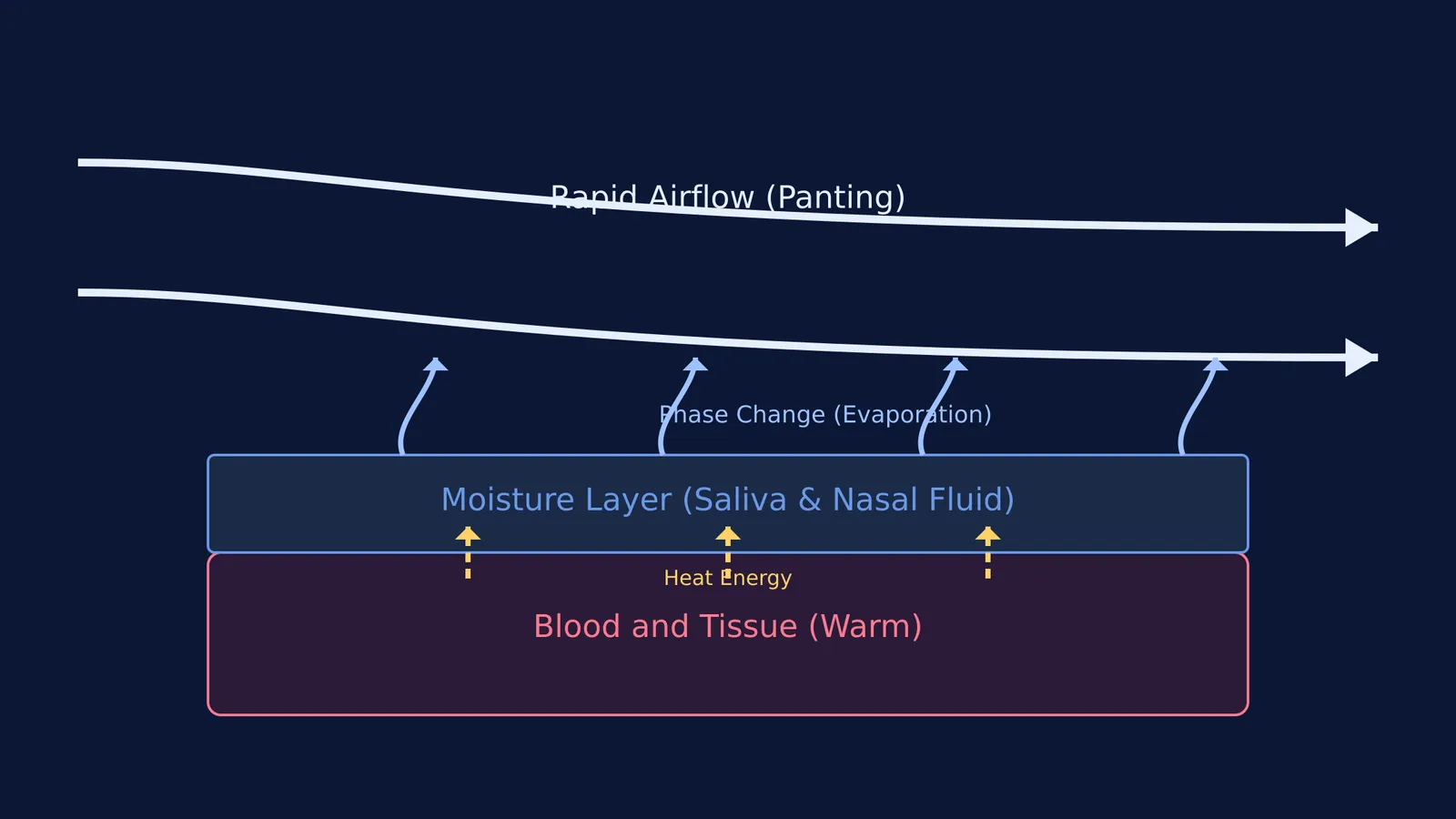
Instead, dogs use the large, moist surface area of their tongue, mouth, and upper respiratory tract. By moving air quickly over these wet membranes, they force the moisture to evaporate, drawing heat directly away from the blood vessels in their head and neck.
How does evaporative cooling work in a panting dog?
Evaporative cooling is a phase change: turning liquid water into water vapour requires a significant input of energy, known as the latent heat of vaporization. When saliva evaporates from a dog's tongue and airways, that required heat energy is drawn directly from the dog's warm blood.
To maximize this cooling effect, a panting dog dramatically changes its breathing pattern. While a healthy dog at rest typically takes 15 to 35 breaths per minute, a panting dog can reach up to 300 to 400 breaths per minute. This high-frequency, shallow breathing moves a massive volume of air over the moist surfaces without causing the dog to hyperventilate.
The coordination of this airflow is highly specialized. A 1985 study in *Respiration Physiology*90125-2) found that a panting dog's soft palate moves cyclically. It alternates to direct inhaled air through the nose to cool the extensive network of blood vessels, while exhaled air leaves through the mouth to carry the warm vapour away.
How much heat does panting remove?
When water evaporates, it absorbs a massive amount of energy—about 2,260 joules per gram. The same 1972 study found that as the air temperature rises to 50 °C, just one of a dog's lateral nasal glands can secrete up to 9.6 grams of fluid per hour. As this moisture evaporates, it draws thousands of joules of heat energy away from the blood, preventing the animal from overheating.
Because the latent heat of vaporization is so incredibly high, this phase change is an extraordinarily efficient way to dump thermal energy. For a dog that cannot sweat across its skin, relying on the internal surface area of the nose and mouth provides enough evaporative power to maintain a safe core temperature even in extreme conditions.
How does this apply to thermodynamics problems?
The physics of a dog's panting is the exact same physics that governs gas expansion and phase changes in thermodynamics. Whether you are calculating the heat absorbed by a gas or the energy needed to turn a liquid into a vapour, the core principle remains the same: state changes require an energy transfer.
If you are studying these principles for an exam, you can explore how energy and pressure change in different systems in the Fermi Simulation Lab. For example, understanding how a system does work on its environment during the free expansion of an ideal gas or calculating the net energy exchange in a cyclic process loop relies on the same fundamental rules of heat transfer that keep a panting dog cool on a summer afternoon.


