

On this page
A person lifts a 10 kg mass through 0.5 m, a thousand times over. Each time the mass is lowered, its potential energy is lost as heat. Fat supplies about 3.8 × 10⁷ J of energy per kilogram, and the body turns that energy into mechanical work at about 20% efficiency. How much fat is used up? This is a standard Class 11 work-energy problem, and it is a good test of whether you know when to divide by an efficiency and when to multiply.
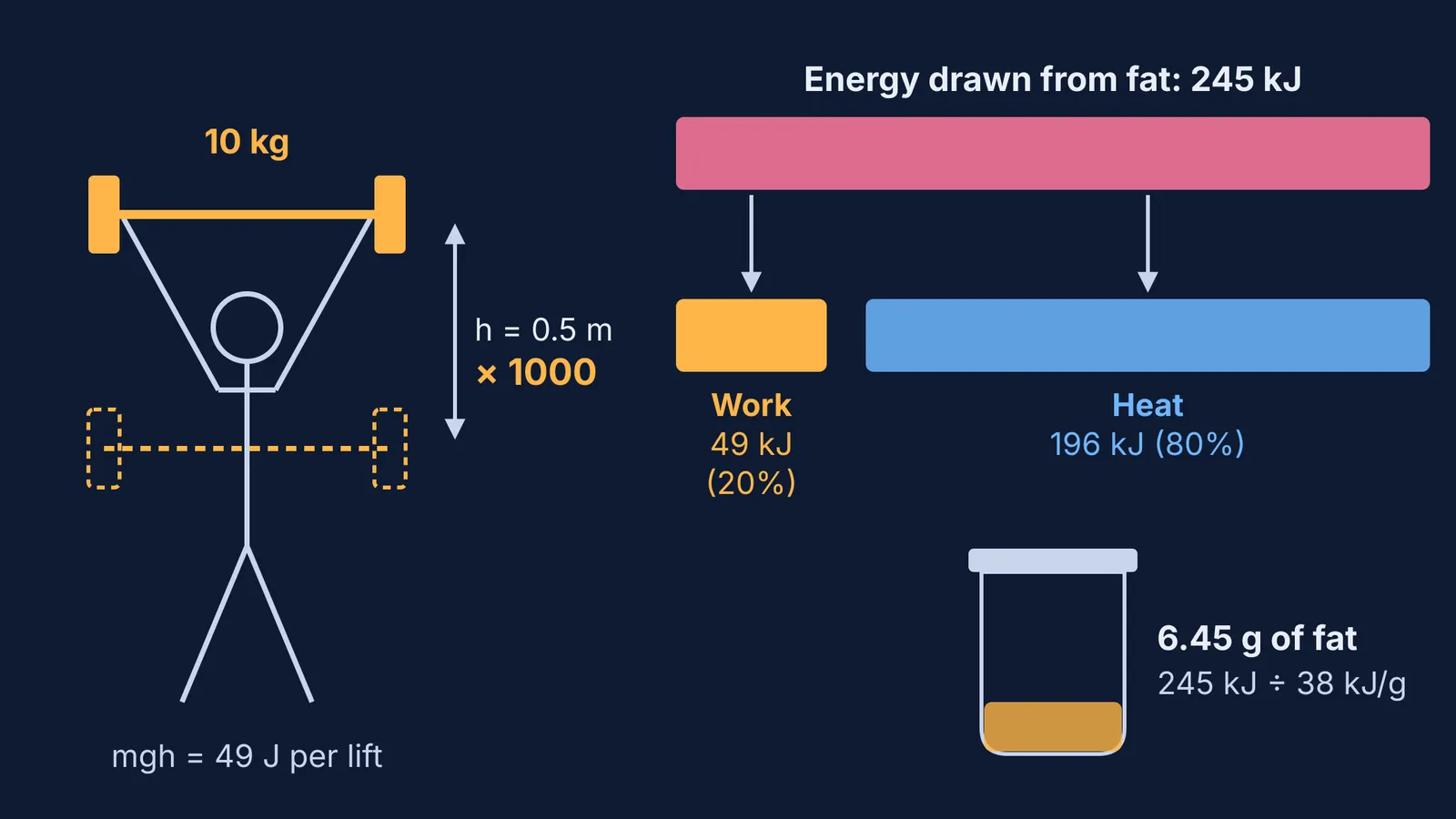
The answer surprises most students: about 6.45 g. Here is where every joule comes from and goes.
How much work does lifting 10 kg through 0.5 m take?
Raising a mass m through a height h at a steady speed means pushing up with a force equal to its weight, mg, over a distance h. The work you do against gravity is:
W = mgh
With m = 10 kg, g = 9.8 m/s² and h = 0.5 m:
W = 10 × 9.8 × 0.5 = 49 J per lift
For 1000 lifts:
Total work = 1000 × 49 = 4.9 × 10⁴ J
Units check: kg × m/s² × m = N × m = J. Notice that the 1000 is exact and the other data have two or three significant figures, so the answer should be quoted to about three figures.
Why don't you add work for lowering the mass? Because the problem says the potential energy is lost each time the mass comes down. It is not stored and returned to the body. The gravitational energy of the mass at the bottom of each cycle is the same as at the start, so the 49 J you put in on the way up ends up as heat on the way down.
Why divide by the efficiency instead of multiplying?
Efficiency is useful output divided by input:
η = useful work out ÷ energy in
Here the useful output is the 4.9 × 10⁴ J of lifting work, and the input is the chemical energy taken from fat. So:
Energy in = useful work ÷ η = 4.9 × 10⁴ ÷ 0.20 = 2.45 × 10⁵ J
The input must be larger than the output. If you multiply by 0.20 instead, you get 9.8 × 10³ J, which is smaller than the work done, and that would break energy conservation. A quick sense check catches this every time.
The other 80% does not vanish. Of the 2.45 × 10⁵ J drawn from fat, 4.9 × 10⁴ J goes into lifting and 1.96 × 10⁵ J becomes heat in the muscles, which is one reason you warm up and sweat when you exercise. For a related estimate of muscle efficiency during exercise, see how much power you use when climbing stairs.
How much fat supplies 2.45 × 10⁵ J?
Divide the energy needed by the energy per kilogram of fat:
Mass of fat = 2.45 × 10⁵ J ÷ 3.8 × 10⁷ J/kg = 6.45 × 10⁻³ kg
That is about 6.45 g.
Worked example: the full energy budget, step by step
Here is the whole calculation in one place, the way you would set it out in an exam.
Work per lift. W₁ = mgh = 10 × 9.8 × 0.5 = 49 J.
Total useful work. W = 1000 × 49 J = 4.9 × 10⁴ J.
Energy drawn from fat. E = W ÷ η = 4.9 × 10⁴ ÷ 0.20 = 2.45 × 10⁵ J.
Heat produced. Q = E − W = 2.45 × 10⁵ − 4.9 × 10⁴ = 1.96 × 10⁵ J.
Mass of fat. m = E ÷ 3.8 × 10⁷ = 6.45 × 10⁻³ kg ≈ 6.45 g.
In kilocalories. 2.45 × 10⁵ J ÷ 4184 J/kcal ≈ 58.6 kcal.
If your paper uses g = 10 m/s², each lift needs 50 J and the answer becomes 6.58 g. Use whichever value the question gives.
Does the textbook value for fat match real data?
The problem's 3.8 × 10⁷ J/kg is a round value. The FAO report on food energy uses a general factor of 37 kJ/g (9.0 kcal/g) for fat, which is 3.7 × 10⁷ J/kg. With that figure the answer becomes 6.62 g instead of 6.45 g, a change of under 3%. The 9 kcal/g figure goes back to the food energy values described in Wilbur Atwater and the 4-9-4 food calorie values. Some physics textbooks use 39 kJ/g, which gives 6.28 g. All three land near 6 to 7 g, which is what matters in an estimate.
Two more cautions keep the estimate honest:
Fat stored in the body is not pure fat. Body fat tissue also holds water and other material, so 6.45 g of fat used is not the same as 6.45 g off a weighing scale.
Real muscles also spend energy lowering a load. Controlling the mass on the way down costs some chemical energy too, even though no work is done against gravity. The textbook model ignores this, so treat 6.45 g as the lifting cost alone.
How does this compare with energy used at rest?
Your body uses energy even when you are still. OpenStax College Physics lists a basal metabolic rate of about 85 W and about 83 W for sleeping for an adult.
Suppose, as an illustrative round figure, the 1000 lifts take 40 minutes (2.4 s per lift). In 40 minutes = 2400 s, a resting body at 85 W uses:
Resting energy = 85 × 2400 = 2.04 × 10⁵ J
The lifting adds 2.45 × 10⁵ J on top of that, so the total for the 40 minutes is about 4.49 × 10⁵ J, roughly 2.2 times the resting figure. The average rate of chemical energy use for lifting is 2.45 × 10⁵ ÷ 2400 ≈ 102 W, while the useful mechanical power is only about 20 W.
That is the physics point of the problem. The body is a heat engine of modest efficiency, and fat stores a lot of energy per gram. A thousand lifts sounds like a lot of effort, yet the energy involved is only a few grams of fat. For a study-based look at how rates of exercise change the energy cost, see power climbing stairs fast vs slow.
If you want more energy and efficiency problems set out this way, the Fermi Problem Library has a step-by-step solver that explains the reasoning at each stage.
Quick checklist
Work per lift: mgh = 49 J; for 1000 lifts, 4.9 × 10⁴ J.
Lowering the mass returns nothing to the body in this model; do not subtract it.
Energy drawn = useful work ÷ efficiency = 2.45 × 10⁵ J. Divide, never multiply.
Heat = 1.96 × 10⁵ J, the other 80%.
Fat used = 2.45 × 10⁵ ÷ 3.8 × 10⁷ = 6.45 × 10⁻³ kg ≈ 6.45 g.
With 37 kJ/g the answer is 6.62 g; the estimate barely changes.
Check units at every step and quote about three significant figures.


