

On this page
Take every fraction between 0 and 1, keep only those in lowest terms with denominator at most 5, and write them in order. You get 0/1, 1/5, 1/4, 1/3, 2/5, 1/2, 3/5, 2/3, 3/4, 4/5, 1/1. That list is the Farey sequence F5, and it hides patterns a Class 11 student can prove.
What is a Farey sequence?
The Farey sequence of order n, written Fn, is the set of reduced fractions a/b with 0 ≤ a ≤ b ≤ n, arranged in increasing order, as defined on Wolfram MathWorld's Farey sequence page. The same page gives F5 exactly as listed above.
The lists grow quickly. The number of terms in F1 to F8 is 2, 3, 5, 7, 11, 13, 19 and 23, from the OEIS entry A005728, "Number of fractions in Farey series of order n". MathWorld gives the count as 1 + φ(1) + φ(2) + … + φ(n), where φ is Euler's totient, and notes it grows like 3n²/π², about 0.304n², for large n (MathWorld).
MacTutor's biography of John Farey (1766–1826) describes him as a geologist, not a mathematician. His 1816 note in the Philosophical Magazine, "On a curious property of vulgar fractions", stated without proof that each fraction in the list is the mediant of its two neighbours; Cauchy supplied a proof the same year. The biography adds that the property was already built into a construction Haros published in 1802.
What is the mediant of two fractions?
The mediant of a/b and c/d is (a + c)/(b + d): add the tops, add the bottoms. It is the "wrong" way to add fractions, yet it always lands strictly between the two.
Mediants also build each Farey sequence from the one before: obtain Fn from Fn−1 by inserting the mediant between neighbours whose denominators add up to n (MathWorld).
Here is the build, step by step:
F1: 0/1, 1/1.
F2: insert (0+1)/(1+1) = 1/2.
F3: insert 1/3 and 2/3, the mediants of each new pair.
F4: insert 1/4 and 3/4 (denominators 1 + 3 = 4); 1/2 and 1/3 are not used yet because 3 + 2 = 5.
F5: insert 1/5, 2/5, 3/5 and 4/5.
Why do Farey neighbours satisfy bc − ad = 1?
For consecutive terms a/b < c/d in any Farey sequence, bc − ad = 1; MathWorld lists this together with the mediant property and notes that the two statements are equivalent (MathWorld). Here is a picture proof using a dot grid.
Plot the points O = (0, 0), P = (b, a) and Q = (d, c). The fraction y/x is the slope of the line from O to (x, y), so P and Q are the two neighbouring slopes. The triangle OPQ has area (bc − ad)/2 by the shoelace formula.
Any other grid point (x, y) in that triangle would have x ≤ n and a slope y/x between a/b and c/d, so it would be a Farey fraction sitting between two neighbours. That is impossible. Points on OP or OQ are ruled out too, because a/b and c/d are in lowest terms.
So the triangle has 0 interior points and 3 boundary points. Pick's theorem for area on a dot grid gives area = 0 + 3/2 − 1 = 1/2. Therefore bc − ad = 1.
One consequence: between neighbours, the fraction with the smallest denominator is the mediant, and it first appears in F(b+d). Between 1/3 and 1/2, the first newcomer is 2/5.
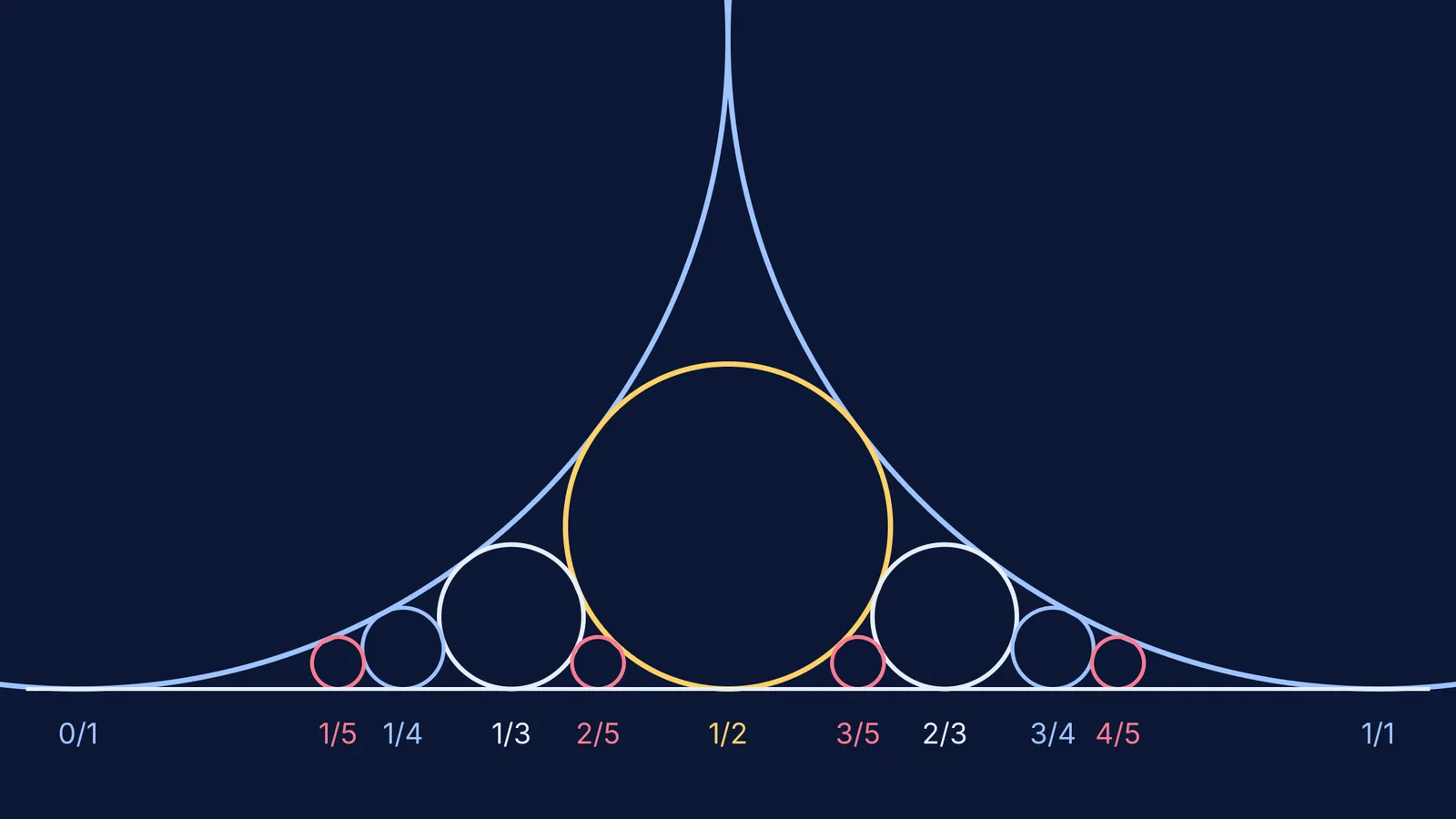
What are Ford circles?
On top of each reduced fraction h/k, draw a circle of radius 1/(2k²) that touches the number line at h/k. These are Ford circles; MathWorld's Ford circle page states that two of them never overlap and are tangent exactly when |hk′ − h′k| = 1. L. R. Ford wrote about them in "Fractions", The American Mathematical Monthly, volume 45, 1938 (DOI 10.1080/00029890.1938.11990863).
Check it yourself. For circles at a/b and c/d, the squared distance between centres is (a/b − c/d)² + (r₁ − r₂)². Tangency needs this to equal (r₁ + r₂)², which simplifies to (bc − ad)² = 1. So the circles of Farey neighbours always kiss. In the picture at the top, every pair of F5 neighbours touches, and so do some older pairs such as 0/1 and 1/2, which were neighbours in F2.
How to practise this
Write F6 and F7 from F5 using mediants, then check every pair with bc − ad = 1.
Find the fraction with the smallest denominator between 5/12 and 3/7. (Hint: the mediant, 8/19.)
Compare with continued fractions and the golden ratio: consecutive convergents p/q and p′/q′ pass the same test, pq′ − p′q = ±1.
Revisit the standard form of a rational number; every Farey term must be in lowest terms.
If Euler's totient or Pick's theorem is new to you, the Fermi Concept Library has a lesson for every concept in mathematics with its place in the map. When a proof step will not come, the Fermi Problem Library has a step-by-step solver that explains the reasoning rather than printing an answer.


