

On this page
In many prawn hatcheries, a worker pinches, burns or cuts off one eyestalk of a female before breeding. It is a hormone trick. The stalk carries a small gland system whose job is to tell the body to wait, and taking it away lets the ovary race ahead. Here is how that system works, what it costs the animal, and how to use the same logic on any hormone question.
What is the X-organ–sinus gland complex?
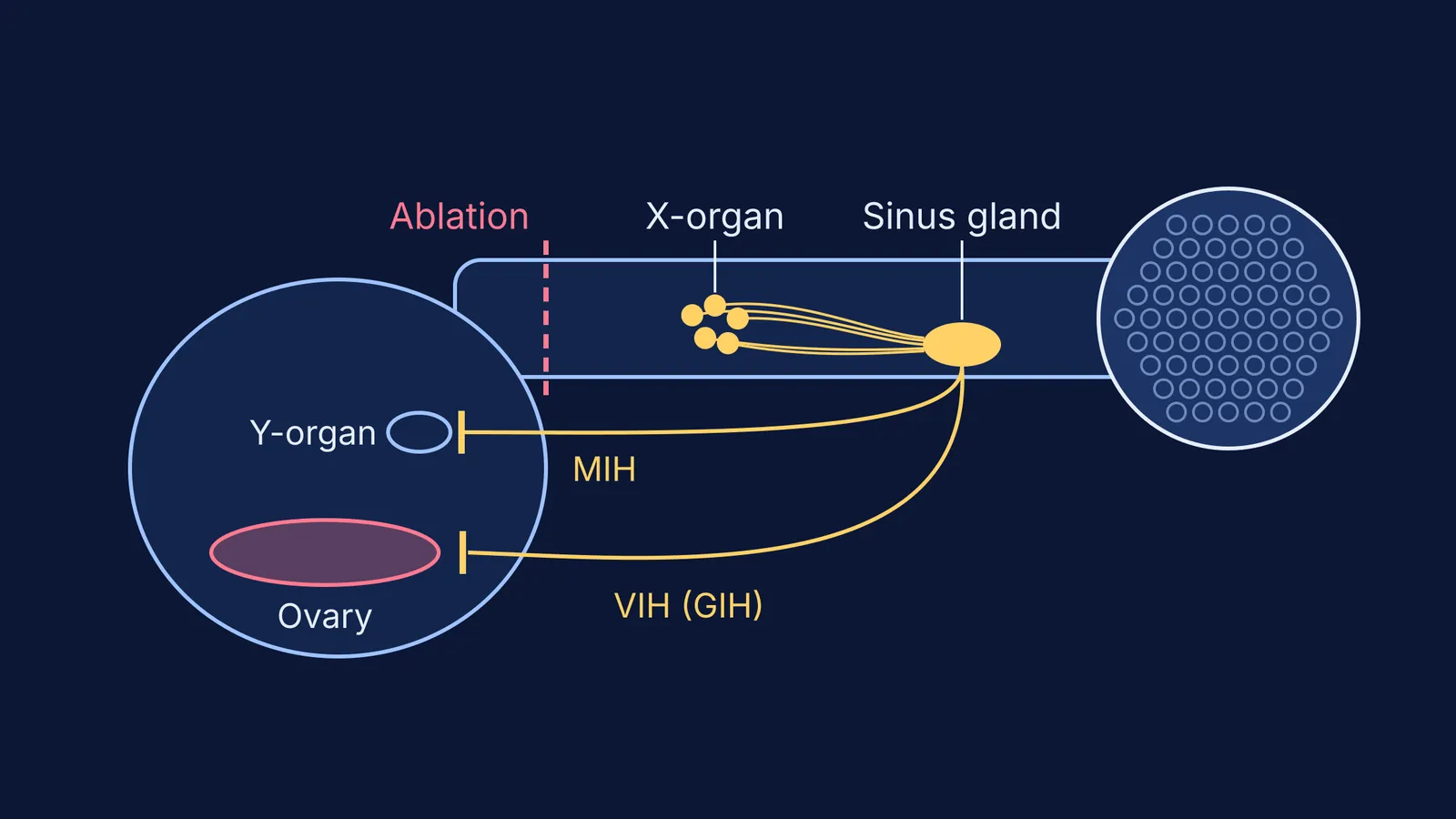
The X-organ sits in the medulla terminalis of the eyestalk, and the sinus gland is a neurohaemal organ where several hormones are released into the haemolymph, according to a 2005 ScienceAsia paper on the black tiger shrimp *Penaeus monodon*. Put simply, the X-organ makes the hormones and the sinus gland stores and releases them, which is why researchers call the pair the X-organ/sinus gland complex.
If nerve cells that release hormones sound odd, our story on Berta and Ernst Scharrer and the nerve cells that make hormones explains where the idea came from. The eyestalk hormones belong to one related peptide family:
Moult-inhibiting hormone (MIH) keeps the Y-organ, the moulting gland, in a resting state so ecdysteroid levels stay low between moults (Shyamal and colleagues, Scientific Reports, 2018).
Gonad-inhibiting hormone (GIH), also called vitellogenesis-inhibiting hormone (VIH), blocks the making of vitellogenin, the precursor of egg yolk protein (Uawisetwathana and colleagues, PLoS ONE, 2011).
Crustacean hyperglycaemic hormone (CHH) gives the family its name; Shyamal and colleagues list it beside MIH among the eyestalk peptides that hold back moulting (Scientific Reports, 2018).
Mandibular organ-inhibiting hormone (MOIH) inhibits methyl farnesoate synthesis in the mandibular organ (Panchan and colleagues, 2005).
Three of the four names say "inhibiting": they are brakes.
Why is the eyestalk removed in prawn farming?
Eyestalk ablation is the pinching, cauterising or surgical removal of a broodstock female shrimp's eyestalk to trigger spawning, as the Global Seafood Alliance describes it.
The logic follows from the list above. With less GIH reaching the ovary, the brake on vitellogenin comes off, yolk builds up in the eggs and the ovary matures. The 2011 PLoS ONE study describes ablation as a common way to induce ovarian maturation in captivity.
The practice is widespread because of one species. A University of Stirling PhD thesis by Simão Zacarias notes that the Pacific white shrimp made up 78% of global shrimp production in 2019 and that its egg production is usually induced by removing or constricting one eyestalk. You can read more about these animals in our guide to crab and prawn crustacean features.
What else changes when the eyestalk is cut?
The cut cannot remove only one hormone. Shyamal and colleagues explain that between moults, pulses of MIH keep the Y-organ at rest; when MIH falls, the Y-organ switches on, ecdysteroids rise and the animal moves towards a moult (Scientific Reports, 2018). (For moulting itself, see why snakes and insects shed their skin.)
The 2011 PLoS ONE paper lists the side effects: ablation harms growth, shortens the moulting cycle, raises energy demands and can end in poorer egg quality and high mortality.
Can prawns breed without eyestalk ablation?
In the Zacarias thesis, Pacific white shrimp females with intact eyestalks produced significantly more eggs and nauplii than ablated females, but output per tank per day was lower (University of Stirling). Their offspring grew and survived as well, and their postlarvae coped better with a salinity stress test and a *Vibrio parahaemolyticus* challenge.
A neater fix, switching off the VIH gene, is harder than it sounds. When Kang and colleagues injected double-stranded RNA against five VIH-type genes in subadult females, only one gene's expression dropped clearly and the ovaries stayed immature.
On 27 August 2025 the Global Seafood Alliance announced that all shrimp facilities certified to its Best Aquaculture Practices standards must end eyestalk ablation, or stop sourcing postlarvae from hatcheries that use it, by the end of 2030.
How do you answer a hormone question like this in an exam?
Use a four-step chain whenever a question removes a gland or blocks a hormone:
Source: where is the hormone made, and where is it released?
Target: which tissue does it act on?
Sign: does it switch the target on or hold it back?
Flip: remove the source of a brake and the target speeds up; remove the source of an accelerator and the target slows down.
Worked example: "Both eyestalks of a crab are removed. Predict what happens to its moult cycle." Source: X-organ makes MIH, sinus gland releases it. Target: Y-organ. Sign: MIH holds the Y-organ back. Flip: with no MIH, the Y-organ makes more ecdysteroids and the crab moults early.
Try it yourself: why does a female prawn spawn sooner after one eyestalk is removed? Run the four steps with GIH and the ovary.
If a chain keeps breaking at the same step, the Fermi Concept Library gives every concept in biology its own lesson and its place in the map, so you can see where neurosecretion sits beside the glands you already know.
Next time you see a hormone named "inhibiting", ask what happens when the brake comes off.


