

On this page
In 1928 Ernst Scharrer saw something in a small fish's brain that nerve cells were not supposed to have: droplets of secretion. Over the next decades he and his wife, Berta Scharrer, argued that some neurons make hormones and release them into the blood. That idea, neurosecretion, is why your biology textbook says the posterior pituitary stores and releases hormones that the hypothalamus makes.
What did Berta and Ernst Scharrer discover?
The National Academy of Sciences biographical memoir of Berta Scharrer, written by Dominick P. Purpura, says that in 1928, during his thesis studies in Karl von Frisch's laboratory, Ernst “discovered secretory droplets in certain hypothalamic neurons of the European minnow Phoxinus”. He called them “nerve-gland cells”. That year he also published a study of light sensitivity in blinded minnows, the first in a series on the fish diencephalon, the brain region that includes the hypothalamus.
Berta Vogel, born in Munich in 1906, married Ernst in 1934, the memoir records. They split the work on purpose: “Berta would explore the invertebrate animals, while Ernst focused on vertebrates.” Berta found neurosecretory cells in the marine snail Aplysia and the marine worm Nereis, and later kept a breeding colony of cockroaches in her office to study two insect glands, the corpus cardiacum and corpus allatum. Finding the same kind of cell in very different animals helped show that Ernst's fish observation was not an artifact.
In 1945 the couple set out the evidence in a review called simply “Neurosecretion” in Physiological Reviews.
Why did scientists resist the idea?
The memoir is blunt: “At that time, conventional wisdom held that nerve function was purely an electrical phenomenon. Few scientists were willing to accept that nerve cells secreted any substance, much less hormones.” For the story of how chemical signalling between nerves was first shown, read about Otto Loewi's frog heart experiment.
Life made it harder. The same memoir says the Scharrers left Nazi Germany in 1937 with “the four dollars each they were permitted to carry out of Germany”, and rules against nepotism left Berta with “neither academic title nor salary” for years. She became a full professor only in 1955, at the new Albert Einstein College of Medicine in New York.
Berta's insect work pointed to hormones carried along nerves to storage points, and the Scharrers “rightly suspected” the posterior pituitary was one. Their friend Wolfgang Bargmann's group learned to stain the granules in mammals. Ernst drowned while swimming in 1965. Berta kept working and in 1983 received the US National Medal of Science “for her pioneering contributions to establishing the concept of neurosecretion”.
How do nerve cells make hormones for the posterior pituitary?
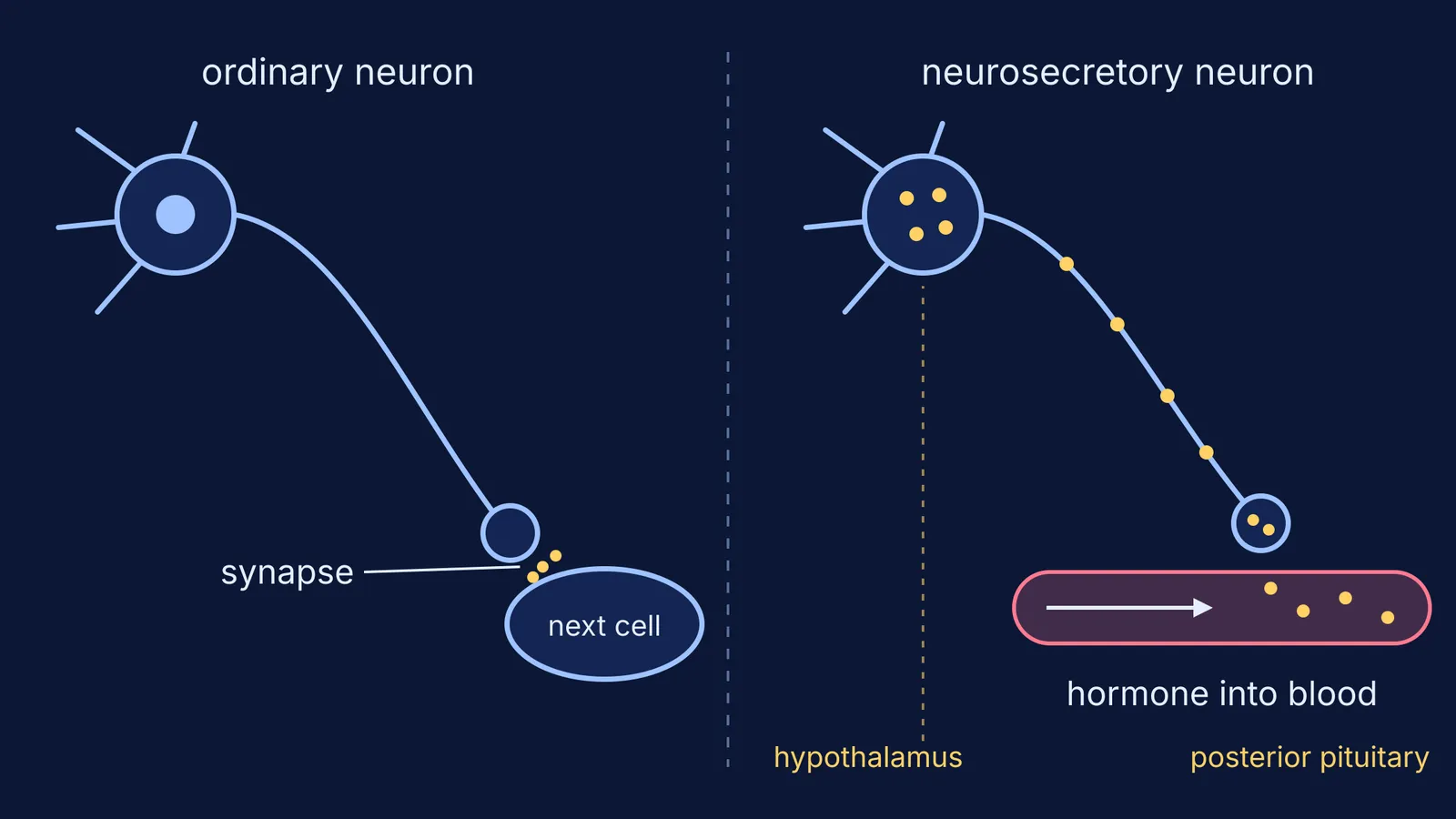
Neurosecretion is the making and release of hormones by nerve cells: the NAS memoir describes membrane-bound granules that are “transported down the axon of the cell and released at the axon terminals”.
The posterior pituitary does not make its own hormones. Peter Baylis and Stephen Ball's chapter in Endotext says it is “composed predominantly of neural tissue” and forms a structural and functional unit with the hypothalamus. Neurons whose cell bodies sit in the supraoptic and paraventricular nuclei “synthesize and secrete” vasopressin and oxytocin, and their axons “terminate on capillaries” in the posterior pituitary. Think of it as a four-step chain:
Make: cell bodies in the hypothalamus make the hormone and pack it into granules.
Ship: the granules travel down the axon, along the supraoptico-hypophyseal tract.
Store: they collect in the axon endings in the posterior pituitary.
Release: the endings release the hormone into the blood of nearby capillaries.
The same Endotext chapter notes that vasopressin is a 9 amino acid peptide and that oxytocin differs from it at only 2 positions. The two hormones have key roles in body fluid balance and reproduction; our explainer on the hormones behind birth and milk covers oxytocin's part.
How should you revise this for Class 11 and NEET-UG?
Check your answers against three common mistakes.
Writing that the posterior pituitary makes oxytocin and vasopressin. The hypothalamus makes them; the posterior pituitary stores and releases them.
Mixing up the two lobes. Only the posterior lobe receives the hormone-carrying axons themselves. Per the Endotext chapter, other, smaller hypothalamic neurons end in the portal blood vessels that lead to the anterior pituitary instead.
Treating neurosecretion as a mammal-only fact. Berta Scharrer's insect and worm work showed it across the animal kingdom.
A model two-mark answer you can adapt: “Oxytocin and vasopressin are synthesised by neurosecretory cells in the supraoptic and paraventricular nuclei of the hypothalamus. They are carried down the axons to the posterior pituitary, stored in the axon endings and released into the blood. This is called neurosecretion.”
If nerve impulses still feel hazy, start with our step-by-step guide to the nerve impulse, synapse and reflex arc. The Fermi Concept Library covers every concept in biology, each with its own lesson and its place in the map, so you can trace how the nervous and endocrine chapters connect.
Next time you draw the pituitary, draw the axons coming down from above. That line is the Scharrers' idea.


