

On this page
These eight original JEE Main-style questions check whether you can turn a lab reading into a result. Each ends with the trap: the wrong option most students pick.
What does JEE Main test in Experimental Skills?
NTA's Syllabus for JEE (Main) - 2027, linked from jeemain.nta.nic.in, makes Experimental Skills Physics Unit 20 and lists 18 experiments, starting with the vernier calipers. For the full list, read our explainer on experimental skills in the JEE Main physics syllabus. For least count and errors, use our guide on how to prepare Units and Measurements for JEE Main.
How should you use this practice set?
Cover the answers and give yourself 15 minutes for all eight.
Mark every miss as method, units or arithmetic, and redo it two days later.
Easy: can you read the setup?
Q1 (easy). A vernier calipers has 20 vernier divisions equal to 19 main-scale divisions of 1 mm. Its zero error is −0.15 mm. For a beaker's internal diameter, the main scale reads 41 mm and the 13th vernier division coincides. What is the internal diameter?
(A) 41.50 mm (B) 41.65 mm (C) 41.80 mm (D) 42.45 mm
Answer: (C). Least count = 1 − 19/20 = 0.05 mm. Reading = 41 + 13 × 0.05 = 41.65 mm. Corrected = 41.65 − (−0.15) = 41.80 mm.
Trap: (A) adds the zero error instead of subtracting it.
Q2 (easy). On a multimeter's resistance range, a component first shows a low resistance that quickly rises to a very high value, and it does the same when the leads are reversed. It does not glow. What is it?
(A) Diode (B) LED (C) Resistor (D) Capacitor
Answer: (D). A capacitor passes current only while charging, so the reading rises, in either direction.
Trap: (A) a diode reads high in one direction only.
Q3 (easy). A travelling microscope is focused on a mark on paper: reading 4.250 cm. A glass slab is placed over the mark and the microscope is refocused on the mark's image: 4.890 cm. It is then focused on chalk dust on the slab's top surface: 6.170 cm. What is the refractive index of the glass?
(A) 0.67 (B) 1.33 (C) 1.50 (D) 3.00
Answer: (C). Real depth = 6.170 − 4.250 = 1.920 cm. Apparent depth = 6.170 − 4.890 = 1.280 cm. n = 1.920/1.280 = 1.50.
Trap: (D) divides by the shift, 0.640 cm, instead of the apparent depth.
Medium: can you turn readings into a result?
Q4 (medium). In a Young's modulus experiment, a 2.0 m wire of diameter 0.50 mm stretches by 1.50 mm when a 3.0 kg load is added. Take g = 9.8 m/s². What is Young's modulus?
(A) 2.0 × 10¹⁰ N/m² (B) 5.0 × 10¹⁰ N/m² (C) 2.0 × 10¹¹ N/m² (D) 8.0 × 10¹¹ N/m²
Answer: (C). F = 29.4 N and A = π(0.25 × 10⁻³)² = 1.96 × 10⁻⁷ m². Y = FL/(AΔL) = (29.4 × 2.0)/(1.96 × 10⁻⁷ × 1.50 × 10⁻³) ≈ 2.0 × 10¹¹ N/m².
Trap: (B) uses the diameter as the radius, which makes the area four times too large.
Q5 (medium). Water rises 4.9 cm in a clean capillary of internal diameter 0.60 mm. Take the contact angle as zero, density 1000 kg/m³ and g = 9.8 m/s². What is the surface tension of water, and what happens to the rise when a little detergent is added?
(A) 0.072 N/m; the rise decreases (B) 0.144 N/m; the rise decreases (C) 0.072 N/m; the rise increases (D) 0.144 N/m; the rise increases
Answer: (A). T = rhρg/2 = (0.30 × 10⁻³ × 0.049 × 1000 × 9.8)/2 ≈ 0.072 N/m. Detergent lowers T, and h ∝ T, so the rise falls.
Trap: (B) puts the 0.60 mm diameter in place of the radius.
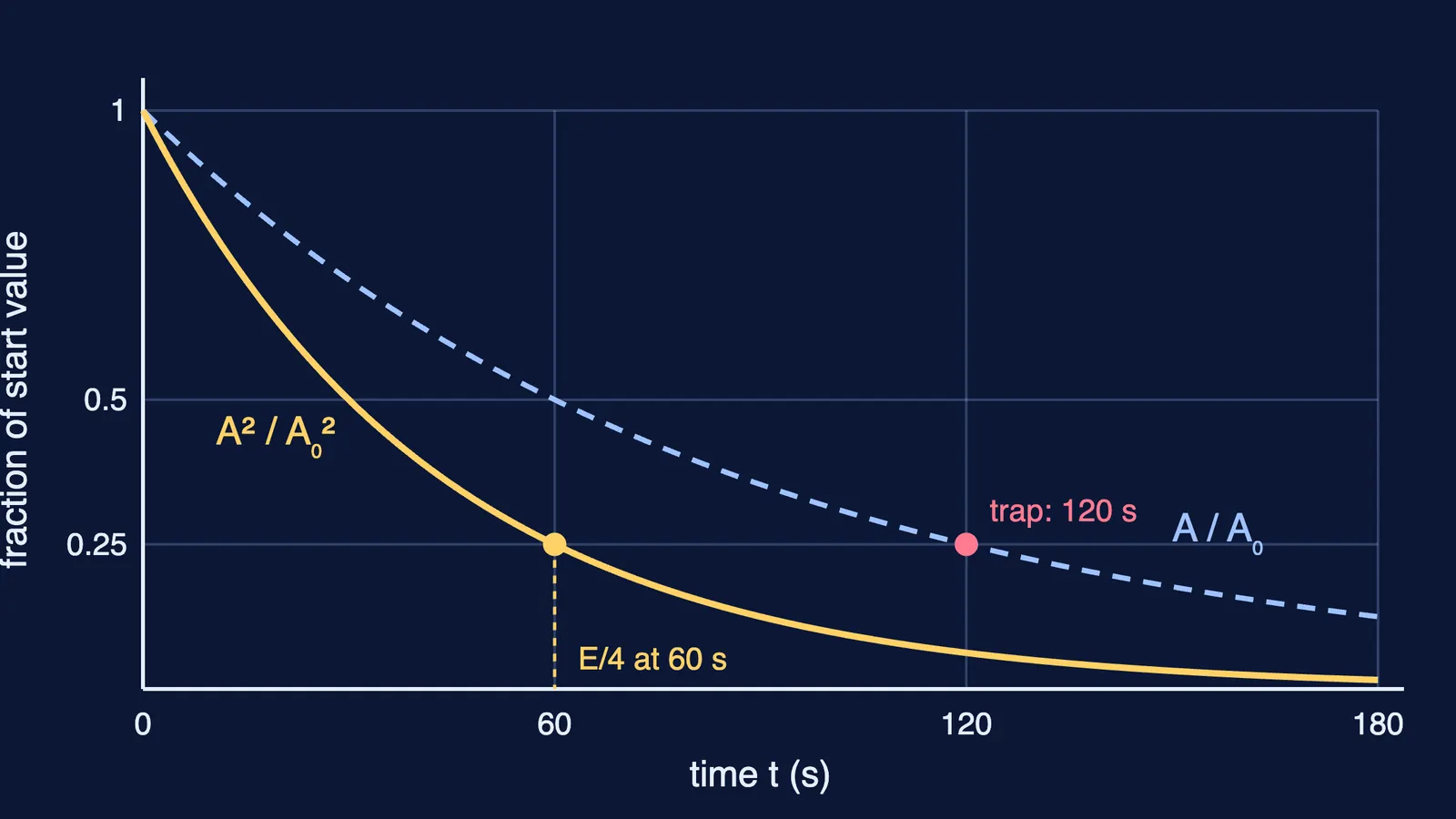
Q6 (medium). A damped pendulum's amplitude falls from 8.0 cm to 4.0 cm in 60 s, decaying exponentially. Its energy is proportional to the square of the amplitude. How long after the start has it lost 75% of its energy?
(A) 30 s (B) 60 s (C) 90 s (D) 120 s
Answer: (B). 25% of the energy remains when A² is a quarter of its start value, so A is half: 4.0 cm, reached at 60 s.
Trap: (D) treats energy as proportional to amplitude.
Hard: can you handle the method behind the number?
Q7 (hard, numerical value). To verify Ohm's law, a student plots current I on the y-axis against voltage V on the x-axis for a wire 1.00 m long with diameter 0.40 mm. The graph is a straight line through the origin with slope 0.25 A/V. Find the resistivity of the wire in units of 10⁻⁸ Ω m, to the nearest integer.
Answer: 50. The slope of I against V is 1/R, so R = 4.0 Ω. A = π(0.20 × 10⁻³)² = 1.257 × 10⁻⁷ m². ρ = RA/L = 4.0 × 1.257 × 10⁻⁷ / 1.00 = 5.03 × 10⁻⁷ Ω m, which is 50 in these units.
Trap: 3, from taking R as the slope itself, 0.25 Ω.
Q8 (hard). A pin 30.0 cm in front of a convex lens of focal length 20.0 cm forms a real image. A convex mirror is placed on the far side of the lens, 40.0 cm from it. The image now falls back on the object pin with no parallax. What is the focal length of the convex mirror?
(A) 10.0 cm (B) 20.0 cm (C) 30.0 cm (D) 40.0 cm
Answer: (A). The lens alone forms the image at v: 1/v = 1/20 − 1/30, so v = 60.0 cm. Rays retrace only if they meet the mirror normally, so its centre of curvature is that image point. R = 60.0 − 40.0 = 20.0 cm, and f = R/2 = 10.0 cm.
Trap: (B) stops at the radius of curvature and forgets to halve it.
What should you do after this set?
For each miss, write one line for that experiment: what is varied, what is read, what is calculated.
If you reach right numbers by wrong methods, the Fermi Problem Library has worked problems with a step-by-step solver that explains the reasoning rather than printing an answer.
Try the set again in a week, without notes.


