

On this page
NCERT gives eosinophils one line: they are 2-3 per cent of white blood cells, resist infections and are associated with allergic reactions (NCERT Biology Class 11, Chapter 15). It does not say why a roundworm infection pushes that number up. The answer is a problem of size, and it also explains why the same cells turn up in allergies. For a refresher on the white cell types, see our guide to formed elements of blood and WBC types.
Why can't phagocytes just eat a worm?
Phagocytosis means a cell wraps its membrane around a target and swallows it. That works for bacteria. It fails for worms, which are thousands of times longer than the cell.
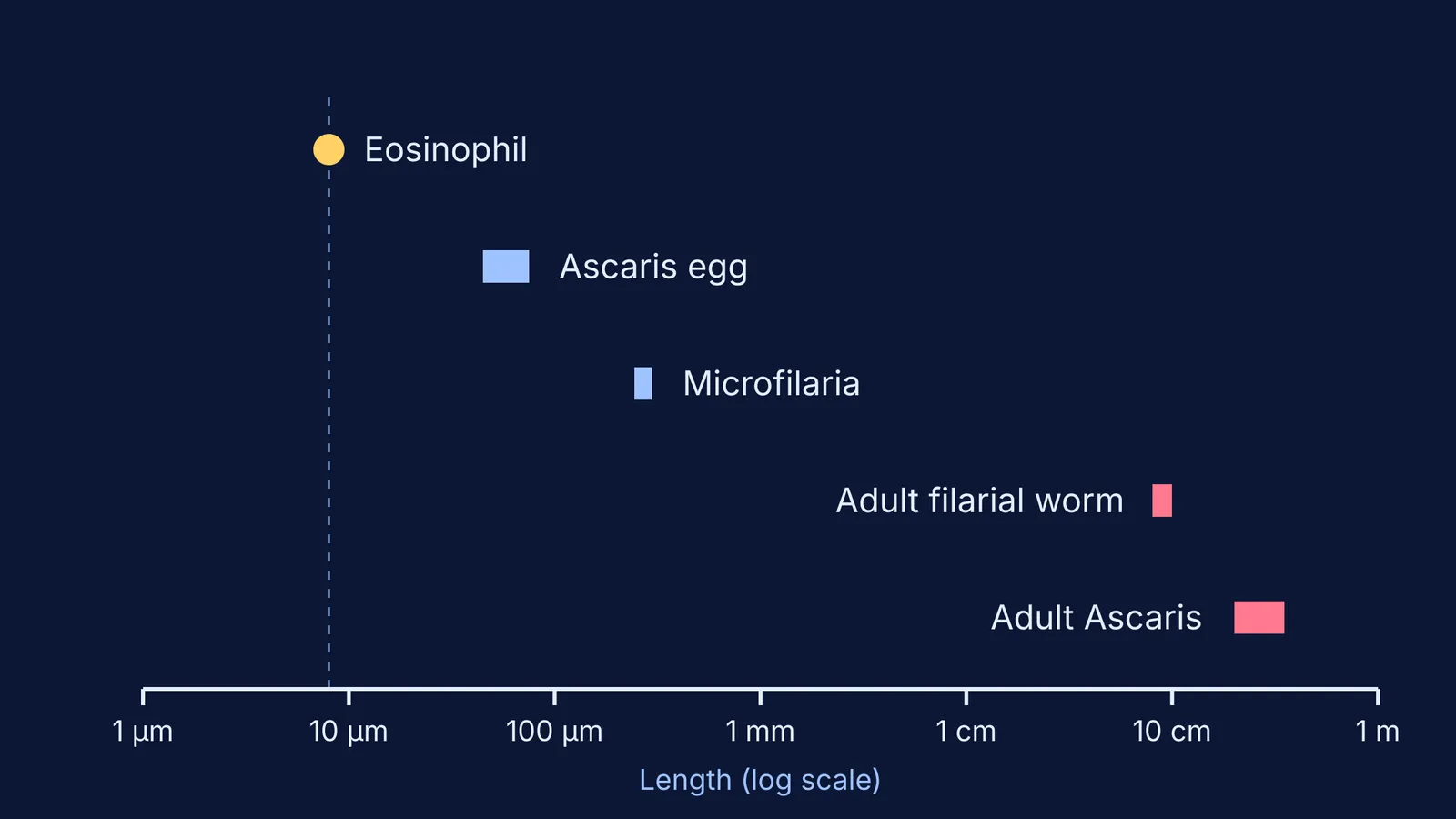
Human eosinophils are approximately 8 micrometres across (British Society for Immunology). Adult female Ascaris lumbricoides are 20 to 35 cm long, and their fertile eggs 45 to 75 micrometres (CDC DPDx, Ascariasis). Adult female Wuchereria bancrofti, the main filarial worm, measure 80 to 100 mm, and even their larvae, the microfilariae, measure 244 to 296 micrometres (CDC DPDx, Lymphatic filariasis).
A classic review by A. E. Butterworth put it plainly: worms "present to the host's defenses large, non-phagocytosable surfaces" (Butterworth, Advances in Parasitology, 1984). So the body needs a weapon that works from the outside.
How big is a worm next to an eosinophil?
Multiply every length by 200,000, so an 8-micrometre eosinophil (BSI) becomes a 1.6 m tall person. Using the CDC sizes for Ascaris and filarial worms:
An Ascaris egg becomes 9 to 15 m long.
A microfilaria becomes 49 to 59 m long.
An adult female filarial worm becomes 16 to 20 km long.
An adult female Ascaris becomes 40 to 70 km long.
Nobody can swallow a 40 km rope. A crowd with spray cans can still damage it, and that is roughly the eosinophil's strategy.
How do eosinophils and IgE attack a worm instead?
Butterworth's review states that helminth infections are "characterized by high IgE responses and increased numbers of circulating eosinophils" (Butterworth, 1984). The chain runs like this:
Th2 helper T cells release the cytokines IL-4 and IL-5. Newly arrived Ethiopian immigrants to Israel who carried worm infections showed raised IgE, raised eosinophils and more IL-4 and IL-5 secretion (Weisman and colleagues, Pathogens and Immunity, 2017).
IL-5, together with the chemokine CCL11, drives the final maturation and release of eosinophils from the bone marrow, so their blood count rises (BSI).
B cells make IgE against worm antigens. IgE, along with IgG and complement, lets eosinophils attach to the worm (Butterworth, 1984).
The attached eosinophil releases its granules onto the worm. They hold cationic toxins that can kill helminths (Gleich and colleagues, Annual Review of Medicine, 1993); major basic protein is one of these eosinophil granule proteins (BSI).
Mast cells release mediators through IgE-dependent degranulation, which can activate eosinophils further. Butterworth called this the eosinophil/IgE/mast cell axis.
A caveat: eosinophils kill worms well in a dish, but their exact role inside the body is still poorly understood, and they cause a considerable amount of the inflammation in worm infections (Klion and Nutman, Journal of Allergy and Clinical Immunology, 2004).
How are Ascaris and filaria linked to allergy?
Allergy uses the same IgE, mast cell and eosinophil machinery, aimed at a harmless target such as pollen. Gleich's review notes that in asthma eosinophils release major basic protein that damages tissue, and that IL-5 is associated with both helminth infection and hypersensitivity (Gleich and colleagues, 1993). The BSI puts the normal eosinophil share lower than NCERT, at about 0.5-1 per cent of white cells, and says it is often raised to 3-5 per cent in people with allergic symptoms (BSI). Our explainer on why allergies happen: IgE, mast cells and histamine covers that side.
Worms are common. The WHO estimates 1.5 billion people, 24% of the world's population, are infected with soil-transmitted worms such as Ascaris (WHO fact sheet), and over 657 million people in 39 countries remain threatened by lymphatic filariasis (WHO fact sheet). For how each disease spreads, see ascariasis, filariasis and ringworm: causes and spread.
The change also reverses: in the Ethiopian study, 33 people successfully treated for worms showed significant normalisation of these immune changes, while 19 who missed treatment did not (Weisman and colleagues, 2017).
How do you write this as a 3-mark answer?
Cover these five points in order:
Size: Ascaris and filarial worms are far too large for phagocytes to engulf.
Signal: Th2 cells release IL-4 and IL-5; IL-5 raises eosinophil numbers.
Antibody: IgE coats the worm and binds mast cells.
Attack: eosinophils attach and release granule toxins such as major basic protein.
Link: the same pathway causes allergy when the trigger is harmless.
The Fermi Concept Library gives each biology concept its own lesson and its place in the map, so you can see how antibodies, granulocytes and allergy connect. For practice questions, the Fermi Problem Library has a step-by-step solver that explains the reasoning rather than printing an answer.


