

On this page
You have probably heard it from a PE teacher or a fitness reel: exercise releases endorphins, and that is why you feel good afterwards. The research tells a more interesting story. Endorphins do rise during exercise, but the best human evidence now points to a different family of molecules, the endocannabinoids, as the main candidates for the runner's high. Here is what each study actually showed, and a quick way to check the next claim you read.
What are endorphins and where are they made?
β-endorphin is a peptide cut from a larger precursor protein called pro-opiomelanocortin (POMC), and it acts mainly on mu opioid receptors, according to a 2020 review in the International Journal of Molecular Sciences.
The same review says β-endorphins are produced mainly in the anterior lobe of the pituitary gland and in POMC cells in the hypothalamus. If those two structures feel hazy, our guide to chemical coordination and integration in Class 11 covers where they sit and what they control.
They are known for strong pain relief, and they are also involved in reward. The review also notes that exercise raises circulating β-endorphin levels, depending on the type and intensity of exercise. So the first half of the popular claim is true: endorphins go up.
Do endorphins from exercise reach your brain?
This is where the popular story breaks down. A review by Siebers, Biedermann and Fuss in The Neuroscientist states that peripheral endorphins cannot cross the blood-brain barrier because they are hydrophilic (water-loving). The 2020 review above is a little softer: it cites evidence that such peptides cross to a degree, but adds that levels in the blood and in the fluid around the brain are not necessarily related.
Either way, a blood test showing more endorphins after a run tells you very little about what is happening at the receptors on your neurons. For a refresher on neurons and synapses, see our notes on neural control and coordination.
What did the 2008 brain-scan study find?
The strongest evidence for endorphins came from a 2008 study in Cerebral Cortex by Henning Boecker and colleagues. The team used PET scans on ten athletes, once at rest and once after two hours of endurance running.
After running, fewer opioid receptors were free to bind a tracer in prefrontal and limbic brain regions, and the runners who reported more euphoria showed lower binding in areas including the prefrontal cortex, anterior cingulate and insula. The authors read this as the brain's own opioids occupying those receptors.
That is an indirect measure in ten people, after a long run. The 2021 trial below says these findings leave the door open for opioids playing a role in more intense or longer endurance exercise.
What do endocannabinoids have to do with the runner's high?
Endocannabinoids are fat-soluble signalling molecules your body makes itself, such as anandamide and 2-AG, and the Neuroscientist review notes that they cross the blood-brain barrier easily.
Humans and dogs: a 2012 study in the Journal of Experimental Biology found endocannabinoid signalling rose significantly after high-intensity treadmill running in humans and dogs, but not after slow walking, and not in ferrets at any intensity.
Mice: a 2015 PNAS study found wheel running raised endocannabinoids and reduced anxiety and pain. Removing or blocking cannabinoid receptors stopped those effects.
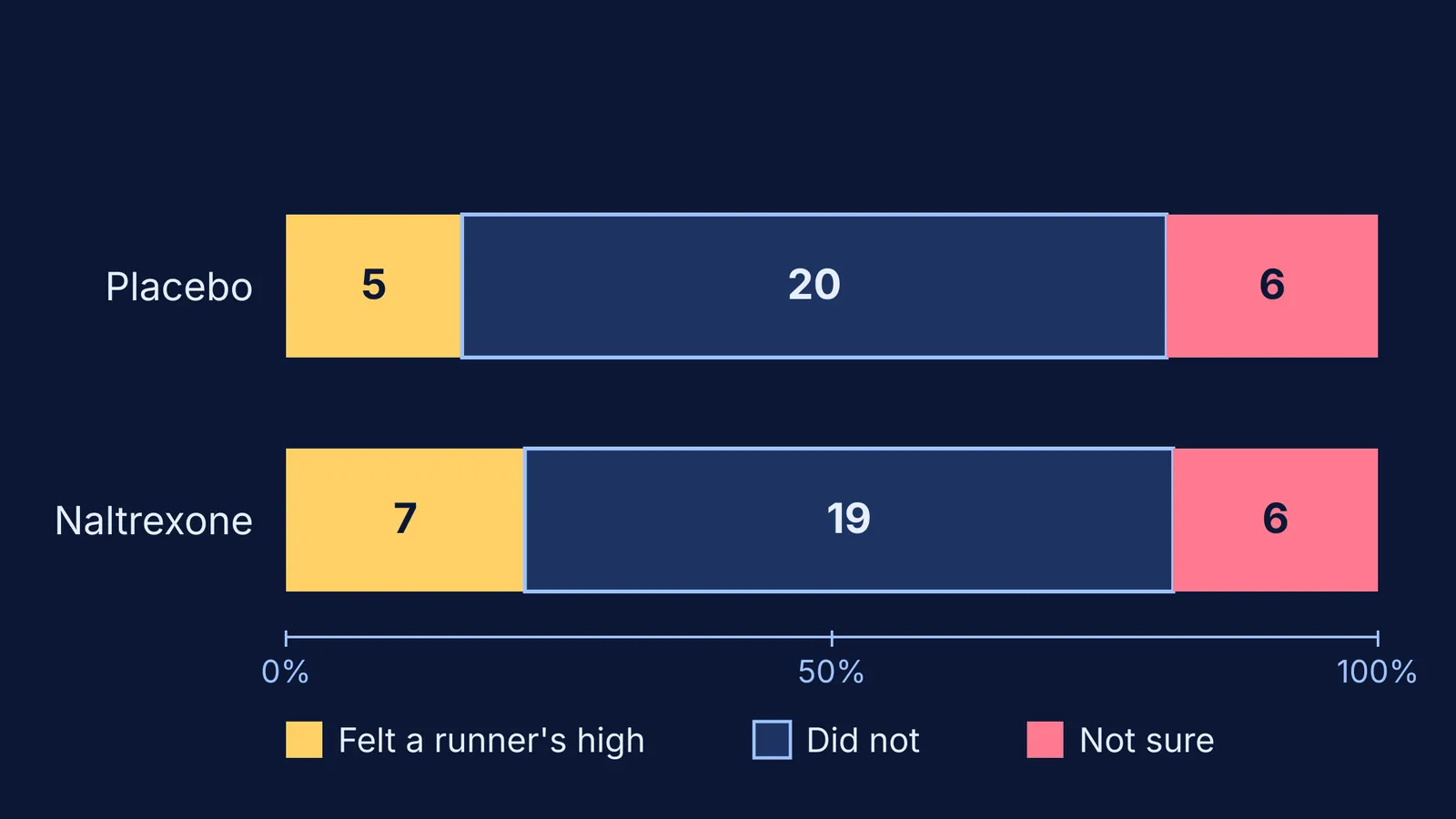
Humans, with a blocker: a 2021 double-blind trial in Psychoneuroendocrinology gave 63 adults either 50 mg of naltrexone, which blocks opioid receptors, or a placebo, then had each of them run for 45 minutes and, on another day, walk for 45 minutes.
In that trial, euphoria roughly doubled after running, anxiety was lower after running than after walking, and anandamide and 2-AG rose. Naltrexone prevented none of it. In the lab, 5 of 31 people on placebo and 7 of 32 on naltrexone said they had felt a runner's high, a difference the authors found was not significant.
How do you check a happy-hormone headline?
Before you believe or share the next one, ask four questions:
Which molecule, measured where: blood, or brain?
Was it tested in people or in animals?
Did the researchers block something to test cause, or only measure a rise?
How many people, and what kind of exercise, for how long?
Worked example: "Running floods your brain with endorphins." Endorphins, yes. Measured in the brain? Only indirectly, in the 2008 PET study. Humans? Yes, ten. Blocked? Not there; when the 2021 trial blocked opioids, the good feeling stayed. Verdict: the claim overstates what was shown.
POMC, the pituitary and receptor types also come up in board biology. If a term in this chain is a gap for you, the Fermi Concept Library has a lesson for every concept in biology, chemistry and physics.
If you want a short screen-free break on study days, our 10-minute nature break plan is a good start. And if low mood or anxiety is sticking around, talk to a doctor or counsellor, or call Tele MANAS on 14416, a free government mental-health helpline.


