

On this page
Hormones are chemical messages. A gland releases a molecule, it travels in the blood, and only cells with the matching receptor respond. An endocrine disruptor is an outside chemical that gets into that conversation. In plastics, the best-known example is bisphenol A (BPA), and since 2023 regulators have moved on it, though not all in the same direction.
What are endocrine disruptors, exactly?
The World Health Organization defines an endocrine disruptor as "an exogenous substance or mixture that alters function(s) of the endocrine system and consequently causes adverse health effects", as quoted by Germany's Federal Institute for Risk Assessment (BfR, questions and answers on endocrine disruptors).
The last part matters. BfR separates a substance that is merely *endocrine active*, whose effect the body can compensate for, from a true disruptor, which causes harm the body cannot compensate for. Headlines often blur the two.
The same BfR page lists four ways these chemicals can act:
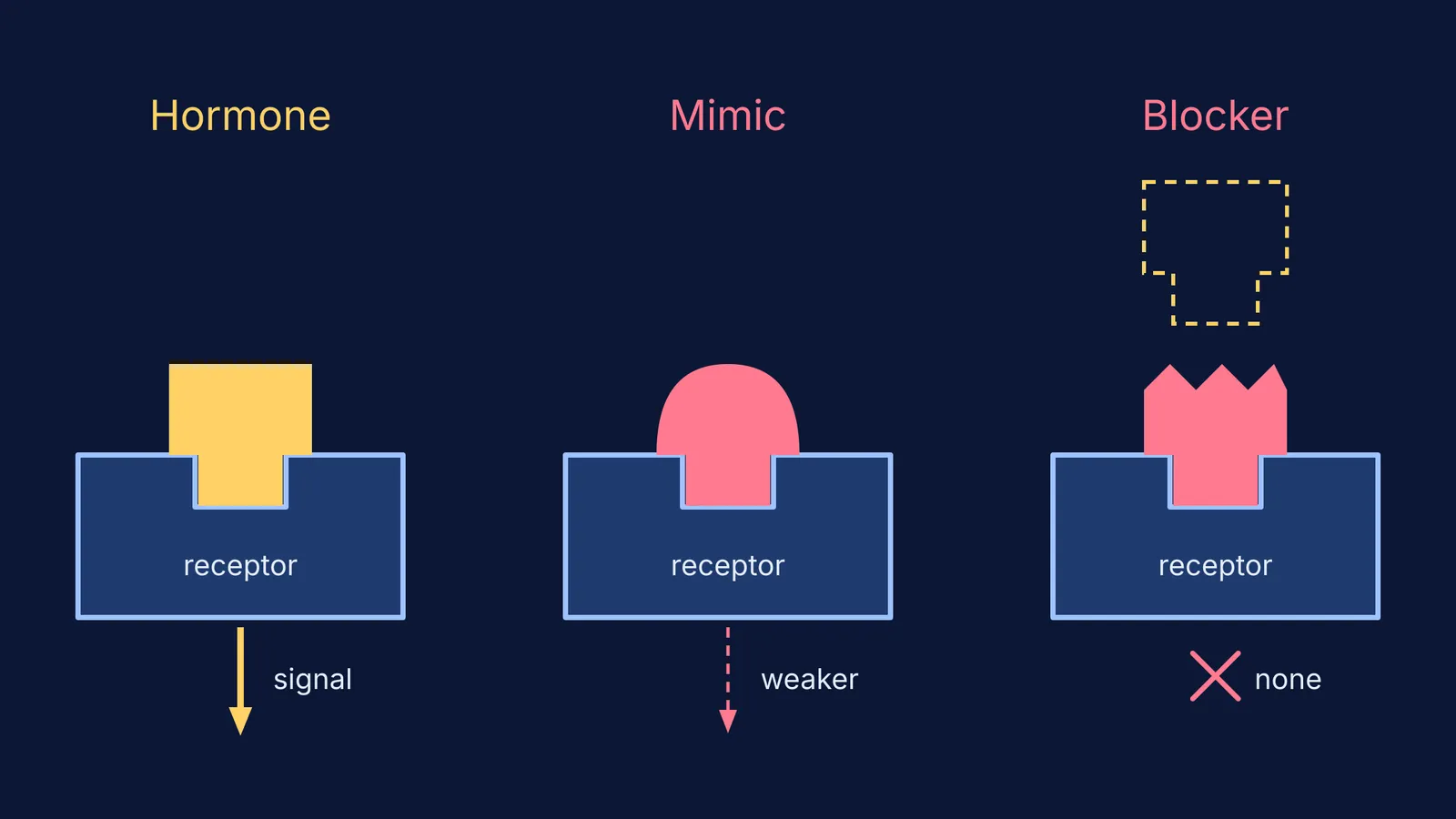
mimicking a natural hormone at its receptor
blocking the receptor so the real hormone cannot bind
interfering with how hormones are made or broken down
changing how hormones are transported in the body
For what the sex hormones normally do, see our explainer on the functions of androgens, oestrogens and progesterone.
How can BPA mimic or block a hormone?
Think of a receptor as a pocket with a particular shape. When oestradiol, the main oestrogen, sits in it, the receptor switches certain genes on.
BPA can sit in that pocket too, but far more weakly. A 1998 study in *Endocrinology* found that oestrogen-like environmental chemicals, including BPA, "compete with E2 for binding" to both types of oestrogen receptor, and that in most cases their relative binding affinity was at least 1000-fold lower than oestradiol's (Kuiper et al., 1998).
The same molecule can act differently at another receptor. In a 2013 cell study, BPA switched on oestrogen receptor alpha (acting as an agonist) but blocked the androgen receptor (acting as an antagonist): it could bind the androgen receptor but not activate it (Teng et al., 2013, Chemico-Biological Interactions).
That is the agonist and antagonist idea from your biology syllabus. If receptor binding still feels abstract, the Fermi Concept Library gives each biology and chemistry concept its own lesson and shows where it sits in the map.
What do regulators actually say about BPA?
The big disagreement is over how much exposure is safe.
European Food Safety Authority (EFSA), April 2023: it set a tolerable daily intake of 0.2 nanograms per kilogram of body weight per day, around 20,000 times lower than its previous 4 micrograms (EFSA). The deciding effect was a rise in T helper cells, a type of white blood cell, in animal studies. It found that people with average and high exposure, in all age groups, exceeded the new limit.
BfR, Germany: it derived a limit of 200 nanograms per kilogram per day, 1000 times higher than EFSA's, arguing that the immune finding is not suitable for predicting harm in humans (BfR on BPA).
European Commission, 19 December 2024: it banned BPA in food-contact materials, including can coatings, reusable plastic drink bottles and water coolers, giving most products 18 months to phase it out (European Commission).
US Food and Drug Administration: it states that "BPA is safe at the current levels occurring in foods". It stopped authorising BPA-based polycarbonate in baby bottles and sippy cups in 2012, after industry had abandoned that use (FDA).
Is BPA banned in India?
For baby feeding bottles, yes. The Bureau of Indian Standards revised the feeding-bottle standard IS 14625 in 2015 to prohibit BPA (Down To Earth). The same report describes a 2019 test by the advocacy group Toxics Link: all 20 bottles and sippy cups collected from eight states released BPA in the first test, at 0.9 to 10.5 parts per billion.
How should you read the next BPA headline?
Run any claim through five questions:
Disruptor or only endocrine active? Did the study show harm, or only an effect on hormones?
What dose? Compare it with a stated limit, such as EFSA's or BfR's.
Cells, animals or people? A cell result shows a mechanism, not a health outcome.
Which receptor, which direction? Does the chemical mimic the hormone or block it?
Who said it, and when? A regulator's current page beats an old news story.
Worked example. A headline says: "Europe says BPA is 20,000 times more dangerous." Question 2 shows that 20,000 describes how much EFSA's safe limit was cut, not how toxic BPA became. Question 3: the deciding evidence came from animals. Question 4: the deciding effect was on immune cells, not a hormone receptor. Question 5: BfR disputes the cut, while the EU acted on it in 2024. A fairer headline: "EU food agency sets a much lower safe limit for BPA; German agency disputes it."
This post is not medical advice; if you have a health concern, talk to a doctor. Next, see what the plastic recycling numbers 1 to 7 can and cannot tell you, and where microplastics come from and what is known about their health effects.


