

On this page
Plastic does not disappear; it breaks into smaller pieces. Here is where those pieces come from, how labs count them, and what the health evidence really says.
What are microplastics, and how small is small?
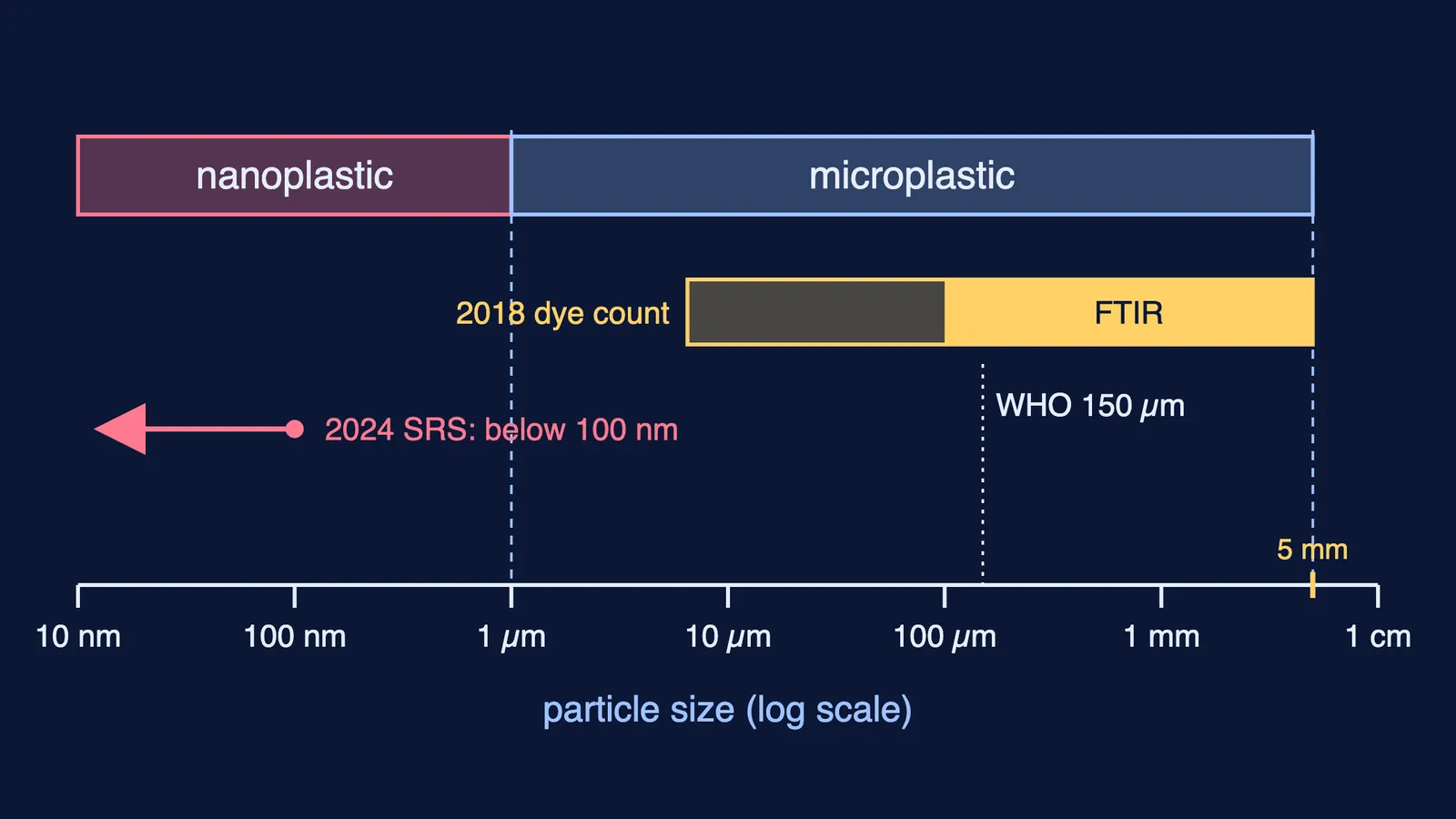
Microplastics are plastic pieces less than 5 millimetres long, according to the US National Ocean Service (NOAA).
Many chemists add a lower limit: a 2024 study in PNAS defines microplastics as 1 µm to 5 mm, and nanoplastics as anything smaller than 1 µm. A micrometre (µm) is a thousandth of a millimetre, so the biggest microplastic is 5,000 times wider than the smallest.
If polymer names like polyethylene and PET feel hazy, the Fermi Concept Library has a lesson for every concept in chemistry.
Where do microplastics come from?
Scientists sort them into two groups, as the IUCN report Primary microplastics in the oceans explains:
Primary microplastics are released already small: microbeads in face scrubs, plastic pellets, dust worn off tyres, fibres shed when synthetic clothes are washed.
Secondary microplastics form when larger items, such as bags and fishing nets, break down in sunlight and waves.
The IUCN model estimated that primary microplastics put about 1.5 million tonnes of plastic into the oceans each year, two-thirds of it from synthetic textiles and tyres. Its authors note this is a model, not field measurements.
IIT Bombay researchers found microplastics in all eight Indian sea salt brands they tested, at averages of 56 to 103 particles per kilogram, carried in by the sea water the salt is made from.
How do scientists count microplastics in water and salt?
The usual steps, from a review of extraction methods and the 2018 bottled-water study:
Collect. Dissolve the salt in water, then pass the water through a filter.
Clean up. Remove plant bits, sand and other natural material, by digesting it or separating by density.
Stain and count. The bottled-water study used Nile Red, a dye that clings to plastic and glows under the microscope.
Confirm. Infrared spectroscopy (FTIR) identifies the polymer. In that study only particles above 100 µm could be checked, and half were confirmed as plastic.
Subtract the lab's own plastic. The 2018 study corrected for background contamination, such as fibres from air and clothing.
The smallest size a method can see sets the answer. The 2018 study found an average of 10.4 particles per litre above 100 µm, and 325 per litre down to 6.5 µm. The 2024 PNAS study, using a laser method (SRS microscopy) that sees particles below 100 nm, estimated about 240,000 particles per litre of bottled water, around 90% of them nanoplastics.
A worked example: salt versus bottled water
Take the highest brand average from the IIT Bombay salt study, 103 particles per kg, and suppose an adult eats WHO's upper limit of less than 5 g of salt a day.
5 g = 0.005 kg.
0.005 kg × 103 particles/kg = 0.515 particles a day.
0.515 × 365 days ≈ 190 particles a year.
By mass, using the study's overall 63.76 µg per kg: 0.005 × 63.76 ≈ 0.32 µg a day.
Compare one litre of bottled water at the 2018 study's average of 325 particles: 325 ÷ 0.515 ≈ 630, so one litre holds about as many counted particles as 630 days of salt. The studies used different methods and size limits, so this is rough; still, salt looks like a small route.
Unit chains like this are where exam marks get lost too. The Fermi Problem Library has worked problems with a step-by-step solver that explains the reasoning rather than printing an answer.
Are microplastics harmful to health?
What WHO found. Its 2019 analysis of microplastics in drinking water found that particles larger than 150 µm are unlikely to be absorbed, and uptake of smaller ones is expected to be limited. Dr Maria Neira, Director of WHO's Department of Public Health, Environment and Social Determinants of Health, said: "Based on the limited information we have, microplastics in drinking water don't appear to pose a health risk at current levels. But we need to find out more."
What is not known. In a 2024 study in the New England Journal of Medicine of patients having neck-artery plaque removed, polyethylene was found in the plaque of 150 of 257 patients (58.4%). Patients whose plaque held micro- or nanoplastics had a higher risk of heart attack, stroke or death from any cause over about 34 months than those whose plaque did not (hazard ratio 4.53). The study was observational: it shows a link, not that plastic caused the events. WHO noted that nano-sized particles may be absorbed more, but the data are extremely limited.
For a specific health worry, talk to a doctor rather than rely on a headline. Before trusting a quick summary, try this one-minute check on AI search answers.
How do you judge a microplastics headline?
Size: down to what size were particles counted?
Sample: how many brands, bottles or people, and from where?
Blanks: did the lab subtract its own contamination?
Cause: is it an experiment, or a link seen in an observational study?
Next, read whether biodegradable PLA plastic really breaks down and how reverse osmosis turns seawater into drinking water.


