

On this page
PLA (polylactic acid) is the clear plastic in many ‘eco’ cups, straws, food boxes and 3D-printer filament. It is often sold as biodegradable, and in the right place it is. The catch is the right place: a hot, wet, microbe-rich industrial compost heap, not a roadside drain, a field or the sea.
What is PLA, and how does it break down?
PLA is a polyester: lactic acid units joined in long chains by ester bonds. Bio-based polyesters like it have monomers linked by ester bonds, and their degradation products can finally be metabolised to water and carbon dioxide, according to a 2021 study in Polymers.
So the breakdown happens in two stages:
Water attacks the ester bonds (hydrolysis), cutting the long chains into shorter ones until the pieces are small enough for microbes to take in.
Bacteria and fungi use those small pieces as food and release carbon dioxide and water. Chemists call this second stage mineralisation.
The first stage is the bottleneck. If the chains stay long, microbes have nothing they can eat. You can compare this with two other polymers made to break down in our post on PHBV and nylon-2–nylon-6 and why they degrade.
What conditions does PLA need to break down?
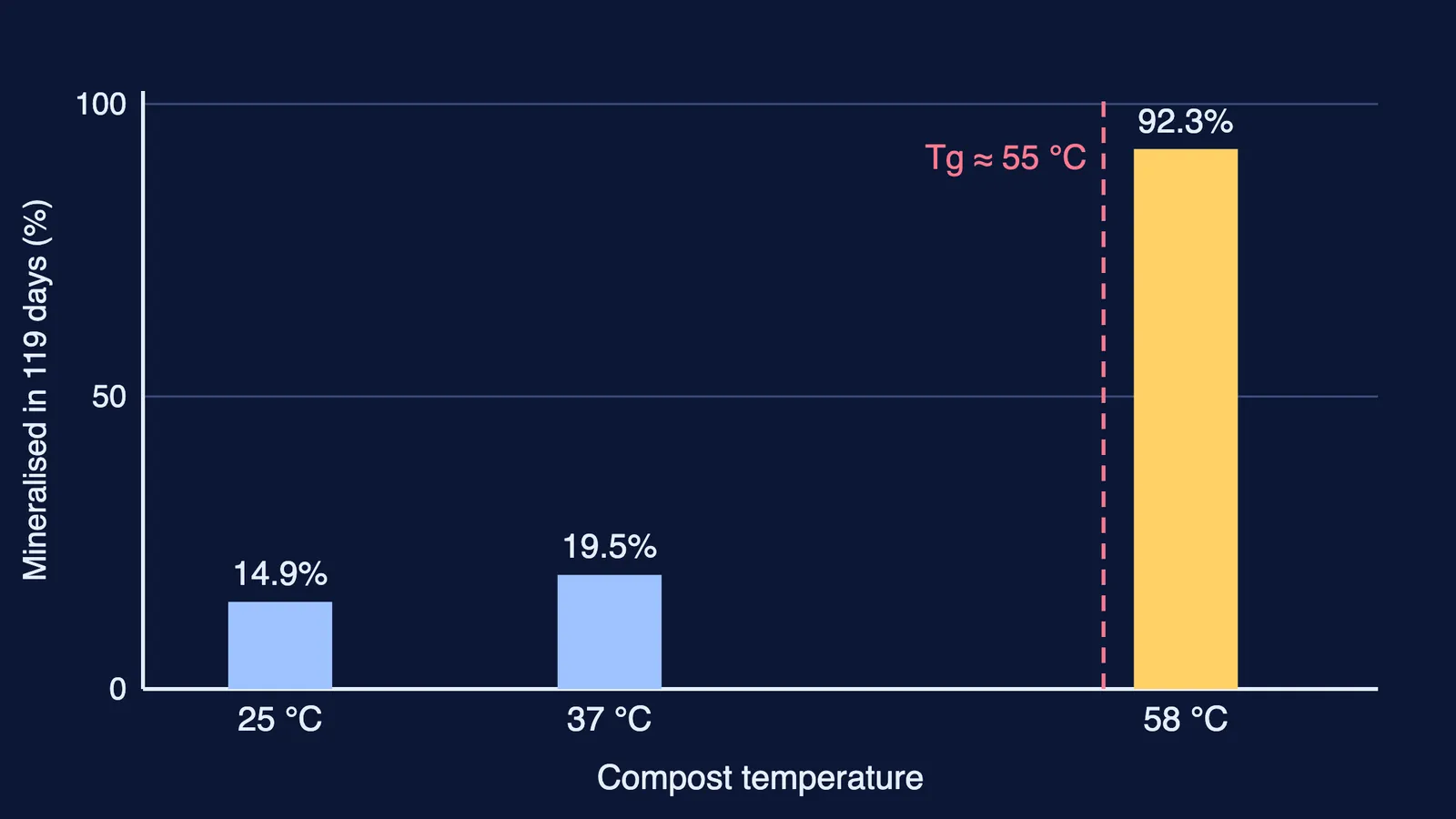
Heat matters most. PLA needs temperatures well over 50 °C to begin biodegrading, and its glass transition temperature is about 55 °C, a 2022 study in Polymers notes. The authors link the two: above the glass transition, the rigid chains loosen and hydrolysis speeds up.
The same paper cites a compost experiment on PLA-based materials run for 119 days at three temperatures: mineralisation reached 92.3% at 58 °C, but only 19.5% at 37 °C and 14.9% at 25 °C.
Industrial composting supplies all three needs at once. Under the EN 13432 standard it means 55–60 °C, about 60% water and oxygen, and dense microbes. Part of that heat comes from the microbes themselves, as our post on why a compost pile gets hot inside explains. Even so, the same paper notes that a typical simple composting plant stays above 50 °C for only about two to three weeks.
If glass transition or ester hydrolysis is new to you, the Fermi Concept Library has a lesson for every concept in chemistry, each with its place in the map.
Does biodegradable plastic break down in soil, the sea or a home compost bin?
Often not fully. A three-year experiment at the University of Plymouth exposed carrier bags to open air, soil and sea. The compostable bag disappeared from the marine test rig within three months but was still present in soil after 27 months, and the ‘biodegradable’ and oxo-biodegradable bags still worked as carrier bags after more than three years in soil or sea. The study is Napper and Thompson, Environmental Science & Technology, 2019.
Home compost is gentler than industrial compost. In the UK's Big Compost Experiment, 60% of the plastics certified ‘home compostable’ did not fully disintegrate under home composting conditions.
Materials can be designed to do better: the 2022 Polymers study found that some PLA/PHB blends fully biodegraded under home-composting conditions within about six months. That is a specific lab-tested blend, not a promise about every PLA cup.
What do ‘compostable’ and ‘biodegradable’ mean on Indian labels?
In a public notice dated 8 September 2026, the Central Pollution Control Board said the two words are not interchangeable under the Plastic Waste Management Rules, 2016:
Compostable plastics break down during composting, must meet IS/ISO 17088:2021, and must be labelled “compostable only under industrial composting”.
Biodegradable plastics must break down in a specific environment such as soil or water without leaving microplastics, and the label must state the number of days and the environment.
Both need a CPCB certificate before sale. As of 23 July 2026, CPCB had certified 371 manufacturers of compostable carry bags and commodities, and no manufacturer of biodegradable ones.
Five common myths, checked
‘Biodegradable means it disappears anywhere.’ PLA needs heat above its glass transition, moisture and microbes.
‘Broken into bits means biodegraded.’ In the Plymouth study, every material fell into fragments after nine months in open air. Fragments are not carbon dioxide and water.
‘A home compost bin will do.’ Most certified home-compostable items in the UK trial did not fully disintegrate.
‘Plant-based means compostable.’ What decides the end is the chemistry and the conditions, not where the raw material grew.
‘Any bag sold as biodegradable in India is certified.’ CPCB says no biodegradable manufacturer had been certified as of July 2026.
A 30-second label check: look for the words “compostable only under industrial composting” and a CPCB certificate; for a biodegradable claim, look for a stated number of days and a named environment. If either is missing, treat it like ordinary plastic and follow your local body's segregation rules.
For more polymer practice, try calculating the degree of polymerisation of polythene and nylon-6,6, and check your method in the Fermi Problem Library, whose step-by-step solver explains the reasoning rather than printing an answer.


