

On this page
Push your hand into the middle of a week-old heap of vegetable peels and dry leaves and it can feel warm, sometimes steaming on a cold morning. Nothing is burning. The heat comes from huge numbers of microbes respiring as they eat, and from the heap itself, which works like a blanket. Two chapters you study separately, respiration and decomposers, meet in one pile of kitchen waste.
What makes a compost pile heat up?
The workers in a compost pile are decomposers: bacteria, fungi and other microbes that feed on dead organic matter. The US Environmental Protection Agency puts their needs simply: microorganisms "use carbon and nitrogen to grow and reproduce, water to digest materials, and oxygen to breathe". Our notes on the role of decomposers in an ecosystem cover the basics.
That "breathe" is aerobic respiration, the same reaction your cells run: glucose plus oxygen gives carbon dioxide, water and energy. One mole of glucose (180 g) releases 686 kcal, about 2,870 kJ, when it reacts with oxygen, according to a teaching module on ATP efficiency by Beals, Gross and Harrell. The same module works out that only about 38% of that energy is captured in ATP under standard conditions (roughly 50% under cell conditions), and "some energy is lost as heat".
Cornell University's composting guide states it directly: "Compost heat is produced as a by-product of the microbial breakdown of organic material." Sprouting seeds do the same, as in the thermos flask experiment with germinating seeds.
Why is the middle hotter than the outside?
Heat is made everywhere inside the heap but can only leave through its surface. Cornell's guide explains that the smaller the pile, "the greater the surface area-to-volume ratio, and therefore the larger the degree of heat loss", and that heat production depends on the pile's size, moisture, aeration and carbon-to-nitrogen ratio.
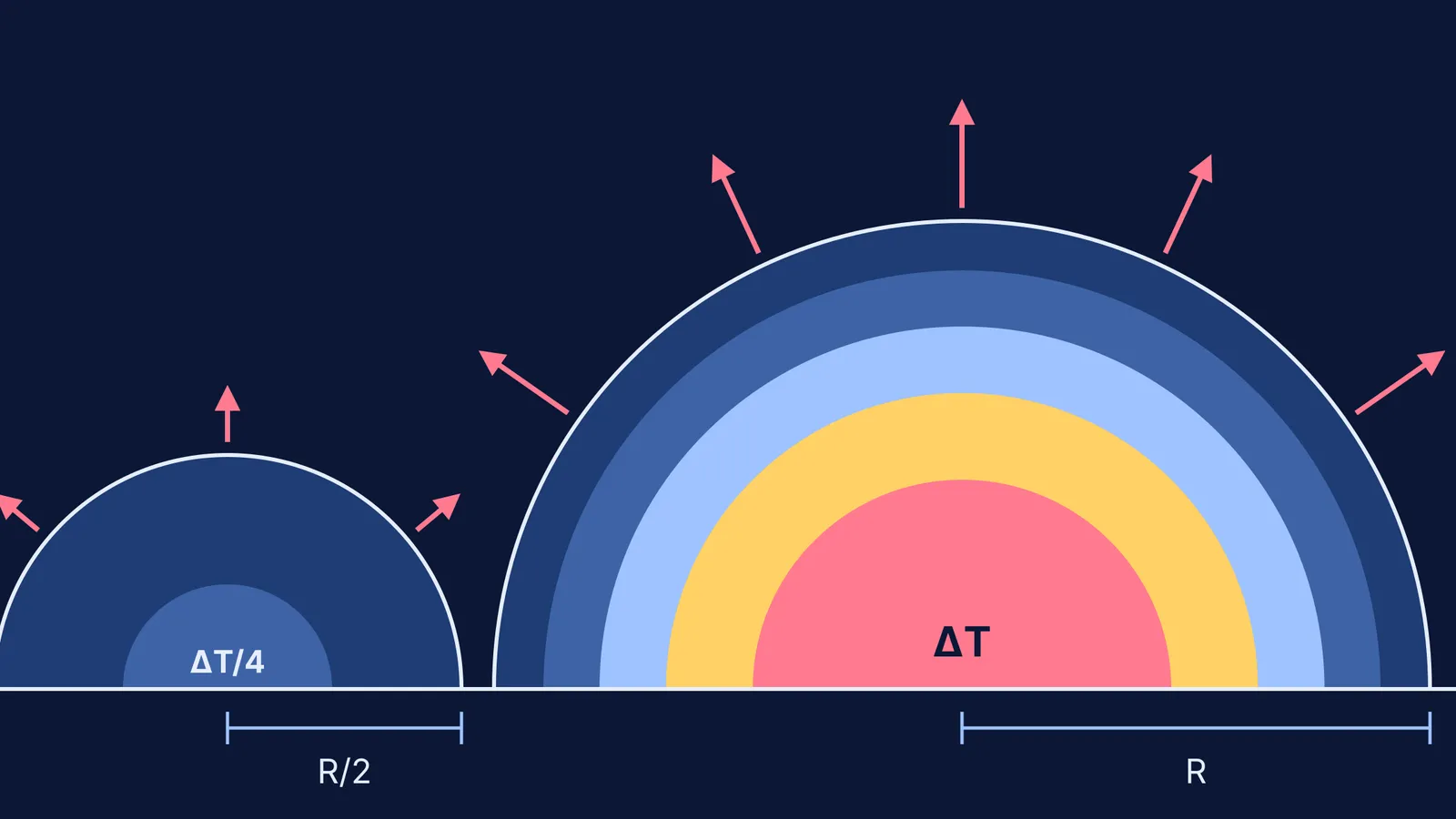
Heat made grows with volume (width cubed), heat lost grows with surface (width squared), and heat from the centre has the farthest to travel. In a simple model of a heap that makes heat evenly and loses it only by conduction, the heat-conduction equation gives a core temperature rise that grows with the square of the heap's radius. Halve the width and the core warms only a quarter as much, which is why a handful of peels in a pot never feels warm.
If that size effect is hard to picture, the Fermi Simulation Lab has interactive simulations for ideas that are easier to see than to read.
How hot does a compost pile get?
Cornell describes the stages on its compost microorganisms page:
Mesophilic phase: 0-40°C, lasting a couple of days, while microbes break down the compounds that degrade most easily.
Thermophilic phase: above about 40°C, lasting from a few days to several months. At 55°C and above, many human and plant pathogens are destroyed.
Cooling and maturation: several months as the pile cools.
The EPA says a well-kept backyard pile can reach 130-160°F, about 54-71°C. Too hot is a problem: Cornell notes that temperatures over about 65°C kill many microbes and slow decomposition, and its home composting fact sheet warns that above 71°C the compost can sterilise itself. A 2023 review in Chemical and Biological Technologies in Agriculture notes that the heat-loving genera Bacillus and Thermus are often described as the main components of compost microbiota (Finore et al., 2023).
How much food does it take to warm a heap?
A rough worked example:
Take a 50 kg heap and treat it like water. Water's specific heat is 4.184 J per gram per °C (LibreTexts Chemistry).
Warming it from 25°C to 65°C needs 50,000 g × 4.184 × 40 = about 8,400 kJ.
One kilogram of glucose is about 5.6 moles, so it releases about 5.6 × 2,870 = 16,000 kJ (NIMBioS module).
If about 62% of that leaves as heat (100% minus the 38% caught in ATP under standard conditions), that is roughly 9,900 kJ.
So burning less than a kilogram of sugar-like food, under 2% of the heap's mass, could warm the whole heap by 40°C if no heat escaped. Real heaps leak heat and real waste is not pure sugar, which is why size and insulation decide whether a pile gets hot.
How can you test it at home or in school?
The EPA recommends mixing nitrogen-rich "greens" with carbon-rich "browns" and keeping the mix as damp as "a wrung-out sponge". Cornell says that for bin experiments a minimum of 10 gallons (about 38 litres) is needed for heat to build up within a few days.
Fill one large bin and one small pot with the same mix of peels and dry leaves.
Predict first: which will warm more, and will the centre or the edge be hotter?
Push a long probe thermometer into the centre and the edge of each, once a day, and plot the readings.
Turn the big bin once it is warm and record what happens next.
Wear gloves and wash your hands afterwards.
The small pot is your control for size. The carbon dioxide your microbes breathe out joins the cycle traced in carbon and phosphorus cycles explained.


