

On this page
Every living cell needs energy. Cellular respiration is the process that breaks down food molecules, like glucose, to release that energy. While some of the energy is captured in molecules of ATP to do cellular work, a large fraction of the original energy is released into the surroundings as heat. Cellular respiration yields around 29 to 30 ATP per glucose molecule 1, but the process is not perfectly efficient. Energy not captured in ATP is released into the surroundings as heat 1.
To see this metabolic heat with your own eyes, biology courses use the classic germinating seeds experiment. It compares a flask of live, growing seeds with a flask of dead ones to prove that respiration is an exothermic (heat-releasing) reaction.
Why do we use germinating seeds and a thermos flask?
Dry seeds are dormant. They have an extremely low metabolic rate, just enough to stay alive. But once they soak up water during germination, they reactivate their metabolic pathways and use stored nutrients to power the growing seedling 2. This sudden burst of activity makes them perfect for demonstrating heat production.
We place the seeds inside a vacuum flask (a thermos) because it acts as an insulator. If we used a normal glass beaker, the small amount of heat produced by the seeds would quickly escape into the surrounding air. The vacuum layer in the thermos traps the heat, allowing the temperature inside to rise enough for a thermometer to measure it.
What is the experimental setup for Flask A and Flask B?
The experiment uses two identical flasks to provide a clear comparison.
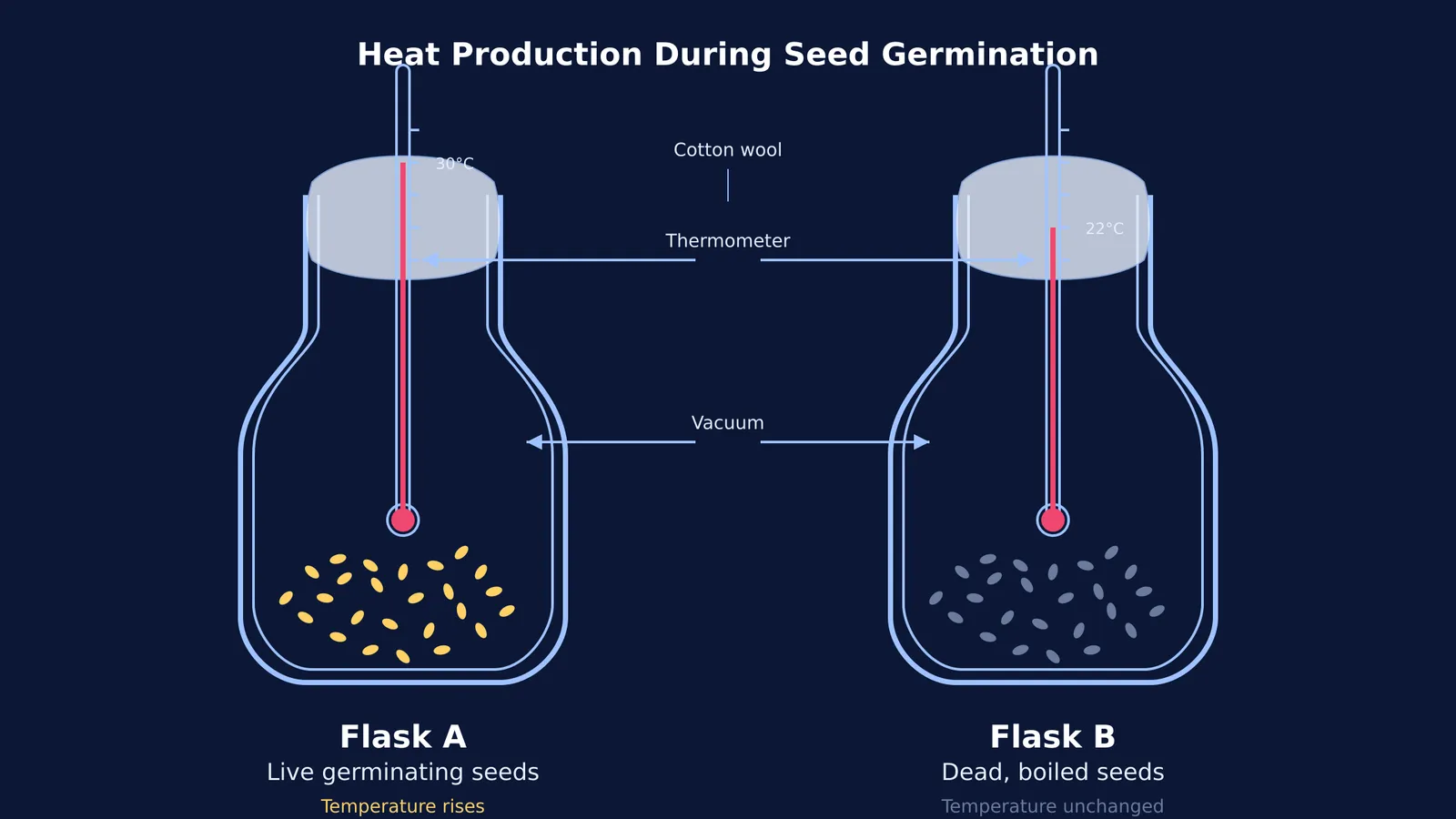
Flask A (The active setup): Contains seeds that have been soaked in water overnight and are actively germinating.
Flask B (The control setup): Contains seeds from the same batch that have been boiled. Boiling kills the plant embryos, meaning these seeds cannot germinate or respire.
Both flasks are plugged with moist cotton wool rather than a tight rubber or cork stopper. The cotton wool allows oxygen from the air to diffuse into the flask so the live seeds can carry out aerobic respiration, while still trapping most of the heat inside. A thermometer is pushed through the cotton wool so that its bulb rests deep inside the pile of seeds.
Why are the boiled seeds washed with formalin?
One of the most common questions examiners ask about this practical is the role of the antiseptic. The boiled seeds in Flask B are dead, but their organic matter is a rich food source for microorganisms.
If left alone in a damp, warm flask, bacteria and fungal spores from the air would quickly land on the dead seeds and start decomposing them. Because these microbes also carry out cellular respiration, they would release their own heat, causing the temperature in Flask B to rise. This would ruin the control experiment.
To prevent this, the boiled seeds are washed with formalin, which is an aqueous solution of formaldehyde 3. It acts as a biocide that kills bacteria and fungi by cross-linking their proteins 3. This ensures that Flask B remains completely sterile and any temperature difference between the two flasks is strictly due to the plant seeds.
What does the thermometer show?
After leaving the apparatus undisturbed for a day, you will observe a clear difference:
The thermometer in Flask A will show a rise in temperature, often by several degrees Celsius. This proves that the live seeds are respiring and releasing heat.
The thermometer in Flask B will show no significant change from room temperature, confirming that without living, respiring cells, no heat is evolved.
This principle is true across all living things. When you learn about the chemistry of breaking down sugars, the Fermi Concept Library can help you trace where the energy goes. If you are struggling to balance the equations for aerobic and anaerobic pathways, Fermi's AI tutor can build a step-by-step plan to walk you through the carbon and energy accounting.


