

On this page
You type a doubt into Google and, before any links, a neat paragraph answers it. That box is useful for getting your bearings, but it is not a textbook. Here is how it is made, where it goes wrong, and a check that takes under a minute.
How are AI summaries above search results made?
Google says AI Overviews use a customised language model that is integrated with its core web ranking systems, and are meant to show only information backed up by top web results, according to a May 2024 post by Elizabeth Reid, Google's VP of Search.
In plain terms: search finds pages, and a language model writes one fresh paragraph from them. Google's guidance for site owners adds that AI Overviews and AI Mode may use a "query fan-out" technique, issuing multiple related searches across subtopics and data sources to build a response.
So one answer can be stitched from several pages written by different people for different purposes. For how those pages get chosen, see our explainer on how search engines rank results.
Why do AI summaries merge sources wrongly?
The model writes new sentences rather than quoting, so two slightly different pages can become one claim neither page made. Common patterns:
Conditions get swapped. One page gives a value under one condition, another under a different condition, and the summary pairs the first value with the second condition.
Old and new get mixed. Last year's exam dates blend with this year's.
Jokes read as facts. Google's own account of early errors names satirical content and forum posts that led to unhelpful answers, plus "misinterpreting a nuance of language on the web" (Google, May 2024).
Google's AI Overviews help page is blunt: "AI Overviews can and will make mistakes." It advises you to check important information in more than one place and click the links to supporting information.
How reliable are AI answers, according to the research?
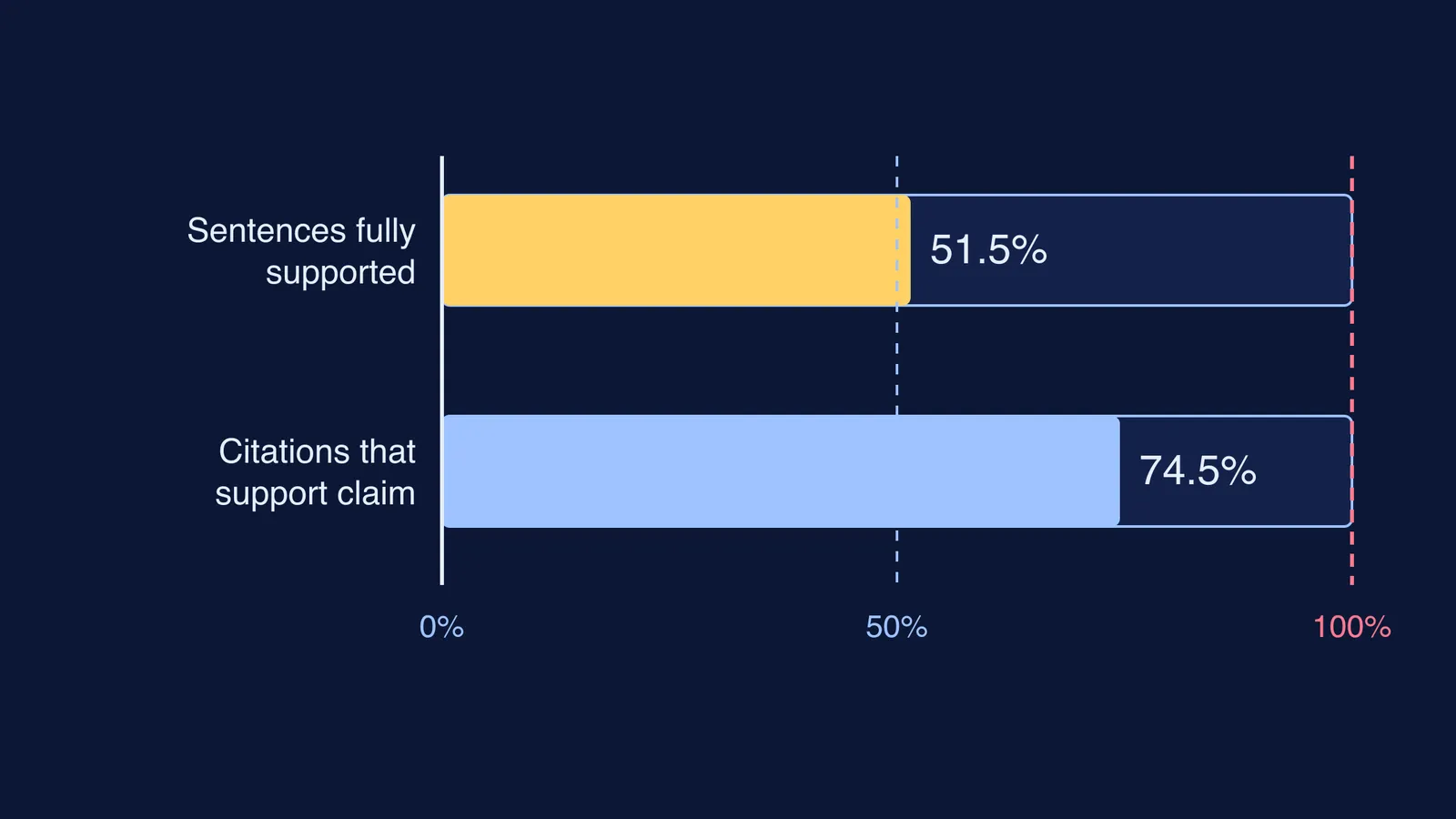
In a 2023 test of four generative search engines (Bing Chat, NeevaAI, perplexity.ai and YouChat; Google's AI Overviews were not among them), only 51.5% of generated sentences were fully supported by citations, and only 74.5% of citations supported the sentence they were attached to (Liu, Zhang and Liang, Findings of EMNLP 2023). So a link beside a sentence does not guarantee the page says it.
Newer work on news questions points the same way. A study coordinated by the European Broadcasting Union and led by the BBC, covering 22 public service media organisations in 18 countries and 14 languages, found that 45% of AI assistant answers had at least one significant issue, and 31% had serious sourcing problems (EBU, October 2025).
And most people never check. In a Pew Research Center study of 900 US adults' browsing in March 2025, users clicked a link inside the AI summary in just 1% of visits where one appeared (Pew Research Center, July 2025).
How can you check an AI summary in under a minute?
Use this habit whenever a fact will go into your notes.
Pick the one claim you will use (10 seconds). Just the sentence you need.
Click the link beside that sentence and find the claim (20 seconds). Press Ctrl+F (or Find in page on a phone) and search a key word. Does the page say the same thing, with the same conditions, units and year?
Ask who wrote the page (10 seconds). NCERT, an official body such as NTA or CBSE, or a university page beats a forum post, a quiz site or an unsigned blog.
Decide (20 seconds). Matches: write the fact with the source name. Partly matches: write the source's version, not the summary's. No link or no match: drop it and open your textbook or the official page.
If step 3 leaves you unsure about a website, the lateral reading method is the next step up.
What does this look like for a real study doubt?
Say you search a physics constant for a lab record. The summary gives a value "at room temperature". You click the link and find-in-page the number. The page does give it, but for a different temperature; the room-temperature figure is further down. The summary merged two lines. Copy the value that matches your condition from the page, and write the page name beside it.
The same habit catches mixed-up exam facts: for a registration deadline, only the current official notice from the exam body counts.
If you keep checking the same idea, the gap is probably understanding, not a missing fact. The Fermi Concept Library gives each concept in physics, chemistry, biology, mathematics and computing its own lesson and its place in the map, so you can see what the idea rests on. For a problem you are stuck on, the Fermi Problem Library has a step-by-step solver that explains the reasoning rather than printing an answer.
Not sure whether to search at all or ask an AI tutor? Read should you search Google or ask AI for a study doubt.


