

On this page
You find a website for a school project. It looks professional and quotes studies. Most of us judge it by reading the page more carefully. Research on how experts check websites says that is the wrong move.
What is lateral reading?
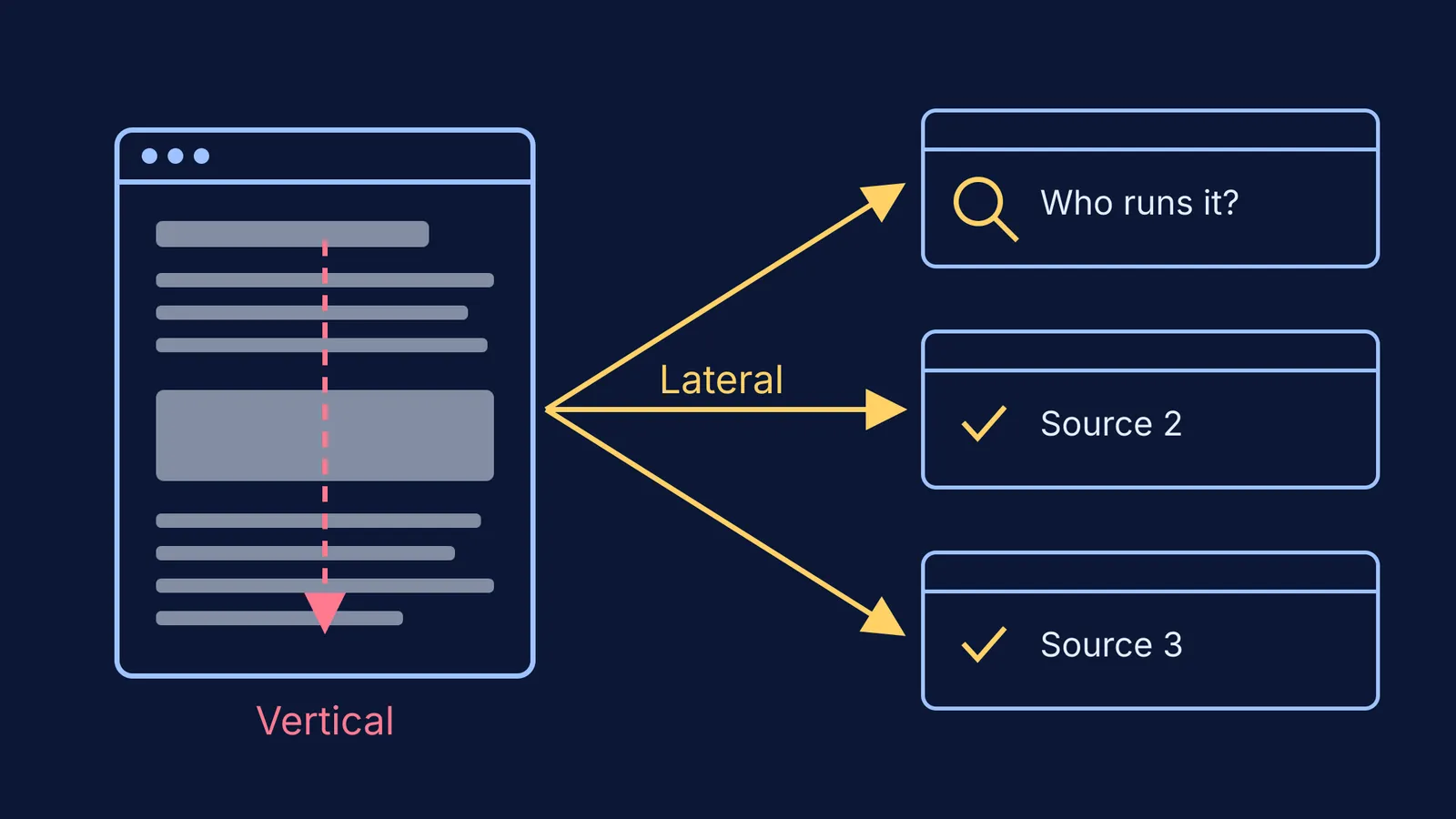
Lateral reading means leaving an unfamiliar website to search the open web before investing attention in the site itself, as defined by Stanford researchers in a district-wide field study. Vertical reading, the opposite, means judging a page from the inside: its design, its About page, its chosen references.
The idea comes from watching experts. Sam Wineburg and Sarah McGrew observed 45 people evaluating live websites: 10 PhD historians, 10 professional fact checkers and 25 Stanford undergraduates (study abstract). Historians and students read vertically and "often fell victim to easily manipulated features of websites". The fact checkers left the site after a quick scan, opened new tabs, and "arrived at more warranted conclusions in a fraction of the time".
Why can't you judge a website by how it looks?
Because the signals on the page are the easiest things to fake. In a US assessment of 3,446 high school students, 96% never learned that a site claiming to share "factual reports" on climate science had ties to the fossil fuel industry (Breakstone and colleagues, Educational Researcher, 2021). The same study found students were taken in by a site's look, its domain ending, its About page and the sheer amount of information on it.
The good news is that the habit can be taught. In the field study, 271 students who had six one-hour lessons over three months were compared with 228 students in regular classes, and the taught group grew significantly in their ability to judge online content (Wineburg and colleagues, Journal of Educational Psychology, 2022; abstract).
How do you check if a website is reliable?
These three moves follow the fact checkers' habits. They overlap with SIFT (Stop, Investigate the source, Find better coverage, Trace claims), a method developed by Mike Caulfield of the University of Washington (UC Merced library guide).
Leave the page. Open a new tab. Do not scroll to the references yet.
Check who is behind it. Search the site's or author's name with "funding" or "fact check". Is it an expert body, a news outlet, a seller, an advocacy group, or a joke?
Compare with two other sources. Search the claim itself. Find two independent sources that do not copy each other, ideally an official body (WHO, ICMR, NASA, a government agency) and a reputable newsroom or fact checker. If they disagree with the page, trust them over the page.
Worked example 1: a health claim
The claim, forwarded on WhatsApp: "Japan has banned microwave ovens because microwaved food causes cancer."
Who is behind it? The Indian fact checker BOOM traced the story to IA Panorama, a Russian site whose disclaimer says its texts "are grotesque parodies of reality and are not real news" (BOOM, November 2021).
Source 2. BOOM found no mention of a ban on the Japanese government's official website, and quoted the WHO explaining that microwaves are contained inside the oven and are only present when it is switched on with the door shut.
Source 3. The US Environmental Protection Agency states: "Microwaves do not make food radioactive" (EPA RadTown).
Verdict: false. If a term like non-ionising radiation stops you, learn it before deciding; the Fermi Concept Library has a lesson for every concept in physics, chemistry, biology, mathematics and computing.
Worked example 2: a science claim
The claim, from a "fun facts" website you want to cite in a geography project: "The Great Wall of China is the only human-made structure visible from space with the naked eye."
Who is behind it? Search the site's name. If you find no named authors, no editor and a page full of ads, treat it as a lead to follow, not a source to cite.
Source 2. NASA, captioning an astronaut's photo of the wall, says it "is difficult or impossible to see from Earth orbit without the high-powered lenses used for this photo" (NASA).
Source 3. Astronomer Phil Plait, writing in Scientific American, notes that one of the wall's wider parts might be 10 metres across, and that China's first astronaut, Yang Liwei, said he could not see it from orbit (Scientific American, 2024).
Verdict: false, and you now have two citable sources instead of one weak one.
What if an AI chatbot gave you the source?
Read it laterally like any unfamiliar page, but first check it exists; chatbots sometimes cite papers that do not. Our guide to spotting AI-made-up sources shows how. For Indian syllabus and exam facts, start from the free official resources for Indian students rather than a blog that summarises them.
If you are starting a research project and do not know where to begin, Fermi's AI tutor can work out what you already know and build a plan for the session. Then open a new tab and check.


