

On this page
You type a question, and in under a second a list appears. The order of that list is not a verdict on truth. It is a prediction, made by software, of which pages are most likely to help with the words you typed.
How do search engines decide which results come first?
Google describes search in three stages: crawling, indexing and serving results (Google Search Central). Ranking happens in the last stage.
Google's automated ranking systems look at many signals about "hundreds of billions of web pages" in its index (Google's ranking systems guide). Google's How Search works page groups the main signals like this:
Meaning: what your query is really asking, beyond the exact words.
Relevance: the most basic signal is that a page contains the same keywords as your search.
Quality: signs of expertise, authoritativeness and trustworthiness, including whether other prominent websites link to the page.
Usability: when other signals are roughly equal, pages that load quickly and work well on phones may do better.
Context: your location, past searches and settings. A search for football shows American football in Chicago and soccer in London.
Google says it does not accept payment to rank a page higher in its normal results (Google Search Central). Ads are separate, and Google says its mobile Search ads are labelled with the word Sponsored (Google Ads Help).
What do links have to do with ranking?
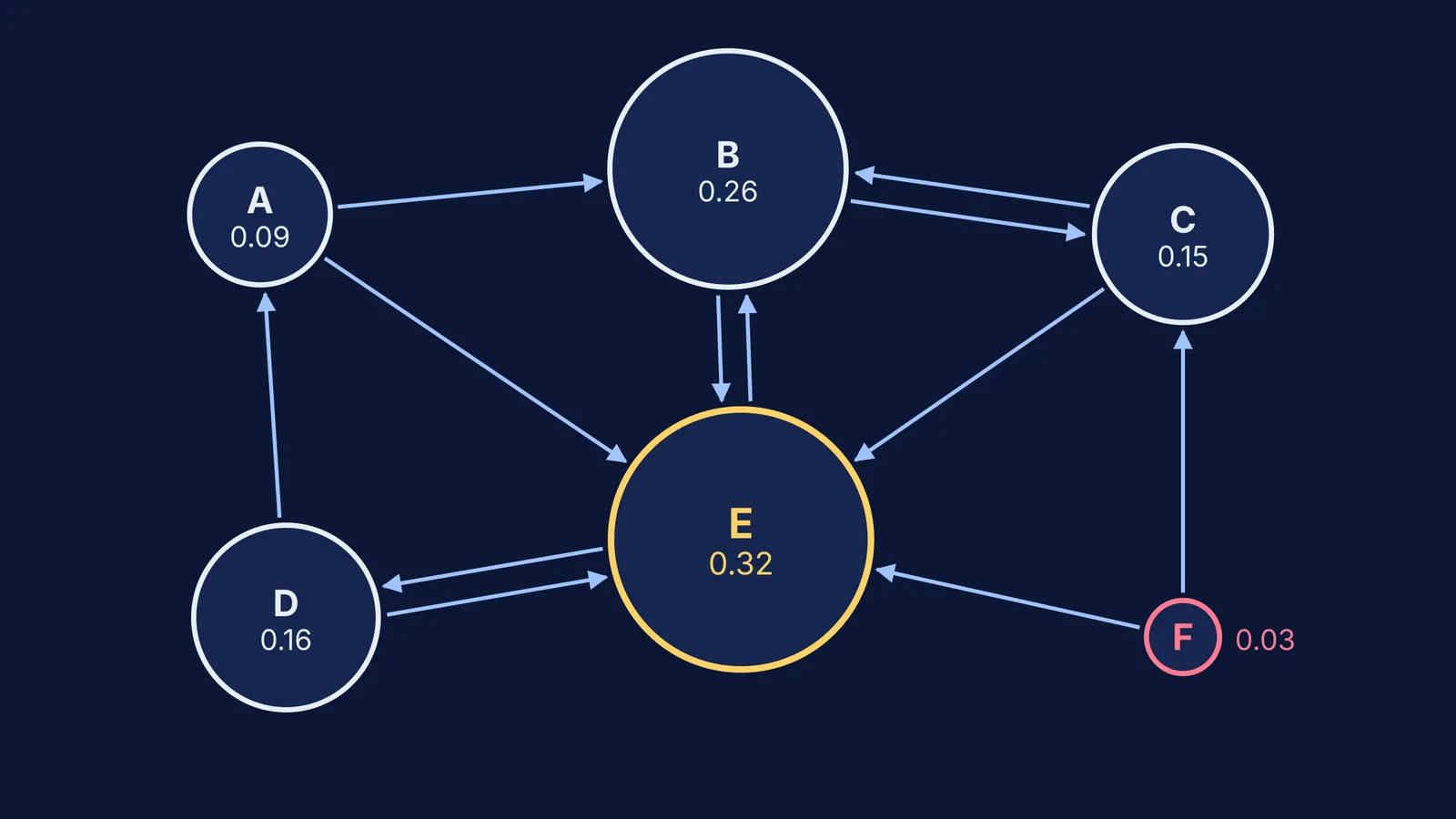
Links were at the heart of Google's original design. In their 1998 paper, Sergey Brin and Lawrence Page took the way scholars count citations and applied it to the web: a page that many pages link to, or that a few highly ranked pages link to, gets a high PageRank (Brin and Page, Computer Networks and ISDN Systems00110-X)).
The diagram at the top runs their formula on a toy web of six pages. Each page shares its score equally among the pages it links to. Page E gets links from every other page, so it scores highest, 0.32. Page F links out but no page links to it, so it scores lowest, 0.03. Notice what the calculation never asks: whether anything written on page E is correct.
Where does AI come into search ranking?
Google still analyses links to work out "what pages are about and which might be most helpful", but its ranking systems guide also names several AI systems. BERT helps Google understand "how combinations of words express different meanings and intent". RankBrain helps it understand "how words are related to concepts", and neural matching links the concepts in your query to the concepts in a page.
AI now also writes answers above the links. Google's own help page says AI Overviews "can and will make mistakes" and advises you to "always check important info in more than one place" (Google Search Help).
Why is the top result not always the most accurate?
Ranking predicts helpfulness from signals; it does not check facts the way a teacher checks your working. A page can be well linked, fast and full of your keywords, and still be wrong or out of date.
We also trust the order more than we should. In an eye-tracking study led by Bing Pan, students chose links higher on the page "even if the abstracts themselves were less relevant" (Pan et al., 2007, Journal of Computer-Mediated Communication). When the researchers secretly reversed Google's order, students completed tasks successfully only 62% of the time, against 85% with the normal order. The analysis used complete data from just 16 students, so treat it as a strong hint rather than the final word.
How do you dig for better sources?
Sam Wineburg and Sarah McGrew watched 45 people, including historians, fact checkers and Stanford undergraduates, judge websites (Wineburg and McGrew, 2019, Teachers College Record). The fact checkers read laterally, leaving a site quickly to check who was behind it, and reached better conclusions in less time. Historians and students were often fooled by official-looking logos and domain names.
Use this five-step check on any result you are about to rely on:
Skip anything labelled Sponsored unless you are shopping.
Ask who made the page: search its name in a new tab rather than trusting its About page.
Go upstream. For exam rules, go to the body that runs the exam, such as the National Testing Agency for JEE Main. For research claims, find the paper the article cites.
Check the date. Syllabi, cut-offs and policies change.
Find a second independent source that agrees. Two blogs copying one press release count as one source.
Concept doubts are harder, because ten results may give ten half-explanations. The Fermi Concept Library gives every concept in physics, chemistry, biology, mathematics and computing its own lesson and its place in the map, and Fermi's AI tutor works out what you already know and checks your understanding as it goes.
Next time you search, read the top result as a suggestion, not a verdict. Then open one more tab.


