

On this page
When you hit a block in your revision, your first instinct is likely to reach for your phone. But should you type your doubt into Google, or should you ask an AI tutor?
The answer depends on whether you need a verified fact or an explanation of a process. While generative AI models are excellent at guiding you through complex problem-solving steps, they still struggle to retrieve hard facts accurately. Knowing which tool to use can save you hours of frustration and prevent you from memorising incorrect information.
Why are search engines better for facts?
If you need a definition, a specific syllabus detail, or the date of an exam, a traditional search engine is still your safest bet. Search engines like Google are designed to index and rank authoritative sources. When you search for the formula of a sphere, you are directed to an established mathematical resource or a textbook.
Generative AI tools, on the other hand, do not actually retrieve facts. They predict the next likely word based on patterns in their large training data. When they encounter gaps in that data, they often confidently invent answers—a phenomenon known as hallucination.
A 2024 study tested this by asking an AI to identify clinical signs of a pregnancy condition. The AI provided accurate responses only 21% of the time. Instead of admitting it did not know, it frequently misinterpreted medical acronyms and generated plausible but entirely incorrect answers. When you need absolute certainty for an exam definition or a historical date, stick to searching for official sources.
When is it better to ask an AI tutor?
Where AI is better than a search engine is in explaining the steps of a problem or identifying where your working went wrong. A search engine will typically give you a final answer or link you to a Wikipedia page. This is not always helpful if you are stuck halfway through a calculation and need to understand the logic behind a specific step.
In contrast, an AI tutor can walk you through the reasoning. A 2026 study in *JMIR Medical Education* found that students with no prior training in a subject who used an AI tutor to solve complex problems scored higher (an average of 13.24 out of 20) than students who had already completed the training but used Google Search (12.14 out of 20). The AI successfully bridged the knowledge gap by explaining the problem-solving logic rather than just delivering disjointed facts.
This focus on the process is exactly how Fermi's AI tutor is designed to work. If you bring a difficult mechanics question to the Fermi Problem Library, it will not just print the answer. Instead, it works out what you already know and builds a plan for the session, writing on a board and checking your understanding as it goes.
The risk of passive learning
Regardless of which tool you use, the biggest danger is passive learning. If you use a search engine to instantly find the answer to a homework question, or if you ask a generic chatbot to write an essay for you, you skip the cognitive struggle required to actually learn the material.
Effective studying requires you to engage with the material actively. When you are stuck, you do not just need the final answer; you need a hint or a guiding question that nudges you in the right direction. This is why specialized AI tutors are programmed to teach rather than simply answer, ensuring that the heavy lifting is still done by your brain.
A practical framework for your doubts
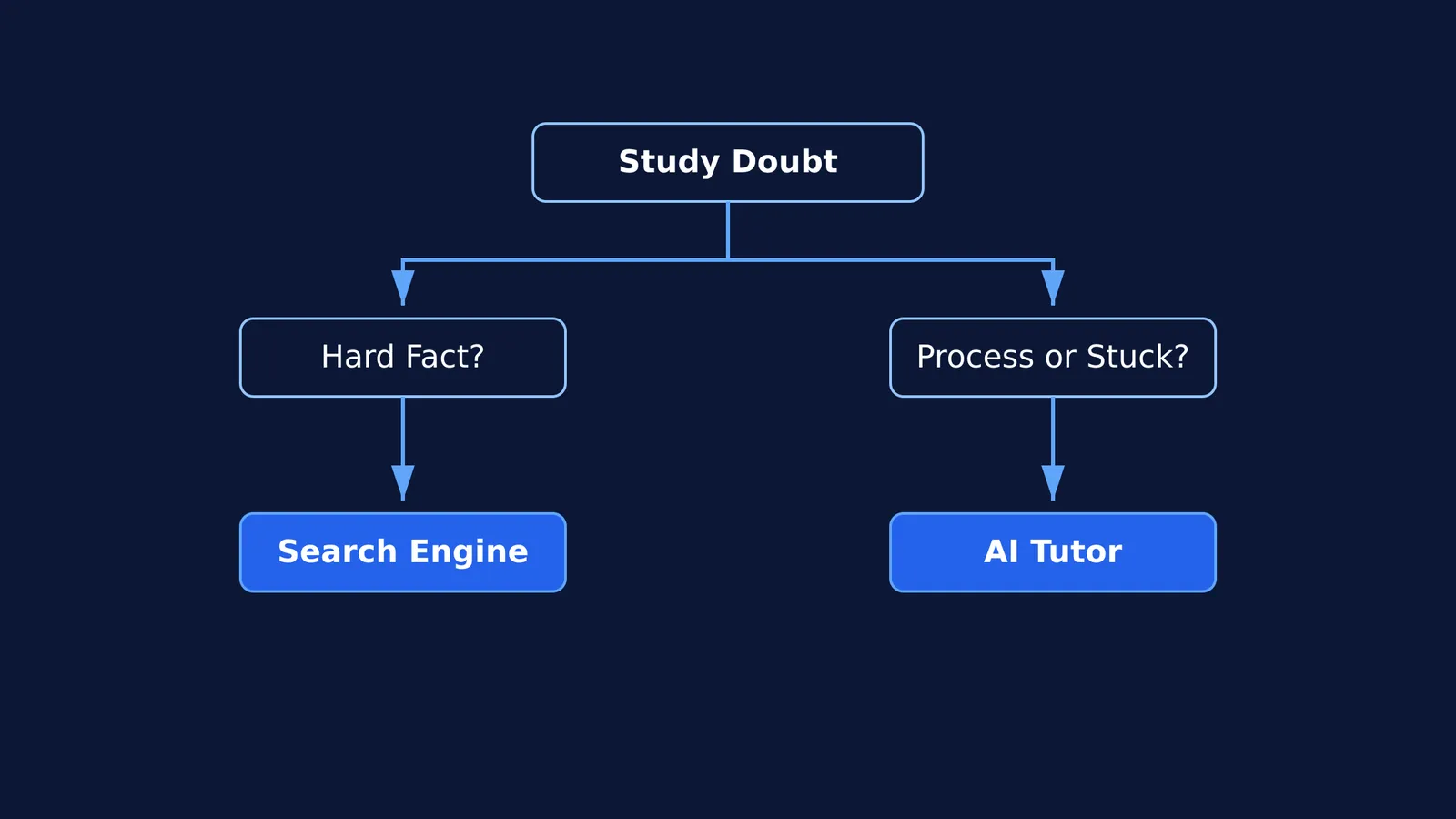
To make the most of both tools, try using this simple decision tree the next time you get stuck on a topic:
Is it a hard fact? (e.g., "What is the atomic number of Iron?" or "Is this topic still in the NEET syllabus?") → Search Google.
Is it a process? (e.g., "Why does the negative sign disappear in this step?" or "I don't understand why the tension in the string is mg cos θ.") → Ask an AI tutor.
Are you stuck on a blank page? → Ask an AI tutor to help you break the task down into smaller, manageable steps.
By carefully matching the tool to the specific learning task, you can study far more efficiently without falling victim to AI hallucinations.
For more advice on choosing the right tools for your revision, read about how to evaluate an AI tutor or explore whether AI tutors can teach better than answer chatbots.


