

On this page
This set follows set 1 of our Electrostatics NEET practice questions with eight new single-correct questions on parts set 1 left out.
What does set 2 cover that set 1 did not?
The NEET (UG)-2026 syllabus published by the National Medical Commission lists Electrostatics as Unit 11. It includes conservation of charge, superposition, continuous charge distributions, potential difference and capacitor combinations. Set 1 tested a neutral point, closed-surface flux, a rotating dipole, charge sharing and a filled dielectric. Set 2 tests charge quantisation, uniform fields, a capacitor network, force vectors, accelerated particles, a partial slab, concentric shells and a charged arc.
The NCERT Class 12 chapters behind these are Electric Charges and Fields, which gives the electron's charge as e = 1.6 × 10⁻¹⁹ C, and Electrostatic Potential and Capacitance. New to the chapter? Read our guide on how to prepare Electrostatics for NEET first.
How should you use this set?
Give yourself 15 minutes, on paper.
Before adding anything, decide: vectors or scalars?
Read every trap line, even where you were right.
Take k = 9 × 10⁹ N m² C⁻², ε₀ = 8.85 × 10⁻¹² C² N⁻¹ m⁻² and e = 1.6 × 10⁻¹⁹ C.
Easy: charge, uniform fields and a capacitor network
Q1 (easy). A neutral metal sphere is rubbed and ends up with +4.8 nC. What happened to its electrons?
(A) 3.0 × 10¹⁰ electrons were removed (B) 3.0 × 10¹⁰ electrons were added (C) 3.0 × 10¹³ electrons were removed (D) 7.7 × 10⁻²⁸ electrons were removed
Answer: (A). Charge is quantised, so n = q/e = 4.8 × 10⁻⁹/1.6 × 10⁻¹⁹ = 3.0 × 10¹⁰. A positive charge means electrons left the sphere.
Trap: (C) reads nC as µC. (B) flips the sign.
Q2 (easy). A uniform electric field of 2000 N/C points along +x. Point A is at the origin and point B is at (4 cm, 3 cm). What is V_A − V_B?
(A) 80 V (B) 100 V (C) 60 V (D) −80 V
Answer: (A). Only the displacement along the field matters: V_A − V_B = E × Δx = 2000 × 0.04 = 80 V. Moving along y stays on an equipotential.
Trap: (B) uses the full 5 cm distance from A to B.
Q3 (easy). A 3 µF and a 6 µF capacitor in series are connected in parallel with a 4 µF capacitor, across a 12 V battery. How much charge does the battery supply?
(A) 72 µC (B) 156 µC (C) 48 µC (D) 24 µC
Answer: (A). The series pair gives 3 × 6/(3 + 6) = 2 µF. In parallel with 4 µF that makes 6 µF, so Q = 6 µF × 12 V = 72 µC.
Trap: (B) puts all three capacitors in parallel (13 µF).
Medium: adding forces, accelerated particles and a partial slab
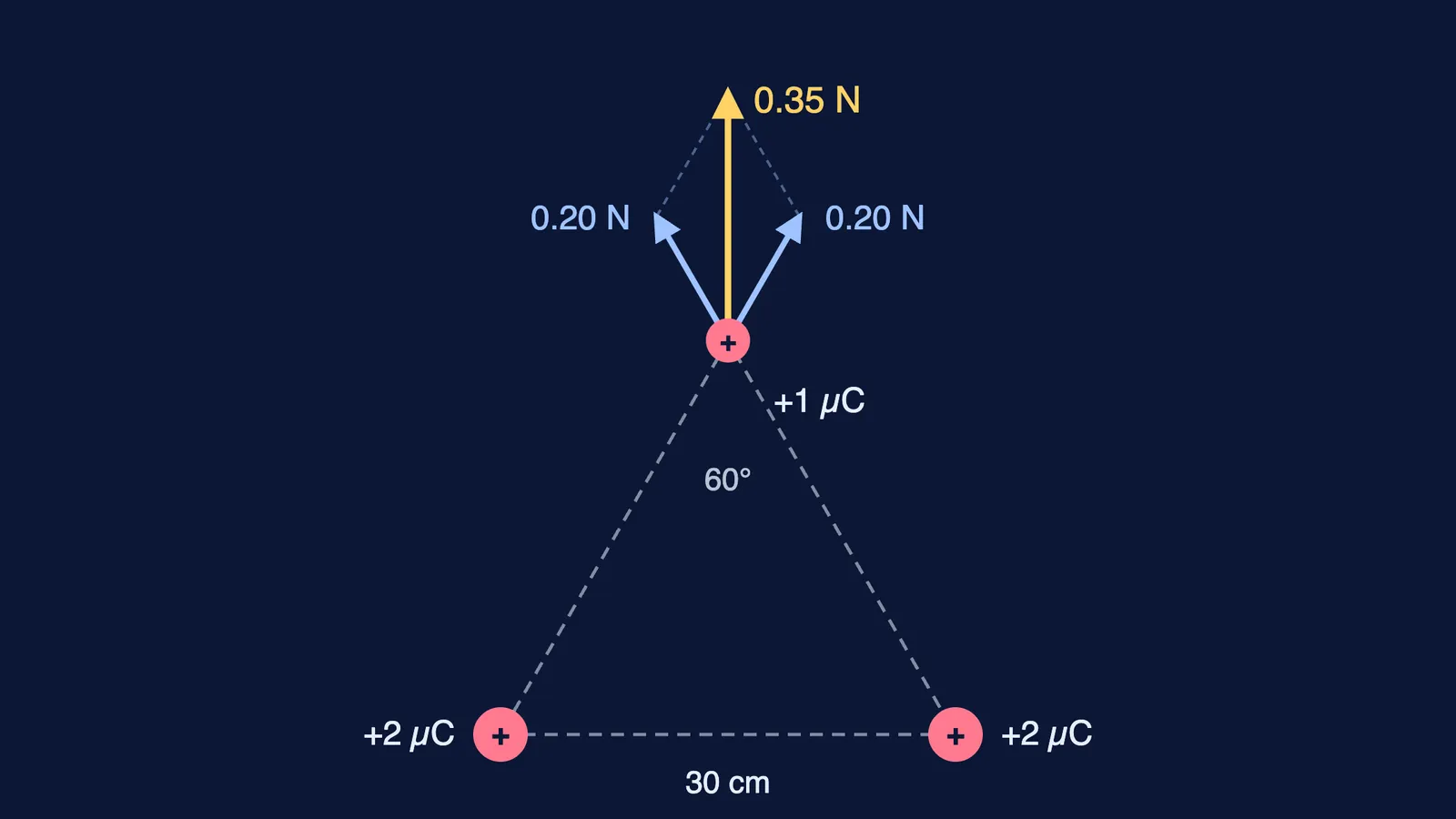
Q4 (medium). Two +2 µC charges sit at two corners of an equilateral triangle of side 30 cm. A +1 µC charge sits at the third corner. What is the net force on the +1 µC charge?
(A) 0.35 N (B) 0.40 N (C) 0.20 N (D) 0.28 N
Answer: (A). Each charge pushes with F = 9 × 10⁹ × 2 × 10⁻⁶ × 1 × 10⁻⁶/0.09 = 0.20 N. The two forces are 60° apart, so the resultant is 2F cos 30° = 0.20 × √3 = 0.35 N.
Trap: (B) adds the two forces as plain numbers. (D) assumes they are at right angles.
Q5 (medium). A proton is accelerated from rest through 200 V. Through what potential difference must an alpha particle be accelerated from rest to reach the same speed?
(A) 400 V (B) 200 V (C) 800 V (D) 100 V
Answer: (A). From qV = ½mv², v² = 2qV/m, so equal speeds need equal (q/m)V. The alpha's q/m is half the proton's (charge 2e, mass 4m), so it needs twice the voltage: 400 V.
Trap: (C) uses the fourfold mass but forgets the alpha's double charge. (D) inverts the ratio.
Q6 (medium). An air parallel-plate capacitor of 8 pF has a 5 mm gap. A slab of dielectric constant 4 and thickness 4 mm, with the same area as the plates, is placed between them. What is the new capacitance?
(A) 20 pF (B) 40 pF (C) 27 pF (D) 32 pF
Answer: (A). The air and slab act as capacitors in series: C = ε₀A/(d − t + t/K). Since ε₀A = 8 pF × 5 mm, C = 8 × 5/(1 + 1) = 20 pF.
Trap: (B) treats the slab as a metal plate. (C) averages the dielectric constant over the gap, as if the layers sat side by side.
Hard: concentric shells and a charged arc
Q7 (hard). Two thin concentric conducting shells have radii 5 cm (charge +2 nC) and 15 cm (charge −3 nC). What is the potential at the common centre?
(A) 180 V (B) 360 V (C) zero (D) −60 V
Answer: (A). Inside a shell, its potential equals its surface value, kq/R. So V = 9 × 10⁹ × (2 × 10⁻⁹/0.05 − 3 × 10⁻⁹/0.15) = 360 − 180 = 180 V.
Trap: (C) assumes zero field means zero potential. It only means constant potential.
Q8 (hard). A charge of +4 nC is spread uniformly along a thin semicircular arc of radius 9 cm. What are the electric field and the potential at the centre of the arc?
(A) 2.8 × 10³ N/C and 400 V (B) 4.4 × 10³ N/C and 400 V (C) zero and 400 V (D) 2.8 × 10³ N/C and 200 V
Answer: (A). All the charge is 9 cm away, so V = kQ/R = 9 × 10⁹ × 4 × 10⁻⁹/0.09 = 400 V. Field components along the diameter cancel; the rest add to E = 2kλ/R with λ = Q/πR, so E = 2kQ/πR² ≈ 2.8 × 10³ N/C, pointing away from the arc's midpoint.
Trap: (B) treats the arc as a point charge, kQ/R², ignoring that its pieces push in different directions.
If a solution loses you partway, the Fermi Problem Library has worked problems with a step-by-step solver that explains the reasoning rather than printing an answer. Redo both sets in a week.


