

On this page
This set follows set 1 of our Electrostatics JEE Main practice questions with eight new ones. Q3 and Q7 are numerical; the rest are single-correct.
What does set 2 cover that set 1 did not?
Unit 11 of the official Syllabus for JEE (Main) - 2027 lists conservation of charge, Coulomb's law, electric flux, the dipole, potential of a system of charges, equipotential surfaces, conductors, dielectrics and energy stored in a capacitor. Set 1 tested line charges, potential gradients, series capacitors, the dipole's field, assembly energy, sheets, a dielectric in series and charge sharing. Set 2 tests flux, charge conservation, a dipole's potential, zero-potential points, a charged pendulum, a metal slab with energy density, closest approach of two free charges, and work done on a dielectric.
The NCERT Class 12 chapters behind these are Electric Charges and Fields and Electrostatic Potential and Capacitance; the second gives energy density as u = ½ε₀E².
How should you use this set?
Take 25 minutes, no calculator.
Name the law you will use before touching numbers.
Read every trap line, even where you were right.
Take k = 9 × 10⁹ N m² C⁻², ε₀ = 8.85 × 10⁻¹² C² N⁻¹ m⁻², g = 10 m/s². New to the chapter? Start with our guide on how to prepare Electrostatics for JEE Main.
Easy: flux, touching spheres and a dipole's potential
Q1 (easy). The field in a region is E = (300 î + 400 ĵ) N/C. What is the flux through a 10 cm square lying in the xz-plane?
(A) 4 N m²/C (B) 5 N m²/C (C) 3 N m²/C (D) 7 N m²/C
Answer: (A). The area vector is 0.01 m² along ĵ. Flux = E · A = 400 × 0.01 = 4 N m²/C.
Trap: (B) multiplies the full magnitude, 500 N/C, by the area.
Q2 (easy). Two identical small metal spheres carry +7 µC and −3 µC and attract with a force of 2.1 N when 30 cm apart. They are touched together and put back 30 cm apart. What is the new force?
(A) 0.4 N, repulsive (B) 0.4 N, attractive (C) 2.1 N, attractive (D) 2.5 N, repulsive
Answer: (A). The +4 µC total is conserved and splits equally: +2 µC each. F = 9 × 10⁹ × (2 × 10⁻⁶)²/0.09 = 0.4 N, and like charges repel.
Trap: (D) averages the magnitudes to 5 µC each, ignoring the minus sign.
Q3 (easy, numerical). A short dipole of moment 4 × 10⁻⁹ C m sits at the origin. Find the potential, in volts, at a point 20 cm away on a line making 60° with the dipole's axis.
Answer: 450. V = kp cos θ/r² = 9 × 10⁹ × 4 × 10⁻⁹ × 0.5/(0.2)² = 450 V.
Trap: 900, which is the axial value.
Medium: zero-potential points, a charged pendulum and a metal slab
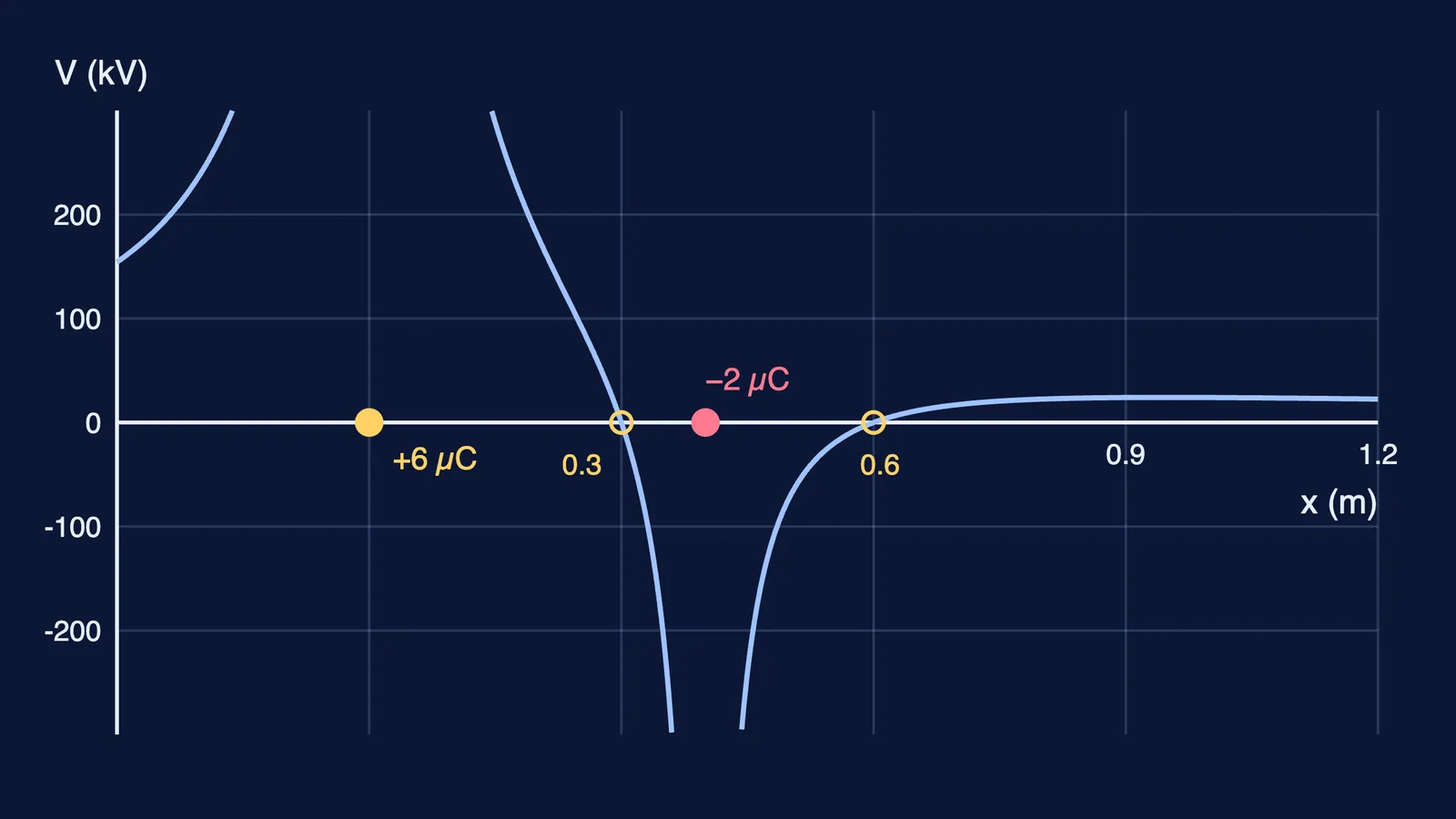
Q4 (medium). A +6 µC charge sits at x = 0 and a −2 µC charge at x = 40 cm. At which points on the x-axis (other than infinity) is the potential zero?
(A) x = 30 cm and x = 60 cm (B) x = 30 cm only (C) x = 60 cm only (D) x = 94.6 cm only
Answer: (A). V = 0 where 6/r₁ = 2/r₂, so r₁ = 3r₂. Between them, x = 3(40 − x) gives 30 cm; beyond −2 µC, x = 3(x − 40) gives 60 cm.
Trap: (B) stops at the first root. (D) is the point of zero field, a different question.
Q5 (medium). A ball of mass 3 g and charge +2 µC hangs on a light thread in a horizontal uniform field of 1.5 × 10⁴ N/C. Find the thread's angle with the vertical and its tension.
(A) 45°, 4.2 × 10⁻² N (B) 45°, 3.0 × 10⁻² N (C) 45°, 6.0 × 10⁻² N (D) 90°, 3.0 × 10⁻² N
Answer: (A). qE = 0.03 N sideways and mg = 0.03 N down, so tan θ = 1 and θ = 45°. T = √(0.03² + 0.03²) = 4.2 × 10⁻² N.
Trap: (B) sets the tension equal to mg.
Q6 (medium). An air parallel-plate capacitor with a 6 mm gap stays connected to a 100 V battery. A metal plate 2 mm thick, the same area as the plates, is slid in parallel to them. What is the energy density in the remaining air gap?
(A) 2.77 × 10⁻³ J/m³ (B) 1.23 × 10⁻³ J/m³ (C) 1.11 × 10⁻² J/m³ (D) zero
Answer: (A). The field inside the metal is zero, so the full 100 V drops across 4 mm of air: E = 2.5 × 10⁴ V/m. Then u = ½ε₀E² = 0.5 × 8.85 × 10⁻¹² × 6.25 × 10⁸ = 2.77 × 10⁻³ J/m³.
Trap: (B) still divides 100 V by 6 mm, ignoring the slab.
Hard: two free charges and a dielectric pulled out
Q7 (hard, numerical). Particle A (mass 1 g, charge +1 µC) moves at 6 m/s straight towards particle B (mass 2 g, charge +2 µC), which is at rest. They start far apart; both are free. Find their closest distance, in cm.
Answer: 150. At closest approach both share one velocity: 1 × 6 = 3v and v = 2 m/s. The kinetic energy lost is ½(0.001)(36) − ½(0.003)(4) = 0.012 J. So kq₁q₂/r = 0.012 and r = 0.018/0.012 = 1.5 m = 150 cm.
Trap: 100, which treats B as fixed.
Q8 (hard). A 20 pF air capacitor, completely filled with a dielectric of constant 4, stays connected to a 50 V battery. The dielectric is pulled out slowly. How much work does the external agent do?
(A) +75 nJ (B) −75 nJ (C) +150 nJ (D) zero
Answer: (A). C falls from 80 pF to 20 pF, so ΔU = ½(20 − 80) × 10⁻¹² × 50² = −75 nJ. 3000 pC flows back into the battery, so W_battery = −3000 pC × 50 V = −150 nJ. Then W_ext = ΔU − W_battery = −75 + 150 = +75 nJ.
Trap: (B) equates the agent's work with the change in stored energy and forgets the battery.
When a solution loses you, the Fermi Problem Library has worked problems with a step-by-step solver that explains the reasoning rather than printing an answer. Redo both sets in a week, starting with the traps that caught you.


