

On this page
Fast breeder reactors are cooled with liquid sodium, and sodium has to be kept moving. A normal pump needs a spinning shaft, and every shaft needs a seal where it leaves the pipe. Sodium burns in air and reacts violently with water, so a seal is a weak point you would rather not have. There is another way. Sodium is a metal, so it conducts electricity. Pass a current through it inside a magnetic field and the liquid itself feels the force on a current-carrying conductor. The pump has no moving parts at all.
Why can a magnetic field push a liquid?
You already know the force on a straight wire in a field: F = BIL, at right angles to both the current and the field. The force on a current-carrying wire does not care whether the conductor is copper, a bent rod or a stream of liquid metal. What matters is that charges are moving through the conductor in a magnetic field.
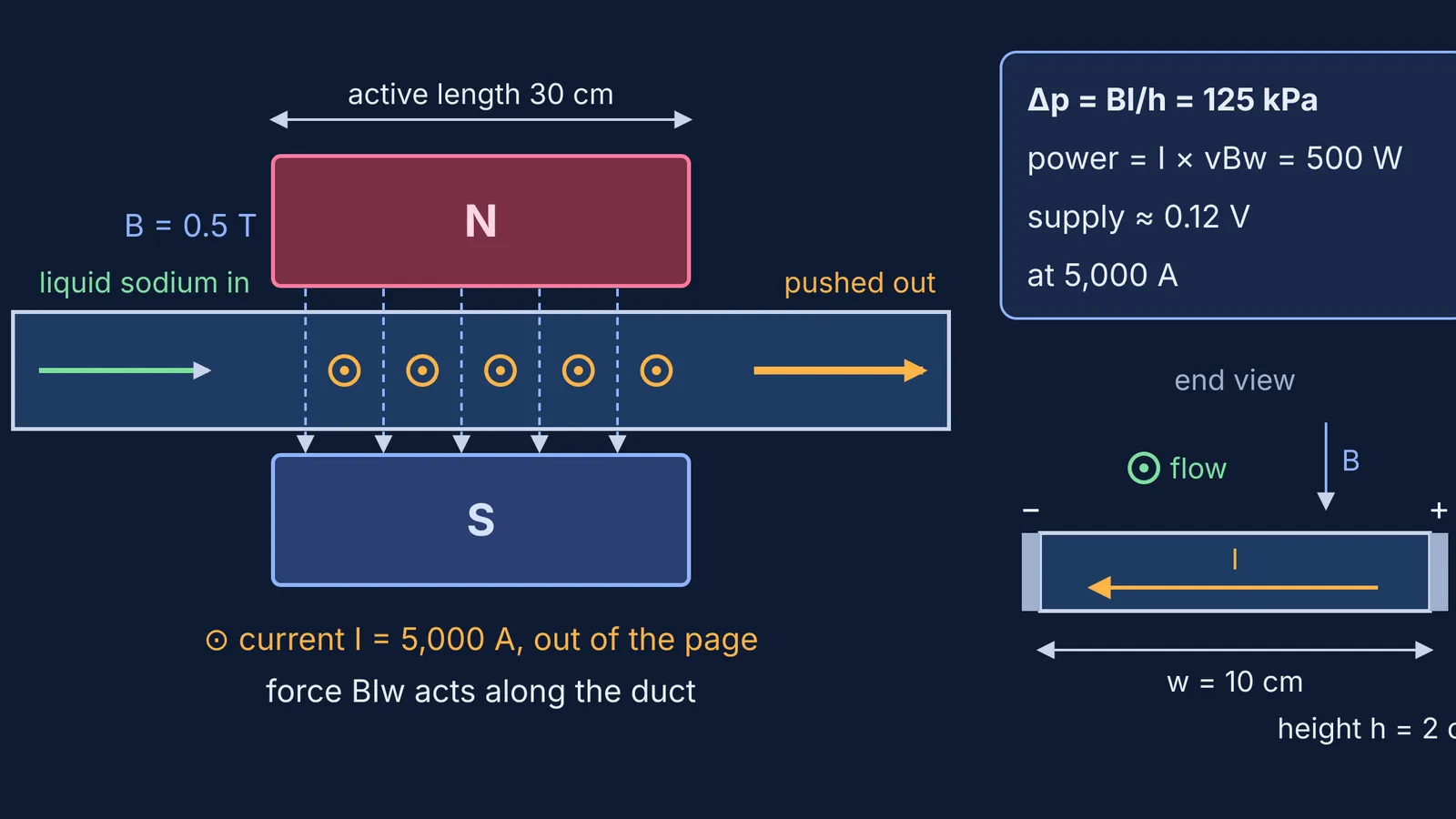
In a DC conduction pump, sodium flows along a flat duct. Two electrodes on the side walls drive a current I straight across the duct, through the sodium. Magnet poles above and below the duct put a field B across it the other way. Current, field and flow are three mutually perpendicular directions. Point them correctly and the force BIL acts along the duct, pushing the sodium forward.
The conductor here is the sodium between the electrodes, so the length L in F = BIL is the duct width w, the length of the current path.
How much pressure does a conduction pump make?
The force acts on the slab of sodium carrying the current. Spread that force over the duct's cross-section, w × h, and you get a pressure rise:
Δp = BIw/(w × h) = BI/h
The width has cancelled. A wider duct gives a longer current path and more force, but also a bigger area for that force to spread over. Only the height h, the duct dimension along the field, survives. To get a high pressure you want a strong field, a large current and a thin duct.
Worked example: an illustrative sodium pump
Take a pump with round illustrative numbers: B = 0.5 T, I = 5,000 A, a duct w = 10 cm wide and h = 2 cm high, and an active length (the length under the magnet) of 30 cm. The sodium is at about 400 °C.
Force. F = BIw = 0.5 × 5,000 × 0.10 = 250 N, along the duct.
Pressure rise. Δp = BI/h = 0.5 × 5,000/0.02 = 125,000 Pa = 125 kPa. Check the units: T × A/m = (N/(A m)) × A/m = N/m² = Pa.
How high could it lift sodium? Liquid sodium at 400 °C has a density of about 858 kg/m³, from the Argonne correlation in Fink and Leibowitz's sodium property report. So the height is H = Δp/(ρg) = 125,000/(858 × 9.8) ≈ 15 m.
Flow. At 2 m/s through a 0.10 m × 0.02 m duct, Q = 2 × 0.002 = 0.004 m³/s = 4 L/s.
Hydraulic power. Δp × Q = 125,000 × 0.004 = 500 W.
Where does the electrical power go?
Here is the part that ties the pump to a motor. The sodium is a conductor moving through a magnetic field, so it generates a motional emf, exactly as in an electromagnetic flowmeter on a water main. Its size is vBw:
Back emf = 2 × 0.5 × 0.10 = 0.1 V.
This emf opposes the current you are driving, so the supply has to push against it.
Power spent against it = I × 0.1 V = 5,000 × 0.1 = 500 W.
That is exactly the hydraulic power from step 5. It is not a coincidence. In any motor, the electrical power that becomes mechanical work is the back emf times the current. Here, Δp × Q = (BI/h) × (v w h) = I × vBw, term for term.
The supply must also drive the current through the sodium's own resistance. The resistivity of liquid sodium at about 673 K is roughly 2.2 × 10⁻⁷ Ω m, read from the recommended values in the NIST-sponsored review of alkali metal resistivity. The current crosses a path 0.10 m long through an area of 0.02 m × 0.30 m:
R = ρw/(h × l) = 2.2 × 10⁻⁷ × 0.10/(0.02 × 0.30) ≈ 3.7 µΩ.
Ohmic loss = I²R = 5,000² × 3.7 × 10⁻⁶ ≈ 91 W.
Voltage needed = back emf + IR = 0.100 + 0.018 ≈ 0.12 V.
So this pump runs on about 0.12 V at 5,000 A. That is why DC conduction pumps need an unusual supply: very low voltage and very high current. Real pumps lose more than this ideal 91 W, because some current leaks through the steel duct walls instead of the sodium, and the busbars carrying 5,000 A have resistance too.
Why do only liquid metals work?
The trick depends on the liquid being an excellent conductor. Liquid sodium's resistivity of about 2.2 × 10⁻⁷ Ω m means a conductivity of roughly 4.6 million S/m. Seawater is around 5 S/m, close to a million times less. To force 5,000 A through seawater in the same duct would take more than ten thousand volts and turn almost all the power into heat. With sodium, the 0.12 V supply wastes under a fifth of its power.
Sodium's other properties help too. It melts at about 98 °C and stays liquid to about 883 °C, so it is liquid over the whole operating range. Why a fast reactor uses sodium at all is explained in what a fast breeder reactor at Kalpakkam is; this post is only about moving it.
Do Indian fast reactors use electromagnetic pumps?
Yes, in some circuits. Engineers at IGCAR, Kalpakkam, report that annular linear induction pumps circulate large quantities of sodium in the auxiliary circuits of Indian sodium-cooled fast breeder reactors, with a typical rating of 170 m³/h. These are AC induction pumps, not the DC conduction pump worked above. A travelling magnetic field induces the current in the sodium instead of electrodes feeding it, but the push is the same force on a current in a field. The paper does not say these pumps drive the main reactor coolant loops, so neither do we.
If the three perpendicular directions of current, field and force are hard to picture, the Simulation Lab has interactive simulations for ideas that are easier to see than read.
Quick checklist
Force on the liquid: F = BIw, with w the current path across the duct.
Pressure rise: Δp = BI/h, independent of duct width.
Pumping power = back emf × current = I × vBw = Δp × Q.
Supply voltage = vBw + IR: a fraction of a volt at thousands of amps.
Works only for very good conductors such as liquid metals.
No shaft, no seal: the liquid is the moving part.


