On this page
India's Department of Atomic Energy reports that the 500 MWe Prototype Fast Breeder Reactor (PFBR) at Kalpakkam, Tamil Nadu, reached first criticality at 8:25 PM on 6 April 2026. First criticality is the start of a controlled fission chain reaction. The Indira Gandhi Centre for Atomic Research (IGCAR) designed the reactor, and Bharatiya Nabhikiya Vidyut Nigam Ltd (BHAVINI) built and commissioned it. It is not yet a power station: Nuclear Engineering International notes it will take months to reach full capacity and longer to produce useful electricity. For a board exam or JEE student, it puts neutrons, fission, beta decay and half-life in one machine.
What is a fast breeder reactor?
The World Nuclear Association says a fast reactor has no moderator and relies on fast neutrons alone to cause fission. Ordinary reactors slow their neutrons down with a moderator such as heavy water, because slow neutrons split uranium-235 more easily. Our explainer on how a nuclear reactor uses control rods and a moderator covers that design.
A fast reactor is called a breeder when it produces more fissile material than it consumes, according to the same World Nuclear Association page. The measure is the conversion ratio, which is new fissile nuclei divided by fissioned nuclei. It is around 0.6 in a normal reactor and can exceed 1.0 in a fast reactor.
How does a breeder turn uranium-238 into plutonium?
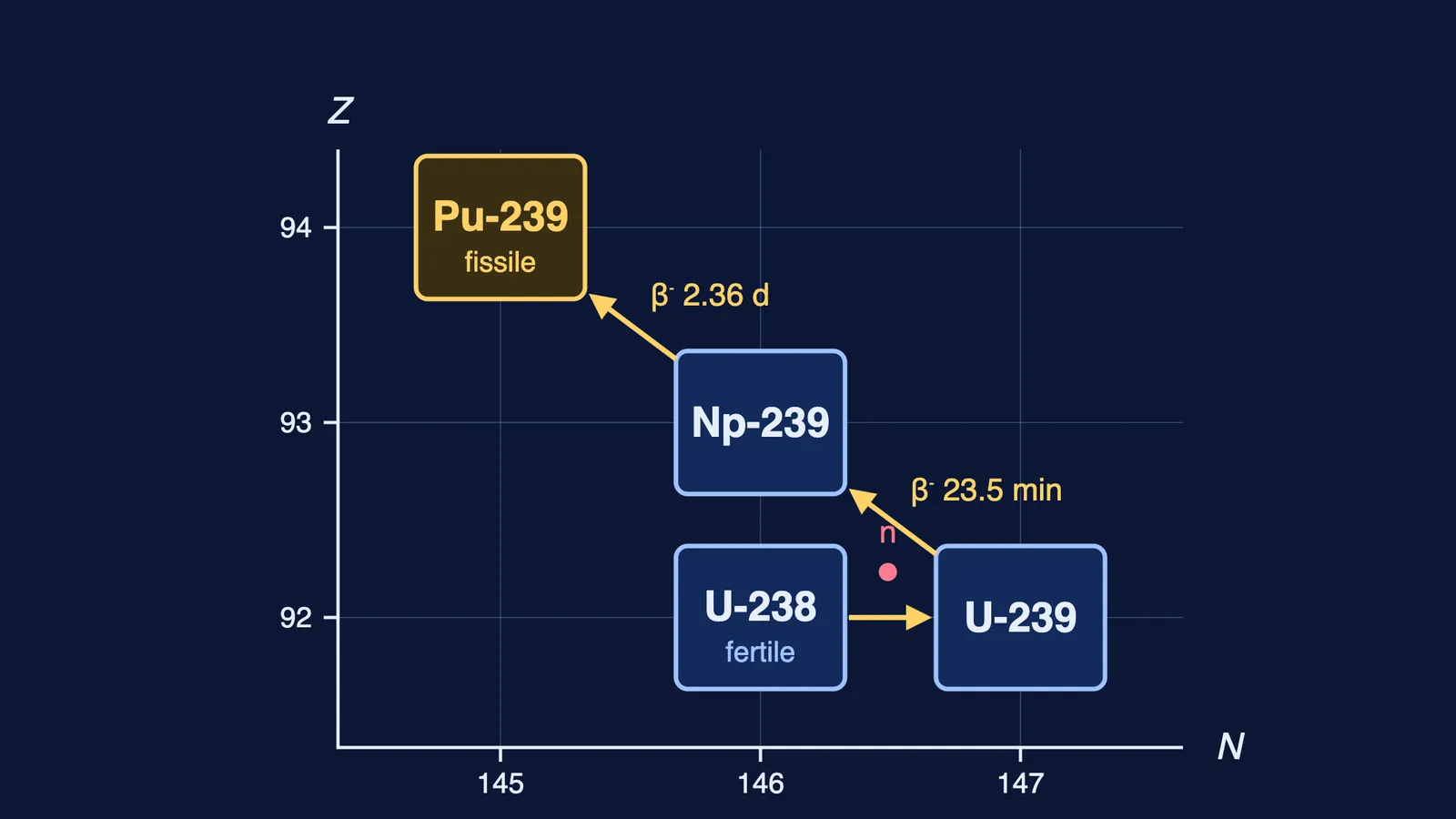
The DAE says the PFBR uses uranium-plutonium mixed oxide (MOX) fuel, and its core is surrounded by a blanket of uranium-238. Fast neutrons convert that fertile uranium-238 into fissile plutonium-239, which lets the reactor produce more fuel than it consumes.
The chain has three steps, laid out in this chemistry textbook chapter on transmutation:
Uranium-238 captures a neutron and becomes uranium-239.
Uranium-239 undergoes beta decay to neptunium-239, with a half-life of 23.5 minutes.
Neptunium-239 undergoes beta decay to plutonium-239, with a half-life of 2.36 days.
Neutron capture adds one to the mass number. Each beta decay turns a neutron into a proton, so the atomic number goes from 92 to 93 to 94 while the mass number stays 239. To see why neutrons make good projectiles in the first place, read why neutrons are used to cause nuclear fission.
Worked example: breeding numbers you can check
Use the 2.36-day half-life from the textbook chapter. Suppose the blanket holds 1,000 freshly made neptunium-239 nuclei.
After 2.36 days, 500 have become plutonium-239.
After 4.72 days, 750 have.
After 7.08 days, 875 have, because each half-life converts half of what is left.
Now apply the conversion-ratio definition from the World Nuclear Association. These are illustrative figures, not PFBR data. If 1,000 fissile nuclei split and 600 new ones form, the ratio is 0.6, and fuel runs down. If 1,100 new ones form, the ratio is 1.1, and the reactor is breeding.
Why does the PFBR use liquid sodium instead of water?
Water would slow the neutrons, and a fast reactor needs them fast. The World Nuclear Association says the coolant is a liquid metal, normally sodium, to avoid neutron moderation. Fast reactors operate at around 500-550°C at or near atmospheric pressure. Designs must keep sodium away from water, because the two react. NEI describes the PFBR as a sodium-cooled fast reactor with a design life of 40 years.
Where does Kalpakkam fit in India's three-stage plan?
The World Nuclear Association's India profile sets out the stages:
Stage 1: pressurised heavy water reactors fuelled by natural uranium, plus light water reactors, which produce plutonium as a by-product.
Stage 2: fast reactors burning that plutonium, which is where the PFBR sits.
Stage 3: advanced heavy water reactors burning thorium-based fuels.
The same India profile says India has reasonably assured resources of 319,000 tonnes of thorium, about 13% of the world total. The DAE says the PFBR is designed to eventually put thorium-232 in its blanket, where it will be converted into uranium-233 to fuel the third stage.
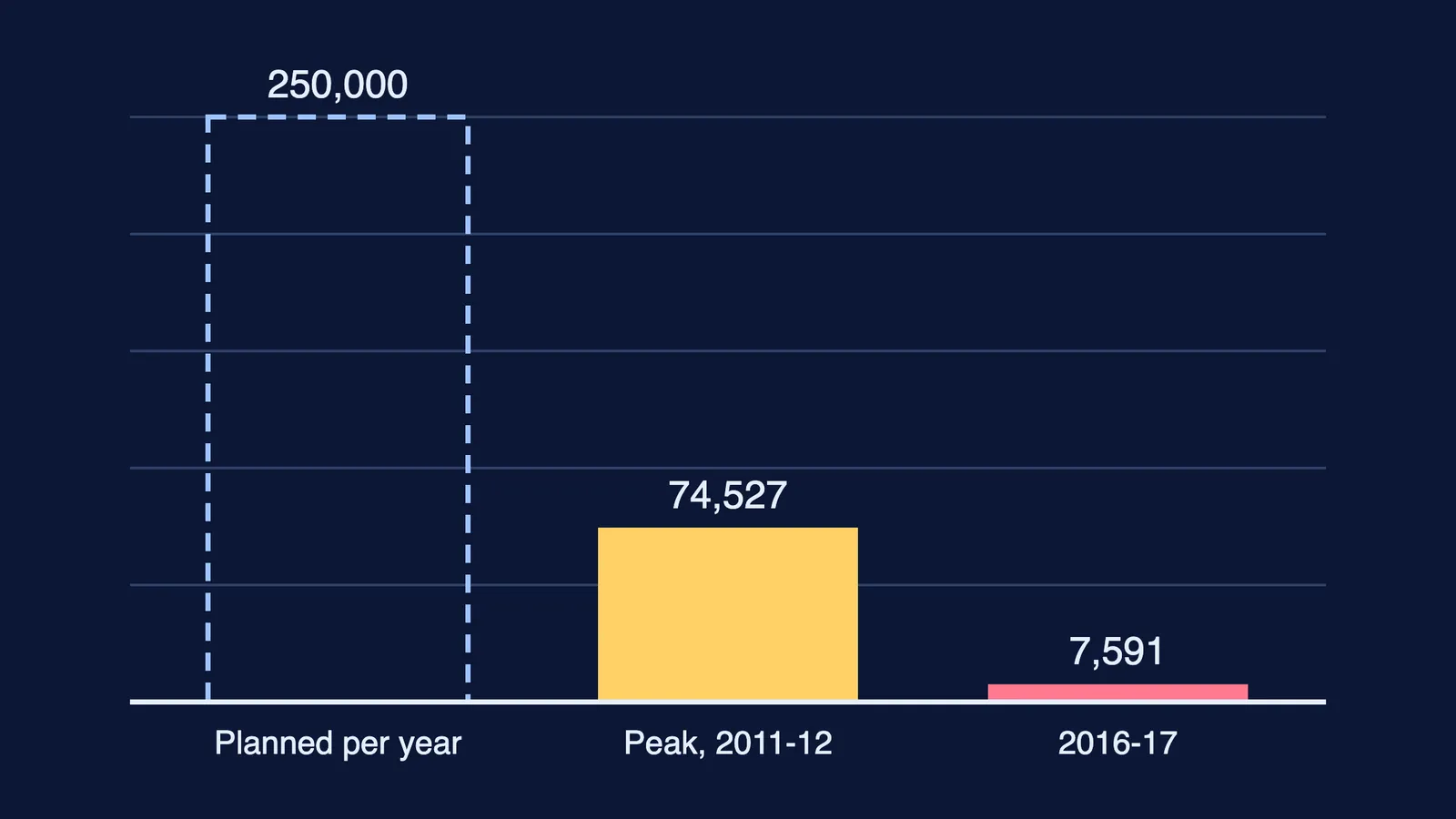
Construction began in 2004 with operation planned for 2010, and a parliamentary committee put the cost at ₹8,181 crore against an original estimate of ₹3,492 crore, according to the International Panel on Fissile Materials. For the people behind India's reactors, read our profile of M. R. Srinivasan, the engineer who built India's nuclear plants.
A five-line revision checklist
Define fast reactor (no moderator) and breeder (conversion ratio above 1).
Write the U-238 to Pu-239 chain with both beta decays.
Explain why water is not the coolant.
Name the fuel of each of the three stages.
Solve one half-life question on neptunium-239.
If the chain still feels abstract, Fermi's AI tutor can draw the figure and check your understanding as it goes, and the Fermi Concept Library has a lesson for each idea in the physics behind it.