

On this page
This set follows set 1 of our EMI and AC questions for JEE Main and repeats none of its situations. These eight original questions test sub-topics set 1 skipped. Q3 and Q8 are numerical.
How should you use EMI practice set 2?
Unit 14 of the Syllabus for JEE (Main) - 2027 lists Faraday's law, induced emf and current, Lenz's law, eddy currents, and self and mutual inductance. All eight also stay inside NCERT Class 12 Physics Chapter 6.
Give yourself 20 minutes, on paper, without a calculator.
Write the flux first, then decide what in it is changing.
Read every trap line, even where you were right.
Shaky on the basics? Start with how to prepare electromagnetic induction for JEE Main.
Easy: can you use Lenz's law and L di/dt correctly?
Q1 (easy). A copper ring lies flat and fixed. A bar magnet, north pole down, sits on the ring's axis above it and is pulled straight up, away from the ring. Viewed from above, the induced current in the ring and the force between ring and magnet are:
(A) clockwise; attraction
(B) anticlockwise; attraction
(C) clockwise; repulsion
(D) anticlockwise; repulsion
Answer: (A). The magnet's field at the ring points down, and that flux is falling. The induced current must add downward flux, so it runs clockwise seen from above. The ring's upper face then acts as a south pole and pulls the magnet back. Trap: (D), which opposes the field itself rather than its change.
Q2 (easy). The current in a 40 mH coil changes steadily from +3.0 A to −1.0 A in 20 ms. The magnitude of the self-induced emf is:
(A) 2.0 V
(B) 4.0 V
(C) 6.0 V
(D) 8.0 V
Answer: (D). The change is −1.0 − 3.0 = −4.0 A, so |e| = L|ΔI|/Δt = 0.040 × 4.0/0.020 = 8.0 V. Trap: (B), which ignores the reversal.
Q3 (easy, numerical). The current in a 0.50 H inductor rises from 2.0 A to 4.0 A. Find the extra energy stored in its magnetic field, in joules.
Answer: 3. U = ½LI², so ΔU = ½ × 0.50 × (4.0² − 2.0²) = 3.0 J. Trap: 1, from ½L(ΔI)², which squares the change.
Medium: where do mutual inductance and motional emf trip you up?
Q4 (medium). When coil P carries a steady 4.0 A, the total flux linked with all the turns of coil Q is 6.0 × 10⁻³ Wb. Now the current in Q changes at 50 A/s. The emf induced in P is:
(A) 0.30 V
(B) 75 mV
(C) 30 μV
(D) It cannot be found without the number of turns in P
Answer: (B). M = NΦ/I = 6.0 × 10⁻³/4.0 = 1.5 mH, and the mutual inductance is the same both ways (M₁₂ = M₂₁ in NCERT). So e = M dI/dt = 1.5 × 10⁻³ × 50 = 75 mV. Trap: (D); the flux linkage already includes the turns.
Q5 (medium). A long straight wire carries 10 A. A rectangular loop in the same plane has its 30 cm sides parallel to the wire and its 20 cm sides perpendicular to it. The loop moves directly away from the wire at 3.0 m/s. Take μ₀ = 4π × 10⁻⁷ T m A⁻¹. When the near side is 10 cm from the wire, the emf in the loop is:
(A) 6 μV
(B) 12 μV
(C) 18 μV
(D) 24 μV
Answer: (B). With B = μ₀I/(2πr), the near side (10 cm) gives Bℓv = 18 μV and the far side (30 cm) 6 μV. Around the loop they oppose: 18 − 6 = 12 μV. Trap: (C), the near side alone.
Q6 (medium). A thin wire bent into a semicircle of radius 10 cm lies in a plane perpendicular to a uniform 0.50 T field. It moves in that plane at 4.0 m/s, perpendicular to the straight line joining its ends. The emf between its ends is:
(A) 0.20 V
(B) 0.40 V
(C) 0.63 V
(D) zero
Answer: (B). The effective length is the straight line joining the ends, 2r = 0.20 m. So e = Bv(2r) = 0.50 × 4.0 × 0.20 = 0.40 V. Trap: (C), which uses the arc length πr.
Hard: what if the field and the circuit change together?
Q7 (hard). Two parallel rails 0.50 m apart are joined at one end. A rod slides along them at a constant 2.0 m/s away from the joined end; at t = 0 it is 0.20 m from that end. A field perpendicular to the rails grows as B = 0.40t (B in tesla, t in seconds). At t = 1.5 s, the emf in the circuit is:
(A) 0.04 V
(B) 0.60 V
(C) 0.64 V
(D) 1.24 V
Answer: (D). Φ = BLx with both B and x growing, so dΦ/dt = (dB/dt)Lx + BLv. At 1.5 s, x = 3.2 m and B = 0.60 T: 0.40 × 0.50 × 3.2 + 0.60 × 0.50 × 2.0 = 0.64 + 0.60 = 1.24 V. Trap: (B), the motional term alone.
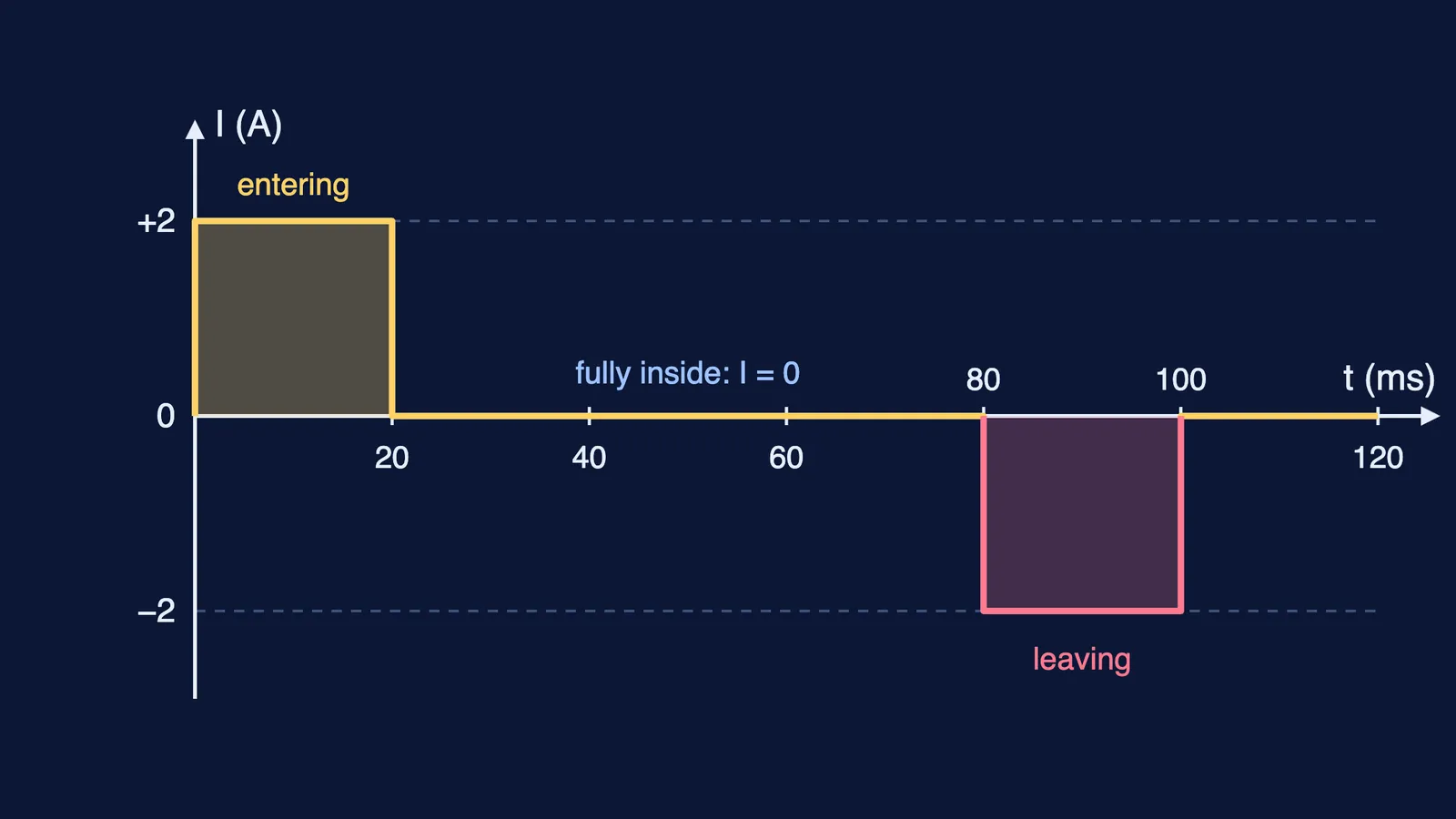
Q8 (hard, numerical). A rectangular loop of resistance 0.25 Ω has sides 20 cm and 10 cm. It is pushed at a constant 5.0 m/s, 20 cm side leading, straight through a strip of uniform 0.50 T field 40 cm wide, perpendicular to the loop. Find the total heat produced in the loop over the whole crossing, in mJ.
Answer: 40. Entering takes 0.10/5.0 = 20 ms with e = Bℓv = 0.50 V and I = 2.0 A, so the heat is I²Rt = 4.0 × 0.25 × 0.020 = 20 mJ. Fully inside, the flux is constant, so no current flows. Leaving adds another 20 mJ. Trap: 100, which keeps current flowing while the loop is fully inside.
What should you do after marking set 2?
Sort each miss into one bin: direction and energy (Q1, Q3, Q8), inductance (Q2, Q4) or motional emf (Q5, Q6, Q7). Practise that bin, then redo your misses in two days without solutions.
When a whole method breaks down, the Fermi Problem Library has worked problems with a step-by-step solver that explains the reasoning rather than printing an answer.


