

On this page
Pass a small current through potassium iodide solution and both electrodes change colour within seconds. The liquid round the anode turns yellow-brown, and blue-black if starch is present. The liquid round the cathode fizzes and turns pink if phenolphthalein is present. It is one of the quickest ways to see every rule of electrolysis at once, and it settles a point many summaries blur: iodide wins at the anode without any help from overpotential.
What do you see when you electrolyse KI solution?
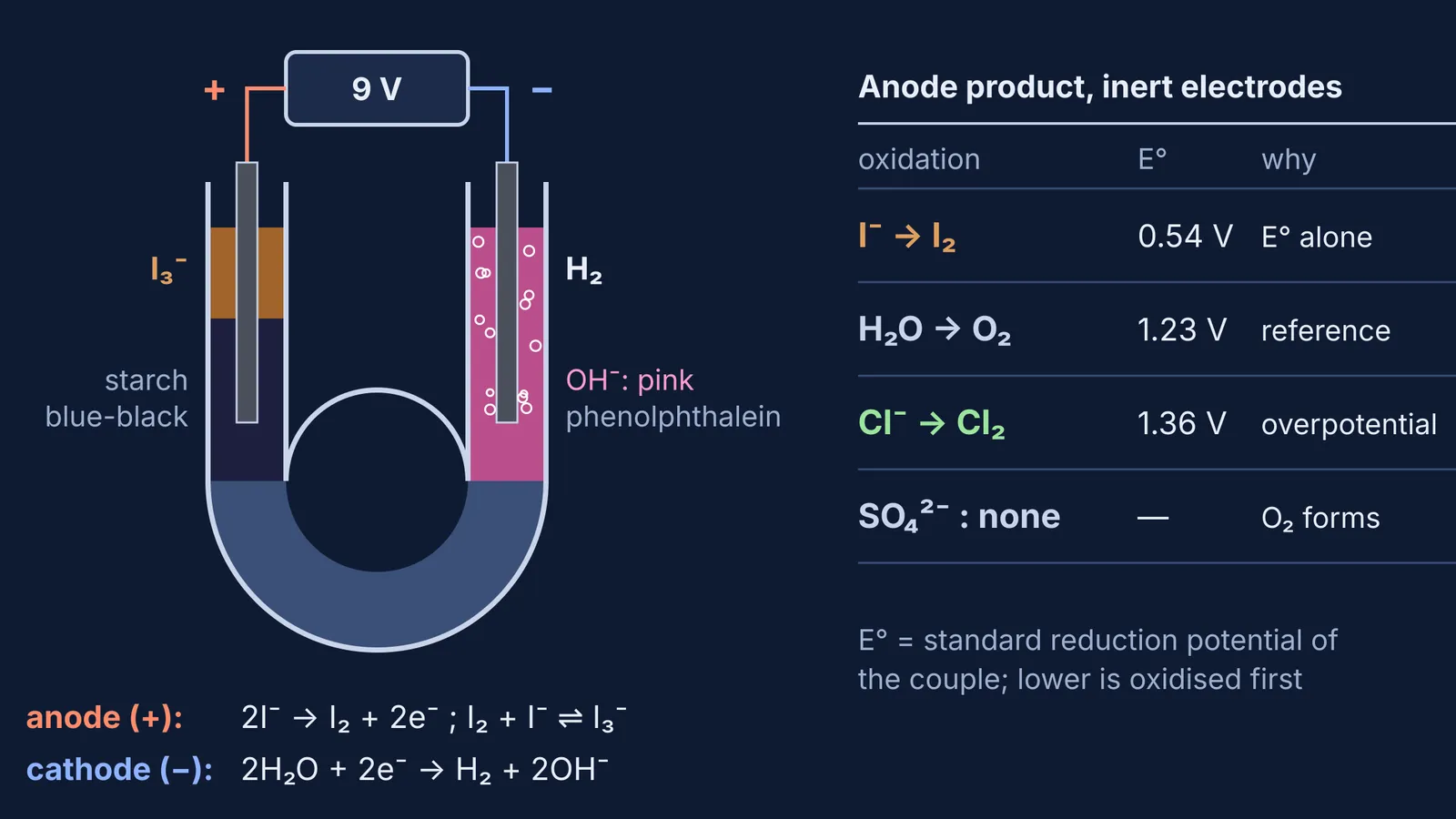
A typical demonstration uses about 0.5 M KI in a U-tube with two graphite rods and a 9 V battery or a low-voltage supply. Add a few drops of phenolphthalein to the whole solution, and a little starch solution to the anode arm.
Anode (+): a yellow-brown colour spreads from the rod, then turns blue-black where the starch is.
Cathode (−): small gas bubbles form on the rod, and the solution around it turns pink.
Nothing grey or shiny forms on the cathode. No potassium appears.
The U-tube keeps the two products apart long enough to see them.
Which reactions happen at each electrode?
At the anode, iodide ions are oxidised:
2I⁻ → I₂ + 2e⁻
Iodine is only slightly soluble in water, but in KI solution it combines with more iodide to form the triiodide ion:
I₂ + I⁻ ⇌ I₃⁻
The equilibrium constant is roughly 700 at room temperature, so in 0.5 M iodide there are a few hundred I₃⁻ ions for every free I₂ molecule. The yellow-brown colour you see is therefore mostly I₃⁻, not free I₂. The shape and bonding of this ion are covered in why iodine dissolves in KI. The blue-black colour comes from polyiodide chains trapped inside the starch helix.
At the cathode, water is reduced:
2H₂O + 2e⁻ → H₂ + 2OH⁻
The bubbles are hydrogen. The OH⁻ makes the solution alkaline, and phenolphthalein turns pink above a pH of about 8 to 10.
K⁺ is untouched. K⁺ + e⁻ → K has E° = −2.93 V, far below water's −0.83 V (in alkaline solution) or −0.41 V (at pH 7). The species with the higher reduction potential is reduced first, so water wins by a wide margin.
Why does iodide win at the anode without any overpotential?
At the anode, the oxidation with the lower reduction potential happens first. Compare the two candidates:
I₂ + 2e⁻ → 2I⁻, E° = +0.54 V
O₂ + 4H⁺ + 4e⁻ → 2H₂O, E° = +1.23 V (about +0.81 V at pH 7)
In neutral or acidic solution, iodide is easier to oxidise than water by at least 0.27 V. So iodine forms for purely thermodynamic reasons, and no kinetic argument is needed. (Only above about pH 12 would oxygen be favoured on paper, and the anode region of a KI cell does not become alkaline.)
Chloride is different. Cl₂/Cl⁻ has E° = +1.36 V, which is above oxygen's 1.23 V. On E° alone, water should be oxidised first in brine. Chlorine forms only because oxygen evolution is slow and needs a large overpotential, as explained in why chlorine, not oxygen, forms in brine.
Here is the anode comparison for common anions, with graphite or platinum electrodes:
I⁻ → I₂ (E° = 0.54 V): below oxygen, wins by thermodynamics.
Br⁻ → Br₂ (E° = 1.09 V): below oxygen's 1.23 V in acid, though above it at pH 7, so it also relies partly on oxygen's overpotential in neutral solution.
Cl⁻ → Cl₂ (E° = 1.36 V): above oxygen, wins only because of oxygen's overpotential, and only when the chloride is fairly concentrated.
SO₄²⁻, NO₃⁻, F⁻: not oxidised. Oxygen forms instead. Sulphur and nitrogen are already in their highest oxidation states, and F₂/F⁻ has E° = +2.87 V.
So when a textbook or a summary says "halides discharge before water because of overpotential", that is only true for chloride (and partly bromide). For iodide it is simply the easier reaction. The general rules are in our post on preferential discharge of ions at electrodes.
How much iodine forms? A worked example
Minimum voltage. Ignoring overpotential and resistance, the least voltage needed is E°(anode couple) − E(cathode couple).
At pH 7, water reduction is at −0.41 V, so the minimum is 0.54 − (−0.41) = 0.95 V.
At pH 14, water reduction is at −0.83 V, so the minimum is 0.54 − (−0.83) = 1.37 V.
Because the cathode region becomes alkaline as the run goes on, the needed voltage drifts towards the higher figure. Real cells need more again, because of overpotential at the electrodes and the resistance of the solution. A 9 V battery is far more than enough.
Amounts. Now pass 0.20 A for 10.0 minutes. Take F = 96 485 C mol⁻¹.
Charge. Q = It = 0.20 A × 600 s = 120 C.
Moles of electrons. 120 ÷ 96 485 = 1.24 × 10⁻³ mol, or 1.24 mmol.
Iodine. Two electrons per I₂, so 0.62 mmol I₂. Mass = 0.62 × 10⁻³ × 253.8 g mol⁻¹ = 0.158 g.
Hydrogen. Two electrons per H₂, so also 0.62 mmol H₂, about 14 mL at 273 K and 1 bar.
Hydroxide. One OH⁻ per electron, so 1.24 mmol OH⁻ near the cathode.
Quick check: moles of I₂ equal moles of H₂, and moles of OH⁻ equal moles of electrons. For more practice with this kind of chain, the Fermi Problem Library has a step-by-step solver that explains the reasoning at each step.
Why does the brown colour fade if the products mix?
If the electrodes are close together in a beaker, the OH⁻ from the cathode drifts across and meets the iodine. In alkaline solution iodine disproportionates:
3I₂ + 6OH⁻ → 5I⁻ + IO₃⁻ + 3H₂O
Check it: 6 iodine atoms, 6 oxygen and 6 hydrogen atoms on each side, and a charge of −6 on each side. The iodine (oxidation state 0) is partly reduced to iodide (−1) and partly oxidised to iodate (+5), and both products are colourless. So the brown colour fades and the pink can spread. It is a second reaction worth explaining, not a failure. A U-tube prevents it.
What else can go wrong in the demonstration?
Wrong electrodes. Copper or iron rods as the anode would dissolve themselves instead of oxidising iodide. Use graphite or platinum.
Too much current. Graphite anodes slowly wear away at high current. Keep the current low; a fraction of an ampere is plenty.
Stains and disposal. Iodine stains skin and clothes. Wear gloves and goggles, and do not pour large amounts of the solution down the drain; follow your lab's disposal rules.
Quick checklist
Anode: 2I⁻ → I₂ + 2e⁻; the brown colour is mostly I₃⁻; starch turns blue-black.
Cathode: 2H₂O + 2e⁻ → H₂ + 2OH⁻; phenolphthalein turns pink; K⁺ (−2.93 V) is not reduced.
Iodide beats water by E° alone (0.54 V against 1.23 V). Chloride needs the overpotential argument.
Minimum voltage: 0.95 V at pH 7, 1.37 V at pH 14, before overpotential.
0.20 A for 10.0 min: 1.24 mmol e⁻, 0.62 mmol I₂ (0.158 g), 0.62 mmol H₂, 1.24 mmol OH⁻.
Mixed products: 3I₂ + 6OH⁻ → 5I⁻ + IO₃⁻ + 3H₂O, so keep the arms apart.


