

On this page
What is the preferential discharge of ions?
When an electric current passes through an electrolyte containing multiple ions, the species compete to exchange electrons at the electrodes. In aqueous solutions, water molecules also participate by dissociating into H⁺ and OH⁻. The selective discharge of one ion species ahead of competing ions is called preferential discharge.
As outlined in NCERT Class 12 Chemistry, the products of electrolysis depend on the electrolyte's state, standard electrode potentials, electrode reactivity, and kinetic overpotentials. Non-spontaneous reactions follow the path requiring the least electrical energy. Understanding this competition is essential for predicting redox reactions from the electrochemical series.
Which three factors decide which ion discharges first?
Three main factors govern electrode reactions during electrolysis:
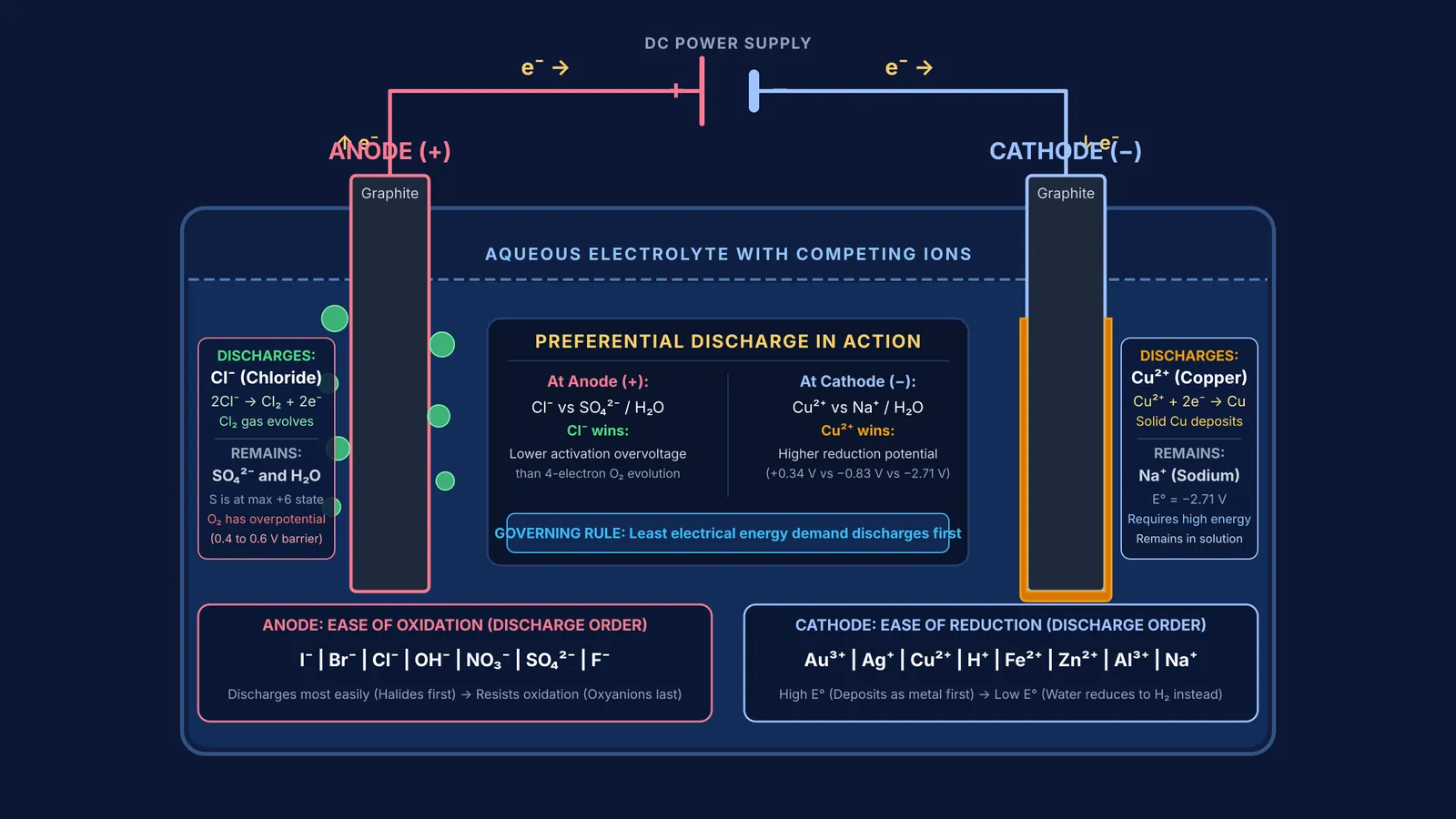
Standard reduction potential (E°): At the cathode, the species with the higher (more positive) reduction potential gains electrons first. At the anode, the species with the lower reduction potential loses electrons first. According to OpenStax Chemistry 2e, water reduction has a standard reduction potential of −0.828 V, higher than −2.71 V for sodium ions, meaning water reduces first in dilute solutions to release H₂ gas.
Ion concentration: Standard potentials are measured at standard 1 M solute concentrations. High solute concentrations shift effective discharge potentials according to the Nernst equation. A concentrated ion can discharge ahead of an ion that holds only a slight thermodynamic edge.
Electrode material: Inert electrodes like platinum or graphite do not react. Active electrodes like copper or silver oxidise directly at the anode because removing electrons from the metal lattice requires less voltage than oxidising dissolved anions or water.
Why does brine yield chlorine instead of oxygen at the anode?
Electrolysing concentrated sodium chloride solution (brine) demonstrates the tension between thermodynamics and kinetics.
At the cathode, reducing water (E° = −0.828 V) is thermodynamically preferred over reducing sodium ions (E° = −2.71 V), as confirmed by OpenStax Chemistry 2e. Hydrogen gas evolves readily, leaving hydroxide ions in solution.
At the anode, two oxidation reactions compete:
Water oxidation: 2 H₂O → O₂ + 4 H⁺ + 4 e⁻ (standard reduction potential E° = +1.229 V)
Chloride oxidation: 2 Cl⁻ → Cl₂ + 2 e⁻ (standard reduction potential E° = +1.358 V)
Thermodynamics favors water oxidation because +1.229 V is lower than +1.358 V. However, Chemistry LibreTexts/20%3A_Electrochemistry/20.09%3A_Electrolysis) notes that oxygen evolution carries an activation overvoltage of 0.4 to 0.6 V on common electrodes. This kinetic barrier pushes the required potential for oxygen release well above +1.6 V. Consequently, chloride oxidises first to produce chlorine gas.
To explore how these redox principles connect across physical chemistry, the Fermi Concept Library covers every concept in physics, chemistry, biology, mathematics and computing, each with its own lesson and its place in the map.
What happens during the electrolysis of copper sulfate?
Electrolysing aqueous copper sulfate (CuSO₄) illustrates how electrode materials switch the reaction pathways:
Inert platinum electrodes: As documented in NCERT Class 12 Chemistry, copper ions (Cu²⁺, E° = +0.34 V) reduce at the cathode instead of water (−0.828 V), coating the cathode with copper metal. At the anode, sulfate ions (SO₄²⁻) resist oxidation because sulfur is already at its +6 limit. Water oxidises instead, evolving oxygen gas and leaving sulfuric acid behind.
Active copper electrodes: Copper still deposits at the cathode. At the anode, copper metal oxidises directly (Cu → Cu²⁺ + 2 e⁻) at +0.34 V, which is much easier than oxidising water at +1.229 V. The anode dissolves to replenish copper ions in solution.
This principle is used in the electrolytic refining of copper, while total deposited mass follows Faraday's laws of electrolysis.
How can you predict electrolysis products systematically?
Use this four-step sequence to determine electrode products:
Identify all species present: Note all cations, anions, solvent water molecules, and the electrode composition.
Check the anode material: If it is an active metal (such as Cu or Ag), dissolve the anode. If it is inert (Pt or graphite), compare the anions with water.
Determine the cathode product: According to OpenStax Chemistry 2e, water reduction occurs at −0.828 V. Reduce the dissolved metal cation if its standard reduction potential exceeds water's −0.828 V (such as Cu²⁺ or Ag⁺). If the cation is an active metal (Na⁺, K⁺, Mg²⁺), reduce water to release H₂.
Determine the anode product: Concentrated halides (Cl⁻, Br⁻, I⁻) discharge before water due to overpotential. Polyatomic oxyanions (SO₄²⁻, NO₃⁻) and fluoride leave water to oxidise to O₂.
For guided practice on electrochemistry problems, the Fermi Problem Library provides worked problems with a step-by-step solver that explains the reasoning rather than printing an answer.


