

On this page
Ask an electric-car owner how long charging takes and the answer is usually "it depends". It depends on three numbers you can work with in a physics exam: how much energy the battery needs (in kWh), how fast the charger can deliver it (in kW), and how much is lost as heat on the way. Divide energy by power, allow for the losses, and you get a charging time within a few minutes of what the maker quotes. This post works through a full example, checks it against a real car's specification, and shows why the last 20% always takes longer.
What is the difference between kW and kWh?
A kilowatt (kW) is a rate: how many joules flow every second, in thousands. A kilowatt-hour (kWh) is an amount: the energy delivered by 1 kW running for one hour.
1 kWh = 1000 J/s × 3600 s = 3.6 × 10⁶ J = 3.6 MJ.
A battery is a store, so its size is in kWh. A charger is a pipe, so its rating is in kW. "A 40 kW battery" is wrong in the same way as "a 40 litres-per-minute bucket". The kWh is also the unit on your electricity bill, the "unit" that a smart meter counts in kWh and pulses.
How do you calculate how long an electric car takes to charge?
Time = energy needed ÷ power, with one correction. Some energy is lost as heat in the charger, the cables and the battery itself, so the grid must supply more than the battery stores:
Energy from the grid = energy into the battery ÷ efficiency
Charging time = energy from the grid ÷ charger power
Use the charger's power in kW and energy in kWh, and the time comes out in hours.
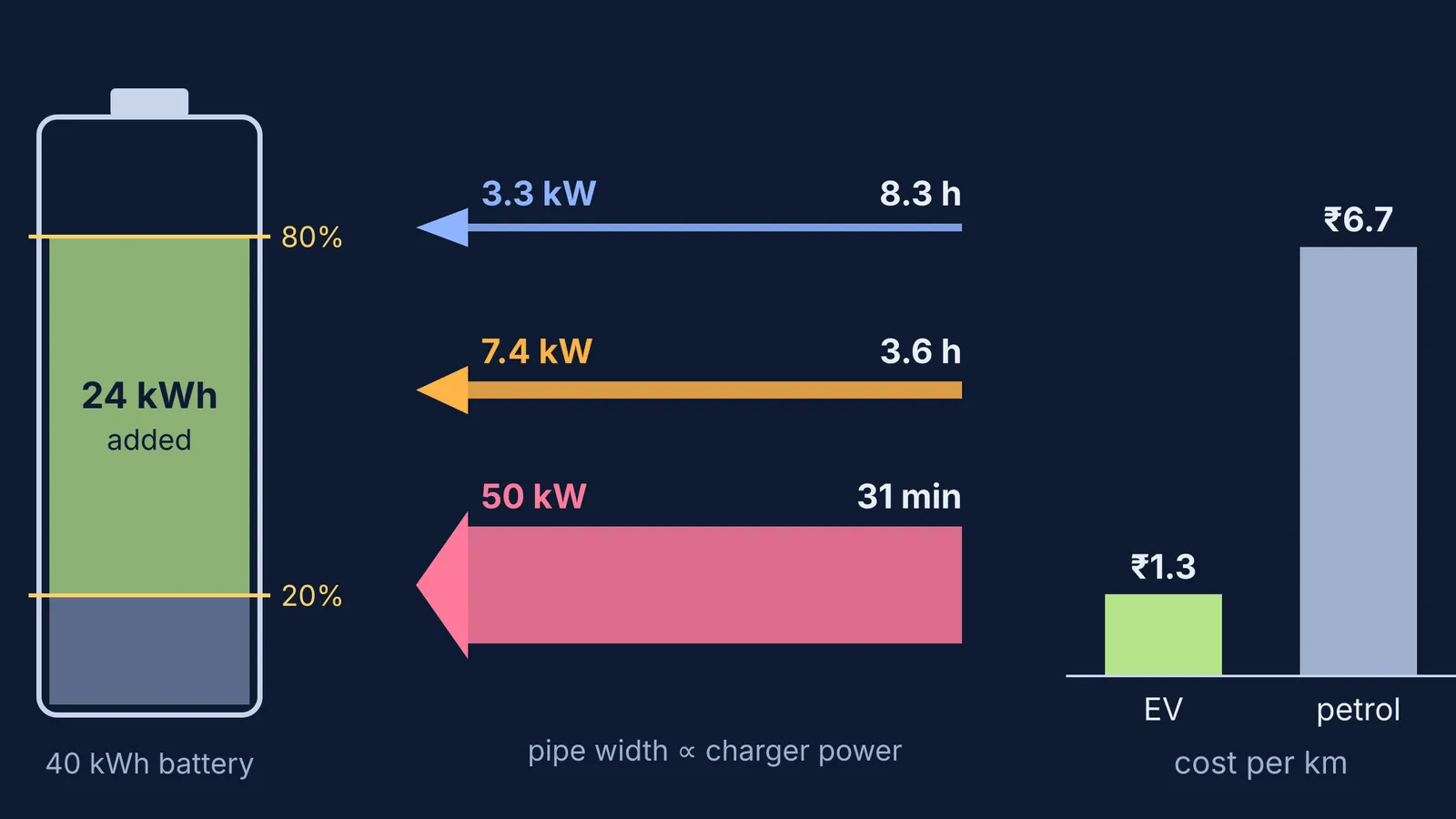
Worked example: charging a 40 kWh car from 20% to 80%
All the figures below are round illustrative values, not those of any one car. Real batteries, chargers and efficiencies vary.
Usable battery capacity: 40 kWh
Charge from 20% to 80%
Overall charging efficiency: about 90% for a home AC charger, 88% for a portable charger, 93% for a DC fast charger (assumed)
Energy into the battery. 80% − 20% = 60%, and 0.60 × 40 kWh = 24 kWh.
Energy from the grid (home charger). 24 ÷ 0.90 = 26.7 kWh. The extra 2.7 kWh ends up as heat.
Power of a home wall charger. A single-phase charger at 230 V and 32 A draws P = VI = 230 × 32 = 7360 W, about 7.4 kW.
Time. 26.7 kWh ÷ 7.36 kW = 3.6 h, about 3 hours 37 minutes.
Portable 3.3 kW charger at 88%. 24 ÷ 0.88 = 27.3 kWh, and 27.3 ÷ 3.3 = 8.3 h.
50 kW DC fast charger at 93%. 24 ÷ 0.93 = 25.8 kWh, and 25.8 ÷ 50 = 0.52 h, about 31 minutes.
Check the units: kWh ÷ kW = h. And notice that the charger, not the battery, sets the time: the same 24 kWh takes anywhere from half an hour to more than eight hours.
How close is this to a real car's charging time?
Try the same method on a real specification. Tata Motors' Nexon.ev specification sheet lists a 40.5 kWh battery for the long-range version, with an estimated 6 hours to go from 10% to 100% on a 7.2 kW AC wall box, and 56 minutes from 10% to 80% on a 50 kW DC fast charger.
AC, 10% to 100%. 0.90 × 40.5 = 36.5 kWh. At 7.2 kW with 90% efficiency, 36.5 ÷ 0.9 ÷ 7.2 = 5.6 h. The maker says about 6 h. The gap is the slower charging near full, explained below.
DC, 10% to 80%. 0.70 × 40.5 = 28.4 kWh. At a full 50 kW that would take 34 minutes, but the quoted time is 56 minutes, an average of 28.4 ÷ (56/60) = 30 kW. The car does not take the charger's full 50 kW for the whole session.
So the simple model gets the order of magnitude and the AC time nearly right. It overestimates fast-charging speed, because the charger's rating is a maximum, not what the battery accepts throughout.
Why does an electric car charge slowly above 80%?
Lithium-ion cells are charged in two stages. First the charger pushes a roughly constant current, and the cell voltage climbs. When the cell reaches its maximum safe voltage, the charger holds the voltage fixed, and the current falls steadily as the cell fills. Lower current means lower power, so the last part of the charge is slow.
That is why fast chargers and makers quote 10% to 80%, and why 0% to 100% is not simply 100/60 times the 20% to 80% time. Charging fast near full would push the cell above its safe voltage and stress it.
Why are fast-charger cables so thick?
Power P = VI. A 50 kW charger feeding a 400 V battery pack pushes I = 50 000 ÷ 400 = 125 A. The heat in a cable is I²R, so doubling the current makes four times the heat for the same cable. Large currents need thick copper, and the highest-power chargers cool their cables. Your phone faces the same trade-off at a smaller scale, covered in how fast charging works in phones.
A home 32 A circuit carries far less current, but it does so for hours. Use only a charger approved by the car's maker, installed or checked by a qualified electrician, and never improvise with extension leads or ordinary sockets.
What does a charge cost, and how far does it take you?
These are illustrative round numbers. Check your own tariff and your car's figures.
Grid energy for the 20% to 80% home charge: 26.7 kWh.
At ₹8 per kWh: 26.7 × 8 = ₹213.
At about 7 km per kWh of battery energy: 24 × 7 = 168 km.
Cost per km: 213 ÷ 168 = ₹1.27/km.
Petrol car at 15 km/L with petrol at ₹100/L: 100 ÷ 15 = ₹6.7/km.
Real-world range is usually below the certified figure, for reasons such as speed, drag and air-conditioning; why your electric scooter's real range is less than claimed works through the same effect on two wheels.
For more P = VI and energy-and-power problems like these, the Fermi Problem Library has a step-by-step solver that explains the reasoning.
Quick checklist
kW is a rate; kWh is an amount; 1 kWh = 3.6 MJ.
Grid energy = battery energy ÷ efficiency; time = grid energy ÷ charger power.
24 kWh from a 7.4 kW home charger: about 3.6 h; from 50 kW DC: about 31 min in theory.
Real fast charging averages less than the charger's rating.
Charging tapers above about 80%, so do not scale times in proportion.
High current means I²R heating, which is why fast-charger cables are thick.


