

On this page
When you plug in a modern smartphone, the battery meter climbs much faster than it did a decade ago. Behind that speed is a careful negotiation of electric power, governed by the same rules of physics taught in high school. Fast chargers push the limits of battery chemistry to reduce time spent tethered to a wall.
To charge a battery faster, the charger must deliver more power. The relationship is given by the formula P = VI, where power is the product of voltage and current. Understanding this equation explains how the industry has pushed charging speeds from earlier standards to the high wattage we see today.
How does fast charging work in phones?
To increase the power flowing into your phone, manufacturers have two choices: raise the current or raise the voltage.
Raising the current is straightforward but has a physical limit. As current increases, the resistance in the charging cable generates more heat. This follows another key physics rule, the heating effect of current, where heat produced is proportional to the square of the current. If manufacturers simply pushed more amps through standard cables, the cables could quickly become dangerously hot and melt.
Instead of pushing large currents through a thin cable, modern fast charging often relies on raising the voltage. The USB Power Delivery specification, created by the USB Implementers Forum, supports charging up to 240W by delivering 48V at 5A. This standard allows laptops, tablets and phones to share the same high-capacity chargers safely. By transmitting power at a higher voltage, the cable stays cooler, and a microchip inside the phone steps the voltage back down to the level the battery needs.
If you are studying electricity in Class 10, the transition from simple chargers to programmable 48V chargers is a perfect real-world example of Ohm's law and electric power in action. To see how voltage, current and resistance interact in real time, you can build a virtual circuit in the Fermi Simulation Lab.
What is the constant current and constant voltage phase?
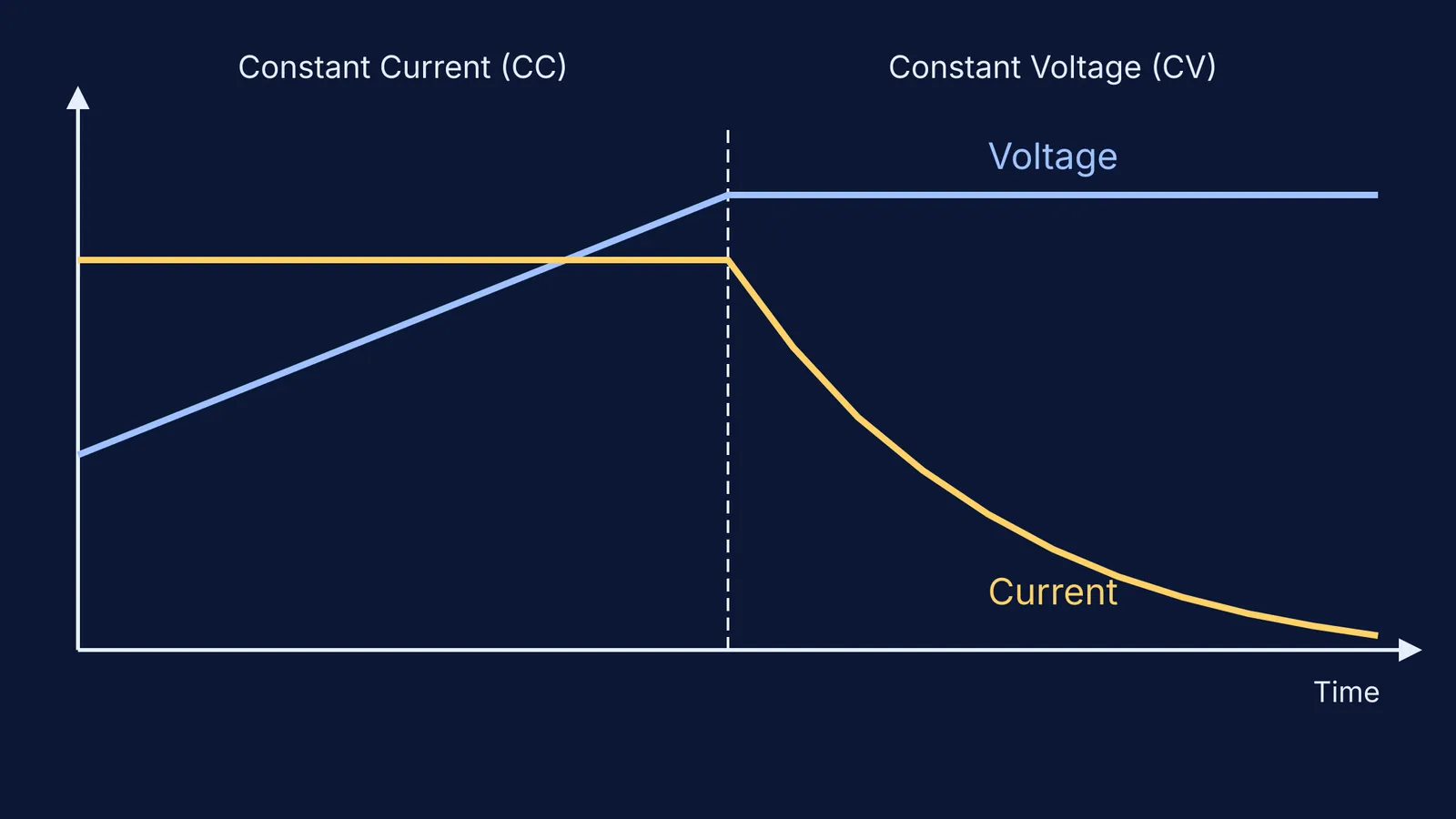
Lithium-ion batteries cannot absorb a large surge of power from an empty state to a full charge without taking damage. Instead, fast charging happens in two distinct phases:
Constant Current: When the battery is low, the charger pushes a high, steady current. The voltage gradually rises as the battery fills up. This is the phase that delivers the rapid speeds often advertised by phone manufacturers.
Constant Voltage: Once the battery reaches its target voltage, the charger holds the voltage steady. The current is allowed to taper off as the battery approaches a full charge.
This two-step process explains why the final portion of your battery takes much longer to charge than the beginning.
Does fast charging damage the battery?
Heat and high charging rates are the natural enemies of battery longevity. When a battery is charged too quickly, lithium ions may fail to slide smoothly into the graphite structure of the negative electrode. Instead, they pile up on the surface as solid metal.
This process is called lithium plating. A study published in Energies highlights lithium plating as a primary cause of capacity loss, leading to a permanent loss of active lithium and active material. Fast chargers avoid this by communicating continuously with the phone, dropping the charging speed if the battery's temperature sensors read too high.


